
With promises of shiny things for the city in the New Year, mid-day checks out buses, Metro, stations across Mumbai to see if they are disability-friendly, too

Jayashree Jadhav, wheelchair-bound Byculla resident who runs a mobile accessories shop near Mahalaxmi railway station. PIC/RITIKA GONDHALEKAR
Mumbai is slated to gain impressive infrastructure in the coming year. Yet, a test drive by this newspaper revealed a harsh reality: for those with disabilities, the “Maximum City” often offers minimum access.
As the world marked the International Day of Persons with Disabilities on December 3, a walk through the city reveals how far it is from being truly inclusive. From broken footpaths to missing ramps, inaccessible public transport to poorly designed public buildings, everyday mobility remains a challenge for people with physical, visual, and auditory impairments.

Ramesh Sartape boards one of the few BEST buses that have a ramp for wheelchair users, in Goregaon West. PIC/SATEJ SHINDE
Footpaths, where they exist, are uneven, encroached upon or abruptly end, forcing wheelchair users and the visually impaired onto dangerous roads. Tactile paving is either absent or laid incorrectly, leading to confusion rather than guidance for the visually challenged.
Public transport, the city’s lifeline, is another major hurdle. While BEST buses have introduced a limited number of low-floor buses, they remain too few to meet demand. Suburban railway stations — used by millions daily — are largely inaccessible, with steep staircases, non-functional lifts, and foot overbridges that are impossible to navigate for those with mobility issues. Even newly redeveloped stations do not have inclusive access.
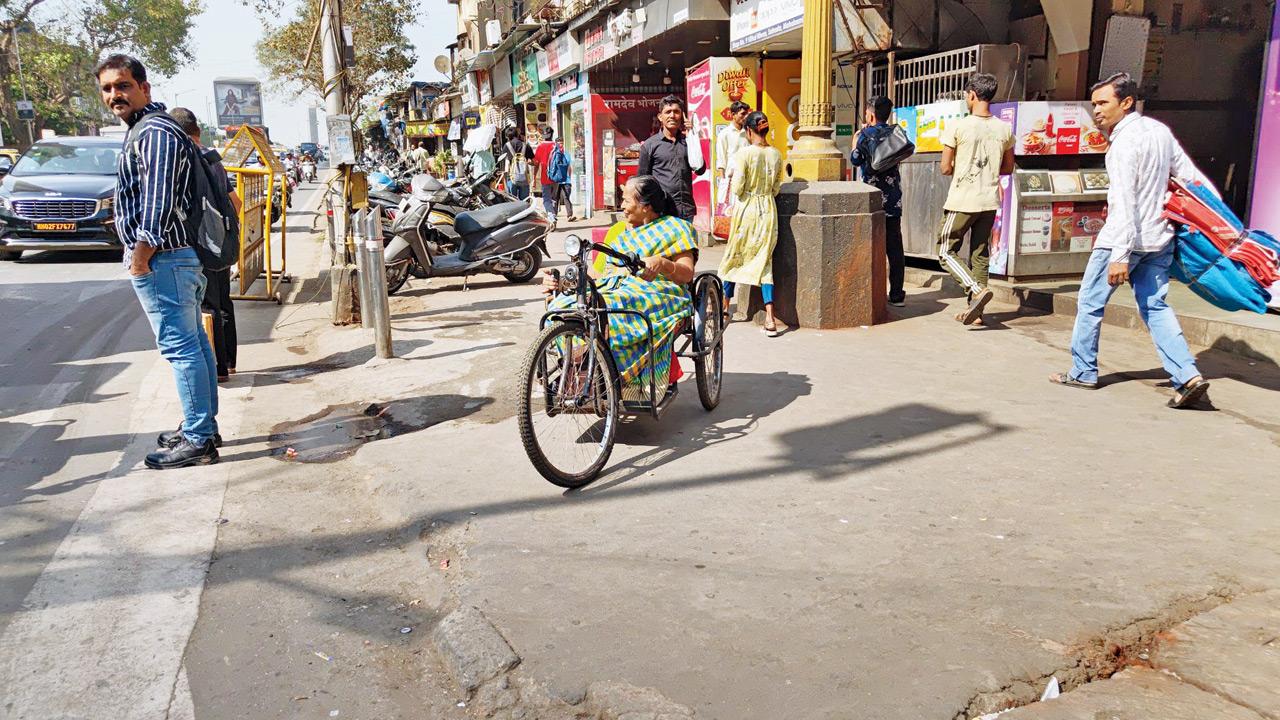 Jayashree Jadhav, wheelchair-bound Byculla resident, who faces obstacles navigating streets. Shopkeepers have helped her by breaking the footpath to make it more accessible. PIC/RITIKA GONDHALEKAR
Activists point out that the problem is not a lack of laws but poor implementation. The Rights of Persons with Disabilities Act mandates barrier-free access in public spaces, yet compliance remains weak. “Infrastructure projects worth thousands of crores are announced, but accessibility is treated as an afterthought,” said Ramdas Khot, a member of the Association for Disabled Persons, Mumbai.
The irony is stark: Mumbai is racing ahead with mega projects like metro corridors, coastal roads and smart city initiatives, but basic universal access is still missing. For persons with disabilities, the city’s growth has not translated into dignity, independence or safety.
Tale of two strugglers
Jayashree Jadhav, a wheelchair-bound Byculla resident who runs a mobile accessories shop near Mahalaxmi railway station, said, “I’ve been using a wheelchair for 40 years. Yet over the years, facilities have only improved by one per cent for people like us. Even the footpath that I use daily had to be broken by kind-hearted shopkeepers so I could use it. Is it so difficult for the authorities to make things accessible for us? Will we continue to remain an afterthought?”

Wheelchair user Ramesh Sartape takes the support of a staircase railing while entering the Goregaon East Metro station as his wife, Vidya, assists him. PIC/SATEJ SHINDE
Ramesh Sartape, a differently abled person who commutes from Goregaon to Andheri daily, said, “Relatively accessible options, such as the Metro, are not affordable for those who earn just enough to survive, while affordable options, like rail, are inaccessible due to infrastructure hurdles." Neither BMC nor Mumbai Metropolitan Region Development Authority officials responded to mid-day’s calls by press time.
Test Drive
RAILWAY
>> No ramp at all entry/exit points
>> Ramps are available at spots where they cannot be used or located easily
>> Lifts are located at just one spot and are 80 per cent of the time non-functional
>> If one overcomes all these hurdles, wheelchair-bound persons cannot enter trains due to the non-availability of ramps and brief halt times
Disabled suburban railway travellers receive a 50 per cent concession on monthly and quarterly season tickets
BEST
>> Not all buses have ramps
>> The drivers and conductors of those that do aren’t trained to operate the ramps
>> Since the ramps are seldom used, their handles are sometimes jammed, rendering them unusable
>> There is no dedicated space inside buses for wheelchairs
The disabled are entitled to free ride in all BEST buses
METRO
>> Lifts are located along footpaths, restricting access
>> Spots where ramps exist are blocked by boulders and rods to keep two-wheelers at bay
>> The wheelchair-dedicated area on Metro trains is only at one end,
>> Able-bodied travellers use scan counters for the disabled, causing the latter to wait unnecessarily
Disabled travellers using the Aqua Line can avail of a 25 per cent concession
 Subscribe today by clicking the link and stay updated with the latest news!" Click here!