Sparse occupancy highlights disconnect between infrastructure rollout and public communication

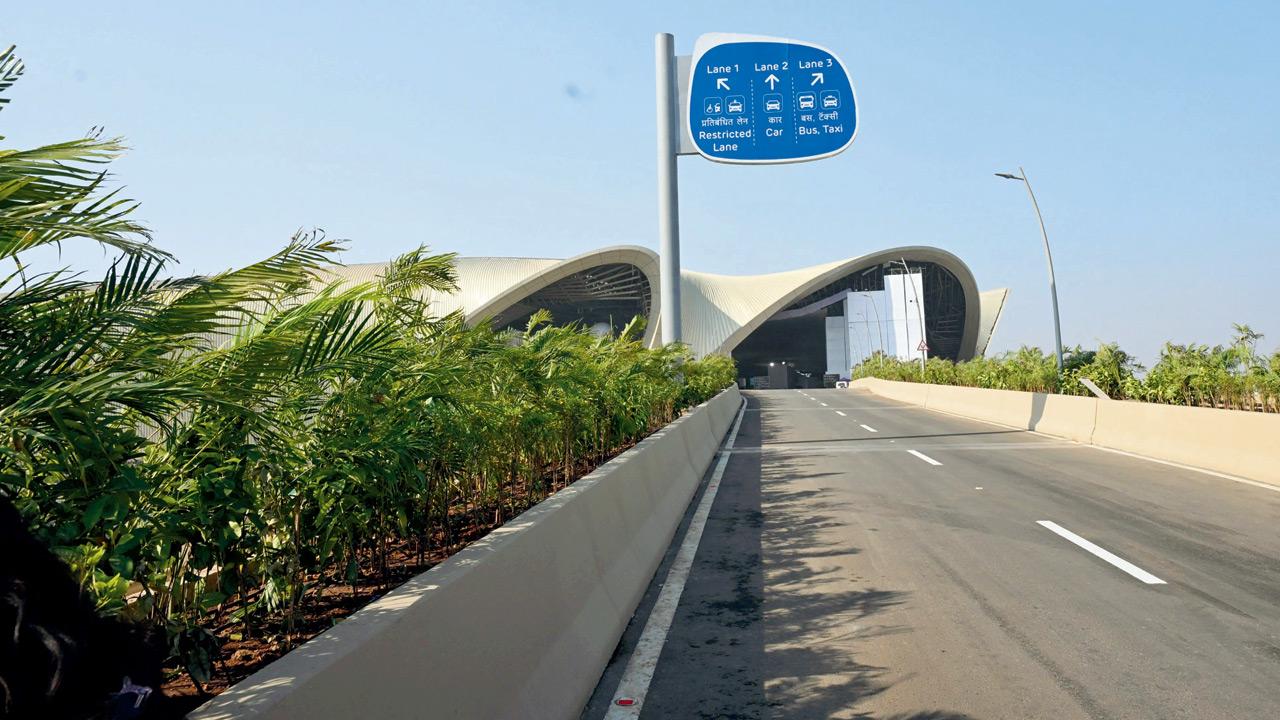
Navi Mumbai International Airport began flight operations on Friday. PIC/SAYYED SAMEER ABEDI
While the Navi Mumbai International Airport (NMIA) created history with its first day of flight operations, its nearest public transport lifeline told a very different story.
The newly-introduced Navi Mumbai Municipal Transport (NMMT) A2 bus route from Targhar railway station to NMIA — touted as the most convenient and affordable option for passengers — saw a shockingly low turnout with just one to three passengers per trip on Day 1. Targhar, the closest railway station to NMIA, was expected to witness heavy footfall as air travellers looked for last-mile connectivity.
Instead, reality fell short of expectations. This mid-day correspondent was the only passenger on the A2 bus that departed Targhar at 11.10 am, after waiting at the bus stop since 10.40 am.
Bus staff candidly admitted that a lack of awareness is the biggest hurdle. “People simply don’t know that a direct bus service to NMIA has started from Targhar, Bamandongari, and Kharkopar stations,” said an NMMT bus driver, speaking on condition of anonymity.
According to him, two A2 buses are currently deployed, each making eight round-trips daily between Targhar and NMIA. “This is a trial phase. Once footfall increases, more buses and additional ferry rounds will be introduced,” he added.
Ironically, despite the low passenger numbers, the A2 route could be a game-changer for commuters. With autorickshaws rarely available outside Targhar station, and private taxis being expensive, the A2 bus offers a direct, reliable ride to NMIA for just Rs 15 — a fraction of what aggregated cabs or private autos would charge.
However, operational gaps remain. The bus driver raised a crucial security concern that has gone largely unnoticed. “All private vehicles, autos and app-based cabs are checked before entering the airport area. But NMMT buses are not checked at all,” he pointed out. “If a passenger carries something suspicious, how will it be detected?”
He suggested that all passengers alighting from NMMT buses at the NMIA terminal should undergo mandatory security checks by airport personnel, just like other modes of transport. “It’s not about buses, it’s about safety,” he said.
The sparse occupancy on Day 1 highlights the disconnect between infrastructure rollout and public communication. While NMIA has taken flight, its public transport network is yet to find passengers.
Unless awareness campaigns are intensified and last-mile connectivity issues are addressed urgently, Navi Mumbai’s most affordable airport commute may continue to run nearly empty despite being the most practical option available.
Subscribe today by clicking the link and stay updated with the latest news!" Click here!