After last Monday’s deluge exposed Aqua Line’s monsoon unpreparedness, authorities come up with weak, temporary fixes for leaks that shocked commuters

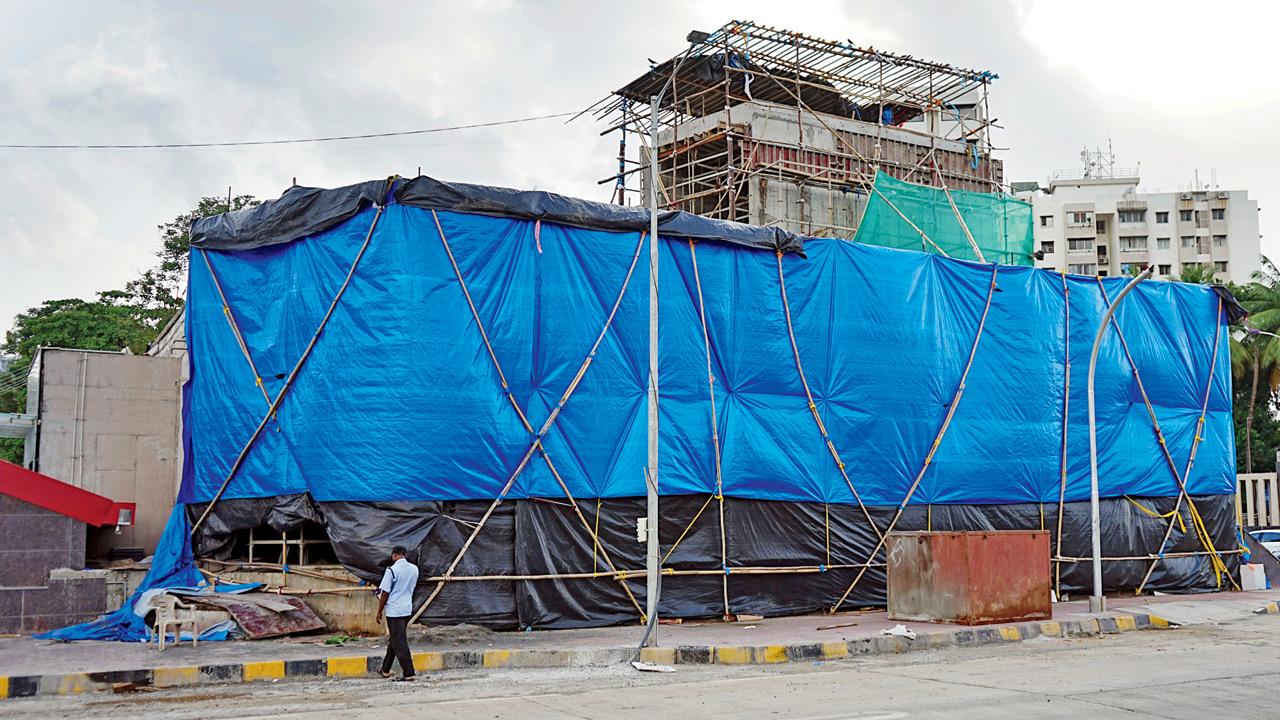
While water leakage at the BKC underground Metro is a concern, the structure above it has been secured to prevent seepage. Pic/Dweep Bane
A Rs 37,000-crore underground Metro line, but the monsoon fix? Plastic sheets and tarpaulin. Days after water flooded the newly opened Acharya Atre Chowk Metro station following heavy rain, authorities have responded with quick-fix solutions that look more like roadside repairs than part of a modern urban transport system.
From draping station entrances with plastic to constructing makeshift bund walls, the Mumbai Metro Rail Corporation Limited’s (MMRCL) temporary measures have raised serious concerns about the project’s preparedness for Mumbai’s rains.

Following last week’s rain, workers cover Marol Naka Metro station’s entrance point with plastic to prevent water ingress. Pic/Nimesh Dave
At some Line 3 stations like Marol, plastic sheets were temporarily placed over one of the entry/exit points. However, when mid-day visited the spot on Sunday, the plastic sheet had already been removed. A portion of an adjacent structure had been covered near entry/exit A4 at BKC station.
Last week’s waterlogging incident at Acharya Atre Chowk station of Metro Aqua Line 3 triggered a flurry of makeshift measures by the Mumbai Metro Rail Corporation Limited. These include tarpaulin sheets, plastic covers over exposed openings, and temporary reinforced cement concrete (RCC) walls at select station entrances to block rainwater from entering.
While not all Aqua Line stations had these temporary fixes in place, mid-day observed tarpaulin sheets outside BKC Metro station. A retaining wall was also under construction outside entry A1 of Acharya Atre Chowk station.
Security guards and ground staff stationed across multiple Metro 3 stations told mid-day that the water ingress issue was limited to a few stations, mainly those with entry and exit points at road level, lacking elevated steps.
What MMRCL says
“Damage assessment has been completed, and rectification works are in progress. Restoration is expected to finish in the next few days. A temporary sandbag bund wall is being built to prevent surface runoff.

Plastic sheets that had been placed over the Marol Naka Metro station’s entrance point on May 29 were removed days after rain lashed the city. Pic/Shadab Khan
Simultaneously, a temporary RCC retaining wall is under construction to withstand similar water ingress scenarios like those experienced on May 26, 2025,” said MMRCL Managing Director Ashwini Bhide. “All dewatering pumps at stations are fully functional, and currently, there is no water accumulation inside the station premises,” she added.
Some entry exits of @MumbaiMetro3 which are under construction are covered with rainproof material as part of the usual practice being followed by under construction sites during monsoon season of Mumbai so that the construction activity safely continues even during rains. https://t.co/OFowmqlzO9
— Ashwini Bhide (@AshwiniBhide) June 3, 2025
Commuter reactions
“After the May 26 water-logging incident, when I got stuck at Acharya Atre Chowk station at Worli after work, I haven’t taken the Metro all week. I don’t plan to use the underground Metro during the monsoon. I’d rather return to my earlier commute — Marol to Andheri by Metro, train to Dadar, then a bus to my office near Acharya Atre Chowk. It’s longer but familiar, and I know how to handle rain disruptions,” said Nandini Maluja, a regular commuter.
“I’ve travelled a bit on the Aqua Line since it opened. The flooding at Acharya Atre Chowk station was unexpected, but I haven’t seen any leaks personally. It’s reassuring to see checks being done at other stations,” said a commuter. Cayden Santis, a Metro user, said, “Considering the risk of getting stuck during heavy rain, I will stick to the bus for now. If you get stuck underground, you’ll end up needing a bus or an auto anyway. Honestly, it might be better if they pause operations during monsoon until the whole line is fully functional and drainage checks are completed. People need visual proof that it’s safe to use.
“While I’ve used the Metro a few times with colleagues, today my family was experiencing it for the first time. Since it wasn’t raining, we gave it a try. But last week’s photos and videos were scary. It feels risky to travel on this line with kids during monsoon,” said Ramnath Pal, a SEEPZ resident headed to Siddhivinayak Temple in Prabhadevi.
Activists speak

Godfrey Pimenta, Advocate
“I hope MMRCL strictly follows safety and environmental standards, and takes preventive measures to avoid such incidents in the future.”

Zoru Bhathena, Environmentalist
“The station’s drainage pumps may not have been activated in time due to the suddenness of the rain. Ideally, water should have been pumped out immediately without affecting passengers.”
Subscribe today by clicking the link and stay updated with the latest news!" Click here!