
India’s small cats represent nearly one-fourth of all felid species worldwide; jungle cat is most widespread, occupying an estimated 96,275 sq km area
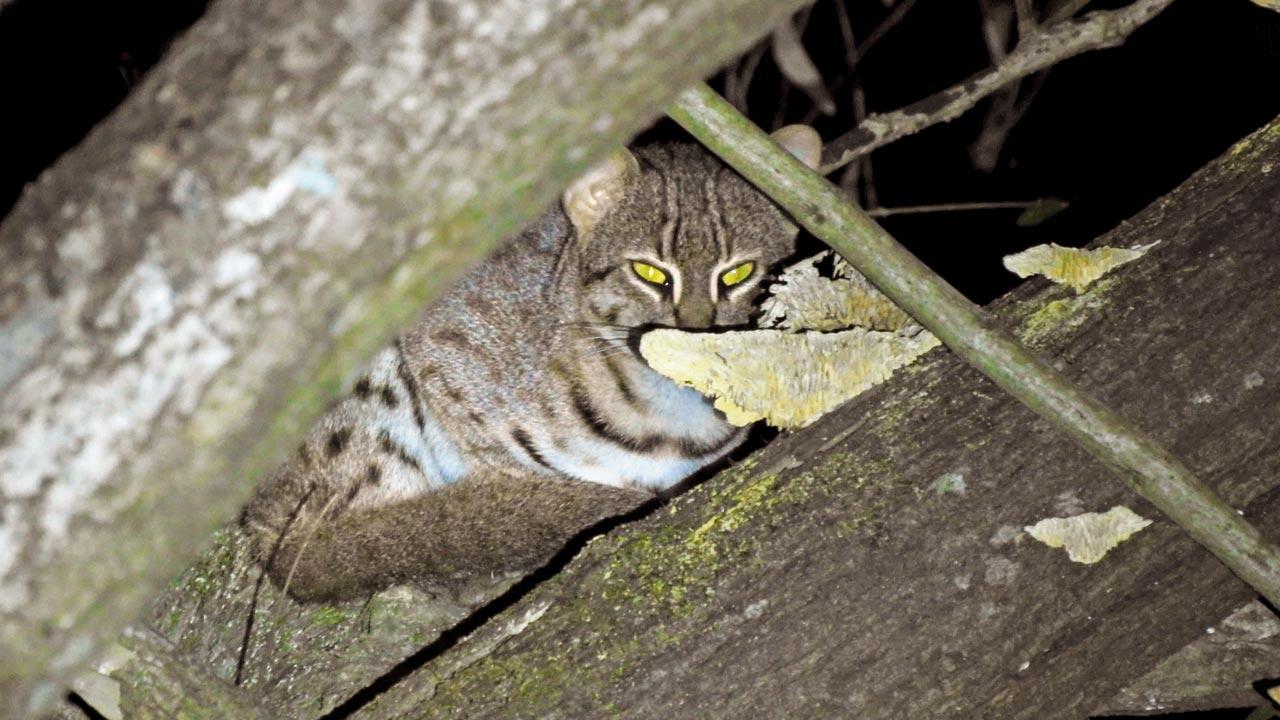
Rusty-spotted cats occupy about 70,075 sq km area in the wild, in India. PIic/Nimesh Dave
A recent report on the status of small wild cats in the Tiger landscape of India released by the Ministry of Environment Forest and Climate Change (MOEF&CC) states that small cats, despite their ecological importance, remain understudied and under-represented in conservation planning.
The small cat species in India represent nearly one-fourth of all felid species worldwide. There are a total of ten small wild cat species found in India, of which three species — the jungle cat, the rusty-spotted cat, and the leopard cat — are the most common.
The jungle cat has emerged as the most widespread species, occupying an estimated 96,275 sq km area, followed by the rusty-spotted cat, occupying 70,075 sq km with high occupancy in mixed deciduous forests.
The report highlights the alarming fact that the jungle cat and rusty-spotted cat, which also occur outside protected areas, face threats from human-wildlife conflicts.
The report reads: “Occupancy generally declined with increasing human disturbance, except in habitat generalists such as the jungle cat and rusty-spotted cat. While occupancy patterns appeared relatively stable between 2018 and 2022, the absence of fine-scale data on prey availability and microhabitat features may mask subtle changes. These findings offer a baseline for targeted research and conservation efforts for India’s lesser-known felids.”
Jungle cat distribution
The report states that, although the jungle cat is widely distributed across a variety of habitats — from semi-arid regions to dense rainforests — its occupancy shows marked variation across landscapes.
“The highest occupancy probabilities were recorded in the dry deciduous forests of central India, particularly in Madhya Pradesh, eastern Maharashtra, and the semi-arid protected areas of Rajasthan. In northeast India, areas such as Kaziranga, Nameri, and the lower elevations of Pakke Tiger Reserve supported relatively low occupancy. The Terai region also exhibited low occupancy across its protected areas, while the Western Ghats generally showed low occupancy. Smaller forest patches in Telangana and Karnataka exhibited a mix of moderate to high occupancy. In contrast, the Sundarbans mangrove ecosystem showed predominantly low occupancy,” states the report.
Distribution of leopard cat
According to the report, leopard cats demonstrate a preference for dense, moist, and relatively undisturbed habitats. Within the Terai Arc landscape, the species show variable patterns of occupancy. Moderate to high occupancy is observed in the eastern Rajaji region, Corbett, the western and central Terai divisions, and the northern parts of Valmiki, while the remaining areas of the landscape exhibit low occupancy.
“In northeast India, occupancy is generally moderate to high, likely influenced by the prevalence of tropical moist deciduous and evergreen forests, as well as consistently high rainfall. In contrast, the central Indian landscape shows a limited presence of leopard cats. Detections are primarily confined to Similipal and Satkosia in Odisha, with moderate to high and low occupancy, respectively. In the Western Ghats, the Nilgiri and Periyar clusters have moderate to high occupancy levels. Other regions within this landscape show comparatively lower occupancy,” the report further stated.
Katerniaghat and Suhelwa
“Notable increases in occupancy were detected in Dudhwa, as well as in select areas of Rajaji and Suhelwa. Conversely, certain grid cells, particularly those located near forest edges, showed a decline in occupancy. In northeast India, occupancy patterns remained largely stable. Similarly, in central India, the Satkosia and Similipal landscapes exhibited consistent occupancy. Within the Western Ghats, overall occupancy was stable, though interspersed with some grid
cells reflecting both increases and decreases,” stated the report.
Rusty-spotted cat
The report states that the results align with the known affinity of rusty-spotted cats for forested environments. It thrives in deciduous forests, favouring less rugged, drier landscapes. The positive association of the species’ occupancy with protected areas underscores the critical role of India’s tiger reserves in securing viable populations of the world’s smallest wild cat.
Highest occupancy probabilities were estimated in several landscapes, including Nagarjunasagar–Srisailam-Amrabad Tiger Reserves complex, Bandipur-Mudumalai-Sathyamangalam Tiger Reserves complex, Bhadravathi and Ballari forest divisions, Sariska and Ranthambore Tiger Reserves, Kuno National Park, Kumbhalgarh, Eturnagaram, Gundla Brahmeswaram, and Dnyanganga Wildlife Sanctuaries.
Occupancy was observed in Pench, Bor, Kawal, Panna, and Mukundara Hills Tiger Reserves, as well as in Kheoni and Shergarh Wildlife Sanctuaries and parts of the Western Ghats. In contrast, low occupancy was characteristic of moist forest ecosystems found in Udanti-Sitanadi, Satkosia, Ratapani, Satpura, and Kanha Tiger Reserves, the Terai landscape, and much of the Western Ghats.
10
No. of small cat species found in India
 Subscribe today by clicking the link and stay updated with the latest news!" Click here!