In a tragic incident, three minor sisters allegedly died by suicide in their flat in Ghaziabad early on Wednesday. Police said the girls had been spending long hours on mobile phones and an online Korean game, and are investigating whether this contributed to the incident, news agency PTI reported. Assistant Commissioner of Police (Shalimar Garden) Atul Kumar Singh said preliminary investigations suggested that the sisters were hooked on a Korean task-based interactive “love game”, and their parents had raised concerns about excessive phone use in recent days. PTI, quoting Deputy Commissioner of Police Nimish Patil, said the girls were influenced by Korean online content and spent long hours on their phones. “Family members had restricted their mobile phone usage for the past few days, which left them distressed and may have contributed to this tragic incident,” he said. Police received information about the incident around 2.15 am. The three sisters lived within the Teela Mor police station limits, in the Sahibabad area. On reaching the scene, police found the girls – aged 16, 14, and 12 – injured. They were rushed to a hospital in Loni, where doctors declared them dead on arrival, PTI reported. According to Singh, the sisters became involved in online gaming during the Covid-19 pandemic and had been continuously playing the Korean game, mostly together. “The three did everything together – from bathing, eating, and sleeping to going to school,” he said. Patil added that the girls’ education had been irregular, and they had not attended school for the past two years. Their academic performance had also been unsatisfactory earlier. He said it was not yet clear when the mobile phone and gaming habits began, and the investigation is still at an early stage. “It is evident, however, that the girls were highly engaged in mobile phone usage,” he noted. Police said the family had five children – four daughters and a son – and that the father had married twice. All family members lived together. The incident occurred late at night after other family members had gone to sleep, officials said. During the probe, police recovered a diary from the girls’ stationery containing material related to the incident. A note inside read: “Read everything written in this diary, it is all here,” accompanied by a crying-face emoji and a handwritten message saying, “Sorry papa, I am really sorry.” Police said the exact circumstances that led to the deaths are under investigation, and statements of family members are being recorded. Need help? Suicide prevention helplines: Samaritans Mumbai (Mon–Fri, 10 am–4 pm): 84229-84527 Connecting NGO (10 am–8 pm): 9922004305 / 9922001122 Snehi (10 am–10 pm): 9376804102 1 Life: 7893078930 Aasra: 9820466726 (With PTI inputs)
04 February,2026 01:35 PM IST | Ghaziabad | mid-day online correspondentResidents across Tamil Nadu can expect a mix of mild winter chill, patchy fog, and isolated rainfall over the next couple of days, according to the latest advisory issued by the Regional Meteorological Centre. The weather department has forecast moderate early-morning fog in several western and north-western districts, particularly in the hilly and interior regions. Districts including Nilgiris, Salem, Krishnagiri, Dharmapuri, Tirupathur, Vellore and Ranipet are likely to wake up to misty conditions during the pre-dawn and early hours. Reduced visibility may affect commuters and motorists on highways and ghat roads, prompting authorities to advise caution during morning travel. In contrast to the foggy conditions in the western belt, parts of southern Tamil Nadu and the fertile delta districts are expected to receive light rainfall on Thursday. The meteorological centre has predicted scattered, light showers at one or two places across these regions. Karaikal and adjoining coastal areas may also witness brief spells of rain. Though the rainfall is not expected to be intense, it could provide temporary relief from the prevailing dry weather and benefit standing crops in agricultural belts. Elsewhere in Tamil Nadu and the Union Territory of Puducherry, dry weather conditions are expected to persist. Skies are likely to remain largely clear to partly cloudy, with no significant precipitation forecast for most interior and northern regions. Meanwhile, temperatures across interior Tamil Nadu are projected to rise slightly in the coming days. Weather officials have indicated that maximum temperatures may remain above normal the day after Thursday, especially in inland districts. The warmer daytime conditions could contrast with the cooler mornings caused by fog and cloud cover, creating noticeable fluctuations in temperature. Chennai, the State capital, is expected to experience partly cloudy skies. While no major rainfall has been forecast for the city, residents can anticipate relatively pleasant weather, with moderate daytime warmth and comfortable evenings. Overall, the state is set to experience varied weather patterns ranging from foggy mornings in the hills to light showers in the south, while most regions remain dry. Authorities recommend that travellers, farmers and the general public stay updated with local forecasts and take necessary precautions. This story has been sourced from a third party syndicated feed, agencies. Mid-day accepts no responsibility or liability for its dependability, trustworthiness, reliability and data of the text. Mid-day management/mid-day.com reserves the sole right to alter, delete or remove (without notice) the content in its absolute discretion for any reason whatsoever.
04 February,2026 01:32 PM IST | Chennai | IANSWest Bengal Chief Minister Mamata Banerjee on Wednesday reached the Supreme Court of India. She will be present in the court for a crucial hearing on the petitions challenging the Election Commission's ongoing Special Intensive Revision (SIR) of electoral rolls in the state. The Chief Minister had earlier also moved an interlocutory application seeking permission to appear and argue in person, as reported by news agency PTI. As per PTI, Mamata Banerjee is personally present in courtroom along with her lawyers. The news agency also reported that a gate pass was issued in the Chief Minister's name on Tuesday. As per the Supreme Court’s website, a bench comprising Chief Justice Surya Kant and Justices Joymalya Bagchi and Vipul M Pancholi is scheduled to hear the petitions of Banerjee and three others filed by Mostari Banu and TMC MPs Derek O'Brien and Dola Sen. Mamata left the residence of Trinamool Congress MP Abhishek Banerjee in New Delhi earlier today as she headed to the Supreme Court ahead of the hearing. Additionally, heavy security was deployed at the Supreme Court ahead of the hearing on the SIR row. Earlier on Monday, Mamata Banerjee, along with Trinamool Congress (TMC) National General Secretary Abhishek Banerjee, party MP Kalyan Banerjee, and others, had also met Chief Election Commissioner Gyanesh Kumar in New Delhi. PTI sources said that despite the polite posture of the Chief Election Commissioner and the two Election Commissioners, the Trinamool Congress leader "raised false allegations, misbehaved, thumped the table and left". "The CEC responded to her queries and explained that the rule of law shall prevail and anybody taking the law into their own hands shall be dealt with strictly as per the provisions of law and powers vested in the Commission." The SIR row The Supreme Court earlier had also directed the Election Commission of India to publish the names of voters categorised under the "Logical Discrepancy" list during the Special Intensive Revision of voter rolls in Tamil Nadu, as per PTI. A bench led by Chief Justice of India Surya Kant issued the directions while hearing a batch of petitions challenging the SIR process in Tamil Nadu on grounds of procedural irregularities. The Court said that the names must be displayed at gram panchayat bhawans, taluka offices in every subdivision, and ward offices in urban areas. Those whose names appear on the list may submit documents within 10 days from the date of display, either personally or through authorised representatives. (With inputs from PTI)
04 February,2026 01:10 PM IST | New Delhi | mid-day online correspondentDelhi woke up to dense fog on Wednesday, with poor visibility disrupting movement of vehicles. The minimum temperature at Safdarjung, the city's base station, settled at 8.2 degrees Celsius, 0.2 notch below the season's normal, according to data from the India Meteorological Department (IMD). The IMD issued a yellow alert and forecasted dense fog during the morning and forenoon. A yellow alert is an early warning signal showing that severe weather conditions are to be expected and may affect day-to-day activities. Station-wise data showed the minimum temperature at Palam at 9.4 degrees Celsius, Lodhi Road at 8.3 degrees Celsius, Ridge at 9.2 degrees Celsius and Ayanagar at 8.6 degrees Celsius. The city's Air Quality Index (AQI) stood at 319 at 9 am, placing it in the 'very poor' category. According to the CPCB, an AQI between zero and 50 is considered 'good', 51 to 100 'satisfactory', 101 to 200 'moderate', 201 to 300 'poor', 301 to 400 'very poor', and 401 to 500 'severe'. This story has been sourced from a third party syndicated feed, agencies. Mid-day accepts no responsibility or liability for its dependability, trustworthiness, reliability and data of the text. Mid-day management/mid-day.com reserves the sole right to alter, delete or remove (without notice) the content in its absolute discretion for any reason whatsoever.
04 February,2026 12:56 PM IST | New Delhi | PTIThe minimum temperature in Jammu and Kashmir's Srinagar city improved marginally on Wednesday, as the Meteorological Department forecast generally dry weather until Friday evening. Srinagar city recorded a minimum temperature of 3 degrees Celsius, Gulmarg ski resort minus 8 degrees Celsius, and Pahalgam minus 5.6 degrees. Jammu city recorded a minimum temperature of 8.3 degrees Celsius, Katra town 7.5 degrees Celsius, Batote 1.6 degrees Celsius, Banihal minus 1.1 degrees Celsius and Bhaderwah minus 2 degrees Celsius. The Meteorological Department has forecast generally dry weather till Friday evening with partly cloudy sky. On February 7, light snow is likely to occur at isolated places on the higher reaches. On February 8, the weather office has forecast generally dry weather, and light rain/snow on February 9 and 10. Since the 40-day-long harsh winter cold period, 'Chillai Kalan', ended on January 30, there is overall improvement in minimum and maximum temperature, although there is very little chance of fresh snowfall in the plains of the Valley during the remaining part of this winter. Thankfully, appreciable heavy snowfall occurred towards the end of January, and that is likely to sustain various water bodies, including rivers, streams, springs and lakes during the coming hot summer months. Despite the minimum temperature dropping as low as minus 6 degrees during the Chillai Kalan, inter-district road connectivity remained unaffected in the Valley. Traffic on the Srinagar-Jammu National Highway and the train service between Katra in Reasi district and Srinagar city continued uninterrupted except for two days' break on the highway and a day's suspension of the train service. A large number of domestic tourists are visiting the Valley these days, and most hotels in Srinagar, Gulmarg, Sonamarg and Pahalgam have good occupancy these days. People from the tourism industry are seeing it as a very positive sign. This story has been sourced from a third party syndicated feed, agencies. Mid-day accepts no responsibility or liability for its dependability, trustworthiness, reliability and data of the text. Mid-day management/mid-day.com reserves the sole right to alter, delete or remove (without notice) the content in its absolute discretion for any reason whatsoever.
04 February,2026 12:54 PM IST | Srinagar | IANSPrime Minister Narendra Modi and Home Minister Amit Shah arrived in Parliament to attend the Budget session on Sunday. Parliamentary Affairs Minister Kiren Rijiju also arrived at the Parliament to attend the Cabinet meeting just before the presentation of Union Budget 2026-27 by Union Finance Minister Nirmala Sitharaman. Speaking to ANI, Rijiju said, "It will be a historic budget. The PM's 'Reform Express' will move forward speedily towards Viksit Bharat." Union Minister Shivraj Singh Chouhan said this would be, "Viksit aur Aatmanirbhar Bharat ka Budget." The Union Cabinet, headed by Prime Minister Narendra Modi, will approve the Union Budget 2026-27 in Parliament. Earlier, Sitharaman arrived at the Parliament to attend the Cabinet meeting ahead of presenting the Budget 2026-27 in Lok Sabha. Meanwhile, President Droupadi Murmu offered 'dahi-cheeni' (curd and sugar) to Union Finance Minister Nirmala Sitharaman when she arrived at the Rashtrapati Bhavan. The 'dahi-cheeni' ritual is carried out by the President as it is considered an auspicious commencement of the day. This customary good-luck gesture was made during the Finance Minister's meeting with President Murmu at Rashtrapti Bhavan. Minister of State for Finance Pankaj Chaudhary was also present on the occasion. The Finance Minister was seen discussing the contours of the Budget proposals with the President. Ahead of her arrival at Rashtrapati Bhavan, Sitharaman was seen carrying her trademark 'bahi-khata', a tablet wrapped in a red-coloured cloth bearing a golden-coloured national emblem on it. MoS Pankaj Chaudhary, Chief Economic Advisor Dr V Anantha Nageswaran, Chairman of the Central Board of Direct Taxes (CBDT) Ravi Agrawal and other officials of the Finance Ministry were seen accompanying the Finance Minister. Sitharaman is set to present her ninth consecutive Union Budget today at 11 am in the Lok Sabha, which will see her equal former Finance Minister P Chidambaram's record and surpass that of Pranab Mukherjee. Former Prime Minister Morarji Desai continues to hold the record for presenting 10 term the most Union Budgets in independent India. Sitharaman will present a statement of the estimated receipts and expenditure of the Government of India for the year 2026-27. The Finance Minister will also lay on the table two statements under Section 3(1) of the Fiscal Responsibility and Budget Management (FRBM) Act, 2003. These include the Medium-term Fiscal Policy-cum-Fiscal Policy Strategy Statement and the Macro-economic Framework Statement. The List of Business further states that Sitharaman will move for leave to introduce the Finance Bill, 2026, in the Lok Sabha. She will also formally introduce the Bill. The Finance Bill gives legal effect to the financial proposals of the government.FM Sitharaman is set to present India's ninth consecutive Union Budget. On Thursday, Union Finance Minister Nirmala Sitharaman tabled the Economic Survey of India in Parliament for the financial year 2025-26. The tabling of the Economic Survey ahead of the Budget follows the long-standing tradition of outlining the state of the economy before detailing future fiscal plans. The Economic Survey of India is regarded as the nation's official annual "report card" on the economy. It provides a comprehensive, data-backed review of the economy's performance over the previous year and offers a broad roadmap for future policy direction. As the government's flagship annual report, it reviews key economic developments over the past 12 months. The survey plays a crucial role in the lead-up to the Union Budget. While the Budget focuses on future government spending, taxation, and policy measures, the Economic Survey explains why those decisions are necessary by analysing past economic performance and trends. The Economic Survey is prepared by the Economic Division of the Department of Economic Affairs under the leadership of the Chief Economic Adviser (CEA). It is presented in two parts, each focusing on different aspects of the economy. The Budget session will span 30 sittings over 65 days, concluding on April 2. The two Houses will adjourn for a recess on February 13 and reconvene on March 9 to enable the Standing Committees to examine the Demands for Grants of various ministries and departments. This story has been sourced from a third party syndicated feed, agencies. Mid-day accepts no responsibility or liability for its dependability, trustworthiness, reliability and data of the text. Mid-day management/mid-day.com reserves the sole right to alter, delete or remove (without notice) the content in its absolute discretion for any reason whatsoever
04 February,2026 11:28 AM IST | New Delhi | ANIUnion Minister G Kishan Reddy reviewed the progress of work at Telangana's AIIMS Bibinagar campus on Tuesday, pointing out that people will be able to access the Ayush Department for treatment once the hospital is completed. Speaking to reporters, Reddy said, "All the new buildings are almost complete. Even in the old section, the emergency block is ready... As soon as the hospital starts functioning, people will receive proper services from the Ayush department as well." "This is a super-speciality hospital, and it is also very close to nature... The AIIMS hospital will have connectivity to every district of Telangana, improving connectivity and transportation," he added. Executive Director of AIIMS Bibinagar, Amita Aggarwal, stated that they wished for the people from other states to visit the hospital along with Telangana's citizens. Highlighting the advanced use of telemedicine adopted by the hospital, she said, "We are currently using telemedicine to connect with people throughout Telangana. Anyone who needs it can consult us through telemedicine from any primary health centre or community health centre, and we are available to them... As soon as our new building is completed, we can provide the best emergency services to the surrounding villages and towns." Meanwhile, Union Minister Kishan Reddy had also stated that the Union Budget 2026-27 is a strong initiative to achieve India's 2047 goals, adding that some parties wrongly believe a Budget is only about giving free schemes. Earlier, on July 14 last year, the first Make-in-India, cost-effective, advanced Carbon Fibre Foot Prosthesis, indigenously designed and developed by DRDO's Defence Research & Development Laboratory (DRDL) and AIIMS Bibinagar, Telangana, was unveiled at AIIMS Bibinagar, Telangana, according to the Ministry of Defence. AIIMS Bibinagar - DRDL, DRDO Indigenously Developed Optimised Carbon Foot Prosthesis (ADIDOC), a major breakthrough under the Aatmanirbhar Bharat initiative, was launched by Distinguished Scientist & Director, DRDL, Dr GA Srinivasa Murthy and Executive Director, AIIMS Bibinagar, Dr Ahanthem Santa Singh.ADIDOC is biomechanically tested to loads up to 125 kgs with a sufficient factor of safety. It has three variants to cater to patients of different weights. This foot is designed with the goal of offering a high-quality and affordable solution accessible to a larger population in need, while delivering performance at par with available international models. This story has been sourced from a third party syndicated feed, agencies. Mid-day accepts no responsibility or liability for its dependability, trustworthiness, reliability and data of the text. Mid-day management/mid-day.com reserves the sole right to alter, delete or remove (without notice) the content in its absolute discretion for any reason whatsoever
04 February,2026 11:07 AM IST | Yadadri Bhuvanagiri | ANITremors were felt in parts of Kolkata following reports of an earthquake in neighbouring countries, such as Myanmar, Bangladesh and Tibet, on Tuesday, according to the National Centre for Seismology (NCS). Locals reported feeling tremors after their surroundings began shaking, after which they realised there was an earthquake. Speaking to ANI, Mrityunjay Das said he saw things shaking, which led him to realise an earthquake was occurring. "We felt the tremors. Later, we felt that the lamp and chair had moved from their position, which is when we got to know that there was an earthquake," he said. Another local said he felt a jerk at his shop, "A little while ago, when I was in the shop, I felt a sudden jerk. Later, I got to know that there was an earthquake." Earlier on Tuesday, an earthquake of magnitude 6.0 struck Myanmar at about 9:04 PM. It occurred at a depth of 27 km, making it susceptible to aftershocks. The earthquake was felt at a latitude of 20.42 degrees North and a longitude of 93.88 degrees East. Another earthquake of magnitude 5.3 struck Myanmar at 9:21 pm, according to the National Centre for Seismology (NCS) website. The earthquake occurred at a depth of 20 km. The earthquake was felt at a latitude of 20.45 degrees North and a longitude of 93.86 degrees East. Meanwhile, an earthquake of magnitude 4.1 also struck Bangladesh on Tuesday, a statement by the National Centre for Seismology (NCS) said. As per the NCS, the earthquake occurred at a depth of 150km. In a post on X, the NCS said, "EQ of M: 4.1, On: 03/02/2026 04:06:46 IST, Lat: 22.84 N, Long: 89.01 E, Depth: 150 Km, Location: Bangladesh." An earthquake of magnitude 3.2 also struck Tibet yesterday, a statement by the National Centre for Seismology (NCS) said. The earthquake occurred at a shallow depth of 10km, making it susceptible to aftershocks. It is estimated that an earthquake occurs every 30 seconds somewhere on Earth. But the bulk of those are too weak to be identified. A magnitude 4.0 earthquake is only equivalent to about 6 tons of TNT explosives, but because the Richter scale is a base-10 logarithmic scale, the amount of energy released increases exponentially: A magnitude 5.0 earthquake is about 200 tons of TNT, 7.0 is 199,000 tons, and 9.0 is 99,000,000 tons of TNT, The Daily Star reported. This story has been sourced from a third party syndicated feed, agencies. Mid-day accepts no responsibility or liability for its dependability, trustworthiness, reliability and data of the text. Mid-day management/mid-day.com reserves the sole right to alter, delete or remove (without notice) the content in its absolute discretion for any reason whatsoever
04 February,2026 11:06 AM IST | Kolkata | ANIThe Indian Army is conducting an intelligence-based joint operation along with the Jammu and Kashmir Police and the Central Reserve Police Force (CRPF) in the Basantgarh area of Udhampur district after contact was established with terrorists on Tuesday afternoon. According to officials, troops of CIF Delta under the White Knight Corps, along with personnel from the J&K Police and CRPF, established contact with the terrorists at around 4 pm in the general area of Basantgarh. Security forces had launched a Cordon and Search Operation (CASO) after receiving specific intelligence inputs regarding the movement of unidentified suspects in Johpar-Marta village of Ramnagar tehsil. The search operation turned into a confrontation when the hiding terrorists opened fire on the security personnel. The forces immediately retaliated, triggering an exchange of gunfire in the forested terrain. To prevent any escape of those terrorists, additional reinforcements have been rushed to the area, and all exit points have been sealed. A cordon has been established around the site, and the operation is currently underway. The joint operation involves troops from CIF Delta, the White Knight Corps, the Jammu and Kashmir Police, and the CRPF. Confirming the development, the White Knight Corps in an X post had said, "Operation Kiya. In an intelligence-based joint Operation, contact has been established with the terrorists by the Troops of CIF Delta, #WhiteKnightCorps, @JmuKmrPolice and #CRPF at around 4 pm today in the general area of Basantgarh. Cordon has been established. Firefight is on. Operation is in progress," the White Knight Corps wrote on X. Further details are awaited as the operation continues. This story has been sourced from a third party syndicated feed, agencies. Mid-day accepts no responsibility or liability for its dependability, trustworthiness, reliability and data of the text. Mid-day management/mid-day.com reserves the sole right to alter, delete or remove (without notice) the content in its absolute discretion for any reason whatsoever
04 February,2026 11:05 AM IST | Jammu and Kashmir | ANIRajya Sabha on Tuesday continued discussion on motion of thanks on the President's address with the members from treasury benches hailing achievements of the government and the opposition members accusing it not addressing problems concerning the common man. Some opposition members also spoke about the India-US trade deal and said there was need for the government to protect the farming and dairy sector. They said they came to know of the agreement from US President Donald Trump and not their own government. Earlier in the day, Union Minister and BJP leader JP Nadda said that the government will make a statement on the deal in the Parliament soon. Opposition members also staged a walk out. In the Lok Sabha, the standoff between the opposition and government escalated after eight opposition MPs were suspended for "unruly behaviour" and Congress leader Rahul Gandhi accused the government of not allowing him to proceed with his speech on the motion of thanks to the President's address. Eight opposition members were suspended from Lok Sabha for the remainder of the budget session for violating rules and "throwing papers on the chair" following uproar in the House over Congress leader Rahul Gandhi's insistence on mentioning a specific reference about the standoff with China in eastern Ladakh in 2020. The House, which witnessed two adjournments earlier in the day, resumed proceedings at 3 pm and Rahul Gandhi, who is Leader of Opposition in Lok Sabha, said that he would not refer to any magazine article about former Army Chief Gen MM Naravane's memoirs but briefly speak about Chinese action during the Kailash Range standoff. The government has said that Rahul Gandhi cannot quote from an unpublished memoir or a magazine article based on it. TDP MP, Krishna Prasad Tenneti, who was in the Chair asked Rahul Gandhi to resume his speech on the motion of thanks to the President's Address and follow the ruling already given by Speaker Om Birla. As Rahul Gandhi insisted on making his intended remarks, the Chair called other members to speak ion he motion of thanks to the President's Address. Congress and opposition members resorted to sloganeering, which intensified after a TDP member started making his speech.Amid uproar, some members were seen throwing papers. The House was adjourned till 3 pm. When the House resumed its proceedings, BJP member Dilip Saikia, who was in the Chair, named eight opposition members. Parliamentary Affairs Minister Kiren Rijiju moved the motion for suspension of the eight members for the remainder of the budget session for "violating rules and throwing papers on the chair" The motion was adopted by the House amid protests from the opposition members. The opposition MPs who have been suspended for the remainder of the session are Congress members Hibi Eden, Amarinder Singh Raja Warring, Manickam Tagore, Gurjeet Singh Aujla, Prashant Yadaorao Padole, Chamala Kiran Kumar Reddy, and Dean Kuriakose, and CPI-M member S. Venkatesan. Rahul Gandhi also wrote to Speaker Om Birla, raising concerns over "being prevented from speaking" on matters of national security during the discussion on Motion of Thanks to the President's Address. In his letter, he stated that he had followed parliamentary convention by authenticating a document he intended to cite, but despite fulfilling this requirement, he was not permitted to speak on the matter. This story has been sourced from a third party syndicated feed, agencies. Mid-day accepts no responsibility or liability for its dependability, trustworthiness, reliability and data of the text. Mid-day management/mid-day.com reserves the sole right to alter, delete or remove (without notice) the content in its absolute discretion for any reason whatsoever
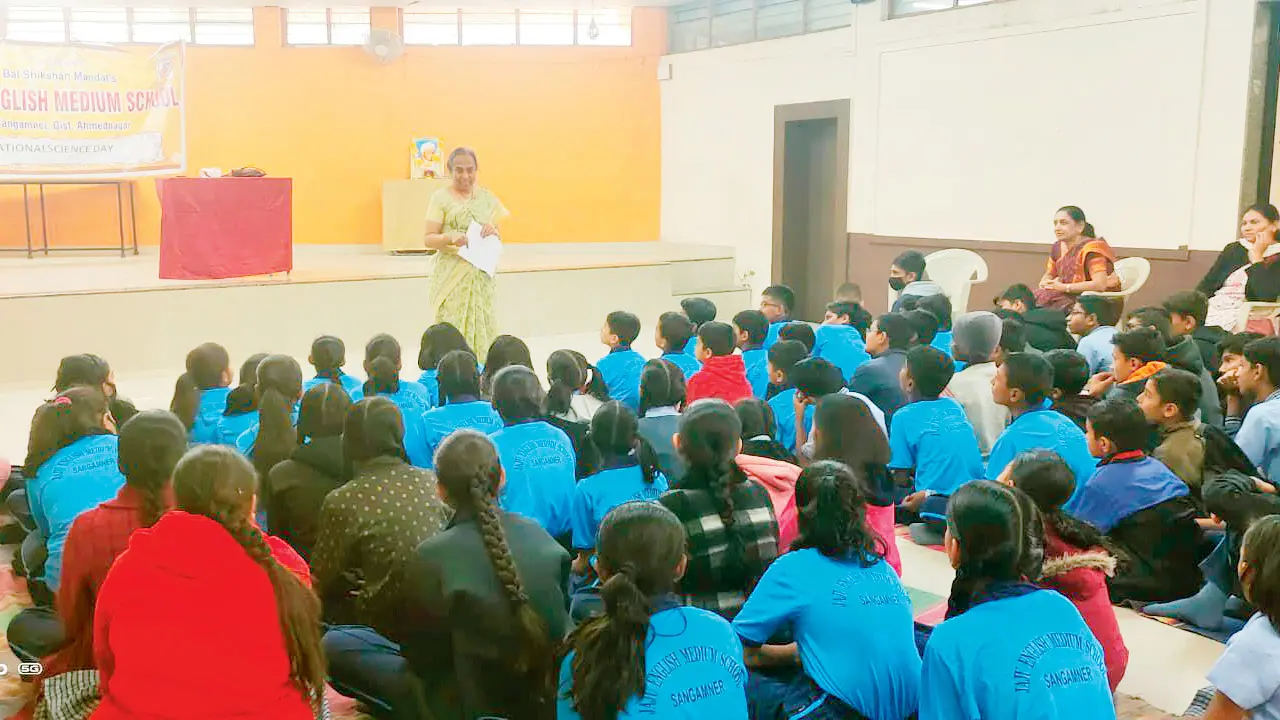
04 February,2026 11:01 AM IST | New Delhi | AgenciesFor Shubhada Rohit Kawale, the idea of service is not a proverb but a practice. Years after retiring as a chemistry professor, she still opens her notebook every day in Sangamner, not for personal pursuits, but for students who cannot afford expensive coaching and quietly fear the Maharashtra State Board examinations. During her nearly 30-year teaching career at Dr DA Ohra College, Sangamner, Kawale noticed a troubling pattern every exam season. Capable students faltered, not due to lack of knowledge, but because they lacked guidance, emotional support, and financial means. Many rural students, she realised, accepted failure as inevitable simply because personal mentoring, counselling, and coaching were beyond their reach. That realisation stayed with her long after retirement. Instead of stepping away from teaching, Kawale chose to step closer to such students. For the past five years, she has been guiding grassroots-level Std XII students across Sangamner taluka in Ahilyanagar district, helping them prepare for board examinations through free classes, counselling, and structured academic support, entirely free of cost. Known as a student-friendly teacher, she connects easily with teenagers and believes education must address the mind as much as the syllabus. Dr Rohit Shriniwas Kawale and Shubhada Rohit Kawale. Pic/By Special Arrangement Her experience taught her that confidence-building and emotional reassurance are as crucial as academic instruction. With this belief, she formed the Maitry Group in 2014 along with like-minded educators to guide adolescents dealing with academic stress and personal challenges. Kawale also serves as Secretary of the Marathi Vidnyan Parishad, Sangamner region. Education runs deep in the Kawale family. Her husband, Dr Rohit Shriniwas Kawale, served in the Department of English at Sangamner College for 36 years and retired in 2019 as professor and head. He has guided MPhil and PhD scholars, authored three books, worked for over a decade with Balbharati’s English Language Committee, and translated Marathi literary works into English. The couple continues the academic legacy of Dr Kawale’s father, the late Dr Shriniwas Kawale, former Vice Principal of Pune’s Sir Parshurambhau College. Despite shifting to Pune post retirement, they chose to continue devoting their time and expertise to a small town like Sangamner. “From the beginning, we realised rural students truly need access to experience and mentorship,” Kawale says. “We decided to guide anyone who approached us.” During the COVID-19 pandemic, Kawale recognised the need to reach students beyond physical classrooms. She developed a digital platform through which she shares short videos on effective study techniques, answer paper presentation, exam strategies, and career counselling. She has also conducted programmes in schools and women’s groups on parenting, self-awareness, responsible mobile phone use, and sensitive topics like good touch and bad touch. “The digital platform allows me to connect with students from any corner. Physically, it is not always possible to visit every school or college,” she explains. Teaching, Kawale says, has always been her passion. “While working, teachers are occupied with exams, practicals, and administrative duties. After retirement, I am enjoying pure teaching, calming fears, and guiding students without pressure,” she says. ‘Your child is important, not the exam’ As board exams approach, anxiety rises among both students and parents. Sleepless nights, fear of forgetting answers, and pressure to perform often overshadow months of preparation. According to Kawale, stress, not the syllabus, is the biggest obstacle to exam performance. “Every parent must assure their child that the child is more important than the exam. They need understanding, not pressure,” she says. One of the most common reasons students forget answers during exams, Kawale notes, is a lack of sleep. Sound sleep helps transfer learning into long-term memory, while excessive tea, coffee, energy drinks or memory-enhancing medicines, can worsen recall. She advises short breaks, light exercise, and walking to improve blood circulation and alertness. She strongly discourages last-minute attempts to cover the entire syllabus. When it comes to writing the paper, Kawale stresses discipline and clarity. Students should read questions carefully, answer in sequence, avoid leaving blanks, and write even partial answers, as they can fetch marks. Clear handwriting, proper numbering, and underlining key points make a significant difference. Parents should avoid comparisons, shouting, or repeatedly discussing completed papers. On the exam day, Kawale advises students to reach centres early, carry only permitted materials, and remain calm. “After the paper, do not analyse answers or mistakes. It increases stress and affects the next exam,” she warns. She recalls a student who scored zero in maths during prelims but went on to score 75 in the board exam with teacher guidance, and parental support.
04 February,2026 09:39 AM IST | Mumbai | Archana DahiwalADVERTISEMENT









-1770187049576_d.png "Temperatures across interior Tamil Nadu are projected to rise slightly in the coming days. File Pic")

-1770185097463_d.png "Commuters ply on a road amid dense fog on a winter morning, in New Delhi. Pic/PTI")
-1770185572143_d.png "An aerial view of snow-covered rooftops after fresh snowfall, on the outskirts of Srinagar. Pic/PTI")