The turnout marks the start of a closely watched, high-stakes contest seen as a litmus test for the ruling National Democratic Alliance’s (NDA’s) popularity. The Election Commission described the polling as peaceful and “festive,” with a record 64.66 per cent of voters exercising their franchise

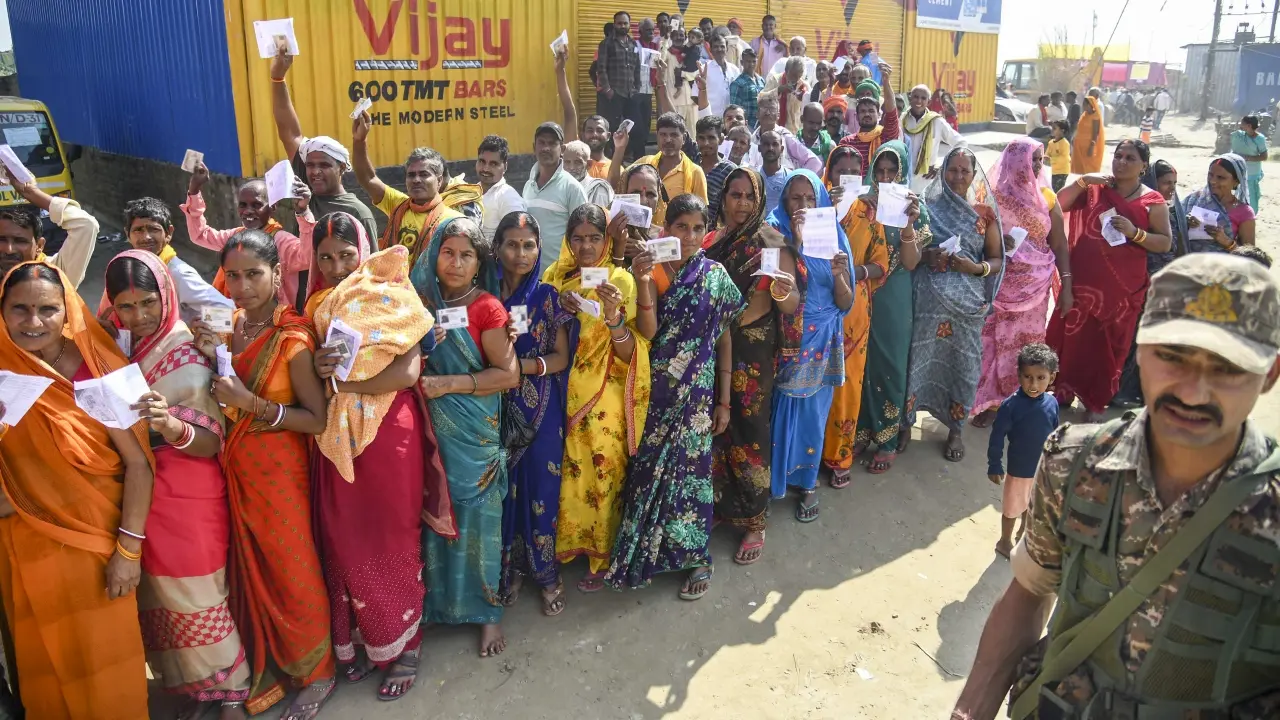
Voters wait in a queue to cast votes at a polling station during the first phase of the Bihar Assembly Elections, at Danapur in Patna. Pic/PTI
Bihar witnessed its “highest-ever” voter turnout on Thursday, as nearly 65 per cent of 3.75 crore electors cast their votes across 121 constituencies in the first phase of the assembly elections, news agency PTI reported. The turnout marks the start of a closely watched, high-stakes contest seen as a litmus test for the ruling National Democratic Alliance’s (NDA’s) popularity.
The Election Commission described the polling as peaceful and “festive,” with a record 64.66 per cent of voters exercising their franchise.
The NDA, which has been in power for nearly 20 years with brief interruptions, is campaigning on its record of “sushasan (good governance),” contrasting it with the alleged “jungle raj” during the 15-year rule of the Rashtriya Janata Dal (RJD))-Congress combine. The Opposition Indian National Developmental, Inclusive Alliance (INDIA) bloc, led by RJD’s Tejashwi Yadav, is banking on anti-incumbency sentiment and its promise of “jobs for every home” to challenge the ruling alliance.
The elections for the 243-member assembly are being closely watched both for their local significance and as an early indicator of political trends ahead of 2029 general polls. Bihar Election 2025 follows the controversial Special Intensive Revision (SIR) of the electoral rolls, which the Opposition alleged involved manipulation. The second phase of polling will be held on November 11, with counting scheduled three days later.
Several key leaders, including Tejashwi Yadav, Deputy Chief Ministers Samrat Choudhary and Vijay Kumar Sinha, as well as several ministers, are among the 1,314 candidates in this phase. While polling was largely peaceful, stray incidents of violence were reported, including an alleged attack on Sinha’s convoy, PTI reported.
Prime Minister Narendra Modi, who campaigned in constituencies going to polls in the second phase, lauded the high participation of women voters. “Mothers, daughters, and sisters have been the worst sufferers of ‘jungle raj’. Today, they seem to have put up a fortress around polling booths to prevent its return,” he said.
The NDA is also counting on Chief Minister Nitish Kumar’s record and recent welfare measures, including 125 units of free electricity, Rs 10,000 cash transfers to over one crore women, and increased social security pensions, to counter anti-incumbency.
The Opposition dismissed the NDA’s claims and urged voters to seek change.
RJD president Lalu Prasad, advocating for his son Tejashwi to form the next government, posted on X: “If a roti is not flipped on a tawa, it gets burnt. Twenty years is a long time. A Tejashwi government is essential to build a new Bihar.”
Both sides traded allegations during polling. Deputy CM Sinha, seeking a fourth consecutive term from Lakhisarai, claimed RJD supporters attacked one of his convoy vehicles to intimidate voters from extremely backward communities. Meanwhile, the RJD alleged deliberate slowing of voting in INDIA bloc strongholds, a charge rejected by the Election Commission.
A notable feature of this election has been the entry of Prashant Kishor’s Jan Suraaj Party, which has positioned itself as a potential dark horse. Kishor has promised to make Bihar “among the top-ranking states in the country,” including bold proposals like scrapping the prohibition law.
Caste and community loyalties continue to play a decisive role in Bihar politics, with Yadavs, Kushwahas, Kurmis, Brahmins, and Dalits influencing outcomes in key constituencies.
(With PTI inputs)
Subscribe today by clicking the link and stay updated with the latest news!" Click here!