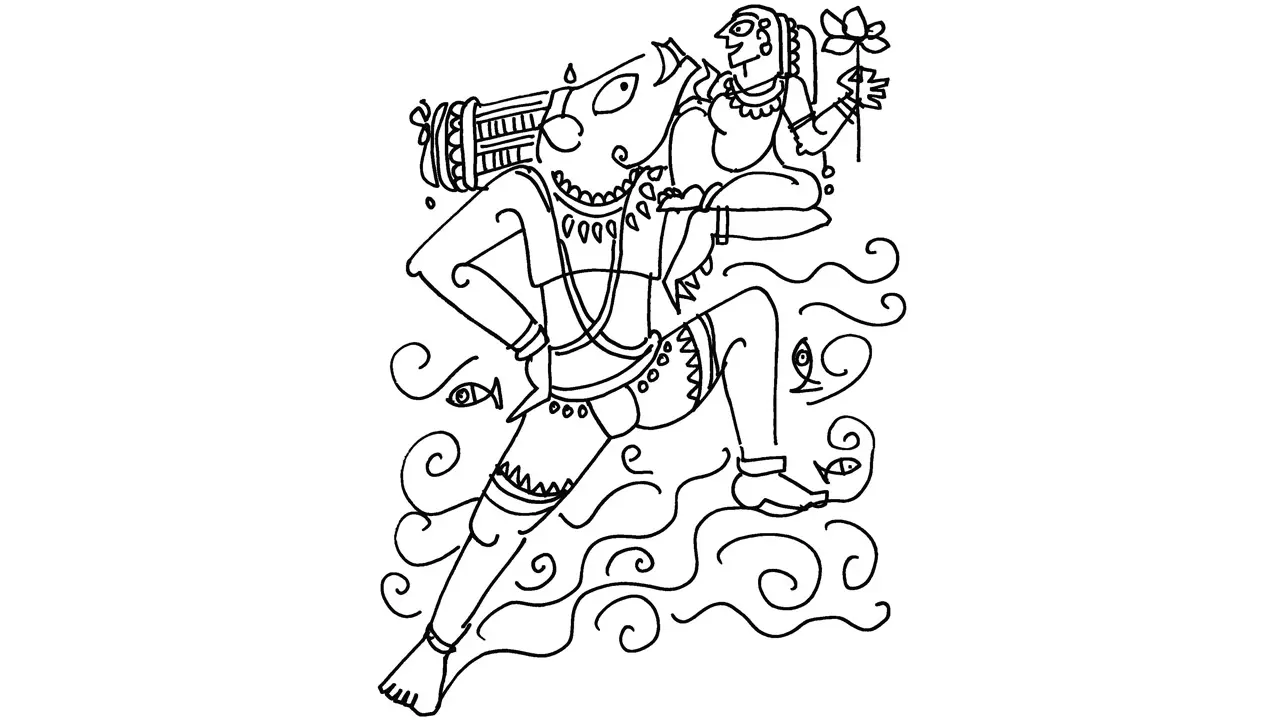
Here Naraka belonged to an ancient past, in Satya yuga. There is no connection between Varaha and Narasimha

Illustration/Devdutt Pattanaik
Once upon a time, the earth-goddess Bhumi was dragged under the sea by an asura called Hiranayaksha. Vishnu took the form of Varaha, killed Hiranayaksha, placed Bhumi on his snout, raised her up and thus rescued the earth-goddess. Bhumi decided to bear Varaha a son called Naraka. But Naraka was a demon, who could be killed only by his father or his mother. In most tales, he is eventually killed by Krishna, who is Vishnu on earth. But in Telugu tales, he is killed by Satyabhama, Krishna’s chief queen, and a form of Lakshmi.
The death of Naraka is celebrated by Brahmin communities across South India during Diwali. His effigy is burnt in Goa, on the western coast of India but in the east, in the Brahmaputra valley, Naraka is considered a local king. His story underwent many transformations.
In the Mahabharata and later in the Harivamsa, dated to 300 AD, Naraka of Pragjyotisha (Brahmaputra valley) is depicted as a violent ruler who is killed by Vishnu. The white peak of Mount Kailash is identified with the pile of his bones. Here Naraka belonged to an ancient past, in Satya yuga. There is no connection between Varaha and Narasimha.
But in Vishnu Purana, dated to 500 AD, Naraka is a king who plunders Indra’s realm and steals his umbrella and elephants and the earrings of his mother. Indra begs Krishna to help him and so Krishna travels from Dwarka in the west to Assam in the east on his eagle, kills Naraka and recovers Indra’s treasures. He, however, promises the earth goddess, Bhumi, that he will protect Naraka’s children. Here Naraka belonged to a recent past, in Dvapara yuga. Here Naraka is a son of Varaha.
From 700 AD, kings of Assam identified themselves as Bhaumas, born of the earth and their story emerges in the Kalika Purana, dated to 1000 AD. Here, Shiva takes the form of Sharabha, the eight legged lion, to kill Varaha, and liberate Vishnu, who is consumed by lust after killing Hiranayaksha. From Varaha’s lustful connection with Bhumi, Naraka is conceived. The earth-goddess who gives Sita to Janaka, king of Videha (Bihar), asks Janaka to raise Naraka too. Just as Sita is born to bring Ram into Videha, Naraka is born to bring Krishna to Assam. Janaka raises Naraka, trains him the Vedic way, gets him to defeat the Kirata tribes of Assam and establish Vedic rule in Brahmaputra valley. But then Naraka is corrupted by Bana, the asura-king, who worships Shiva. Naraka stops respecting the Vedic way and does not let sages enter Kamakhya’s temple. Furious, the goddess abandons Assam and Krishna is summoned to save Assam. So Krishna attacks the kingdom of Pragjyotisha, kills Naraka, and restores order and the worship of Kamakhya. Naraka’s son Bhagadatta is anointed king by Krishna. Bhagadatta is famous for his elephant army in the Mahabharata war. Thus, the Assam royal family is brought into the mainstream Vedic world.
In the Kamakhya Sthala Purana, local lore of the Kamakhya temple, it is said Naraka lusted for the goddess and that was the cause of his downfall. It is the goddess who summoned Vishnu to kill Naraka, forcing his eagle, Garuda, to travel eastwards instead of westwards. Some scholars argue that Jana-ka (ruler of people) and Nara-ka (ruler of men) are titles of local tribal kings who became Hinduised under Brahmin influence during the Gupta Age. We will never know for sure.
The author writes and lectures on the relevance of mythology in modern times. Reach him at devdutt.pattanaik@mid-day.com
Subscribe today by clicking the link and stay updated with the latest news!" Click here!