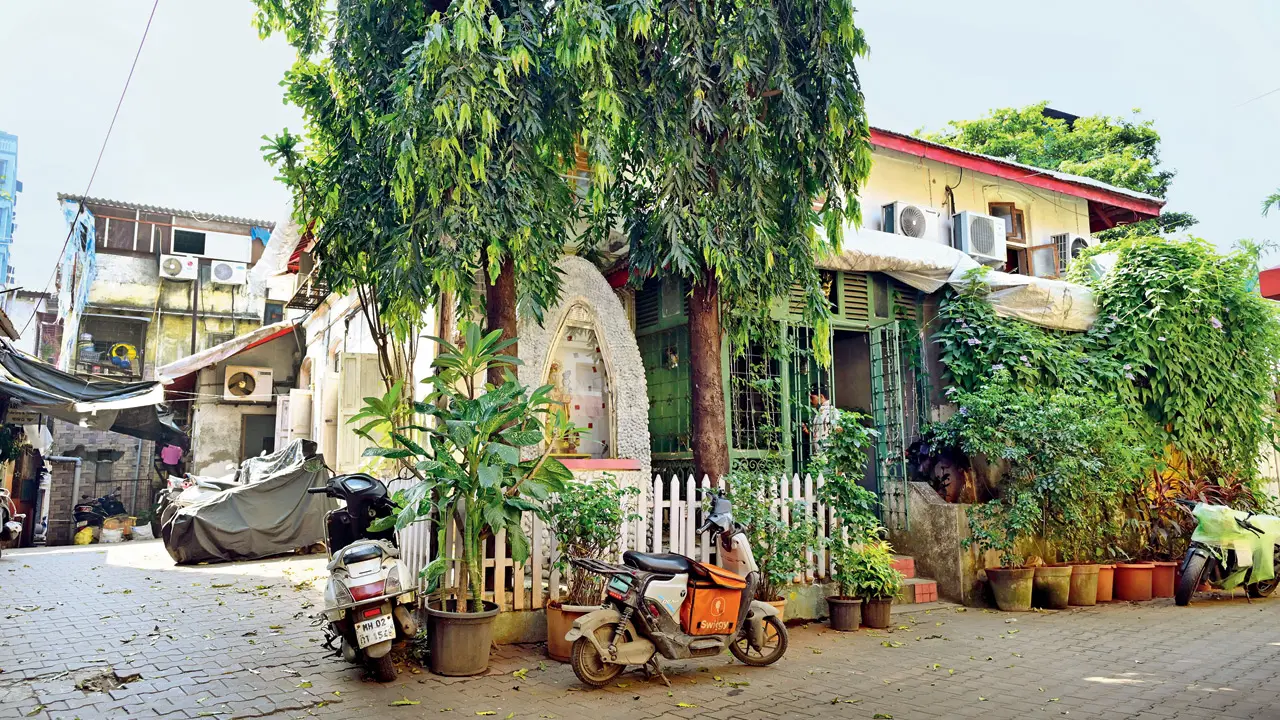
A lesser known Bandra village lane deserves some attention to its history and inhabitants as it shines quietly for Christmas

Grotto near the village square. PICS/SATEJ SHINDE
What should be easy to sight is as easily overlooked. All the world goes traipsing through the obvious showpiece villages of rampantly redeveloped Bandra: Ranwar, Pali, Chimbai, Chuim, Sherly, Rajan….
How about Boran village?
It is, ironically, more centrally positioned than the rest. Entered from Hill Road, opposite Elco Arcade, Boran Road tips south into Bazar Road. But apart from its circle of local villagers and long-time Bandra residents, this lane lies almost relegated to obscurity.

The annual Boran outdoor mass
Originally called Dancavar (sometimes spelt Dandacarvar), Boran or Borivan – one of 25 “pakhadis” under the Gujarat sultanate before the Portuguese and British East India Company acquired them – was populated by paddy-cultivating farmers and fishermen. It was a protected fishing port, paralleled west by Ice Factory Lane. The factory existed because of the fish. Boran, alongside, constituted what was dubbed Bombil Wadi. Rows of Bombay duck were laid to dry on the acre.
Why do I have a soft spot for Boran Road? A favourite aunt lived here in two-storeyed Ascension House, to which my childhood visits were frequent and fun. The name alludes to the biblical story of the Ascension – the Holy Day of Obligation 40 days after Easter Sunday, marking the ascent of Christ to heaven.

Dr Ashwin Correa and his wife Dr Samantha Correa in Ascension House, with a portrait of his grandparents, Professor Raphael d’Almeida and Elfreda d’Almeida
Back at Ascension House after 30-odd years, I meet radiologist Ashwin Correa. His great-grandfather, Domiyar Francisco d’Almeida, was the patriarch of a prominent bloodline that made pioneering contributions to civic and social life in Bombay. His son, Professor JF Raphael d’Almeida, the renowned botanist, mayor and municipal councillor, is honoured at nearby Almeida Road and Almeida Park north-tailing it.
DF d’Almeida, a co-founder of the East Indian Association, built Ascension House in 1909. The garden was planted with mango, chikoo and tetwa trees whose leaves hold medicinal properties. A duck pond was added later.
Ascension House was renovated by Prof Raphael d’Almeida’s dynamic wife Elfreda in the mid-1950s. One of their four daughters, Celsia Bocarro, explains that their botanist father was inspired enough by his passion to name them for a flower each. Elaborating, she says, “Mine, Celsia, is a small wild flower found in the Western ghats. My sister Nymphia was named after the lotus, nymphaea; Yucca after a desert lily; and Norysca after a yellow-white mountain flower. We played a lot together in the doll’s house placed under the outdoor stairway of the old Ascension House when our mother was away. She was a respected activist devoted to public work.”

Olga Pereira at the historic Boran Cross facing her cottage
Adding her own vivid memories of the residents below the d’Almeidas, Bocarro’s daughter Erika Cunha says, “In one of the two ground-floor flats lived Marita Dias who was blind from birth. She had a mother who read to her incessantly and encouraged other children to do likewise. The second apartment was occupied by the spirited Maria Salway, the Anglo-Indian great-grandmother of the actress Kiara Advani. She treated me to Bounty and Mackintosh chocolates. Sitting on the stoop of the house, she’d smoke in style in sleeveless dresses. She played poker and rummy, and told the kids of Boran ghost stories after sunset. She was our Harindranath Chattopadhyay.”
Days ahead of Christmas, Elfreda’s grandchildren were caught in a flurry of excitement preparing sweets for the season. Happy in tasting heaven, they helped her knead piles of – and maybe lick tiny bits of – kulkuls from kilos of batter.

Celsia d’Almeida fronting Ascension House
Reiterating the description of Elfreda d’Almeida as a tireless social worker for several charities, Dr Correa remembers his grandmother was the president of the Bombay Suburban Medical and Relief Society. “When she introduced the widely availed of ambulance service, the vehicle was parked opposite Bhabha Hospital. Its nurse-in-charge, Jeroo Jilla [who worked for the St John Ambulance Association while Elfreda was honorary secretary of its Bandra division], became a familiar fixture in our life. As a boy, I got used to having Nurse Jilla around our home daylong. She was a source of comfort to us.”
Correa leads me to old-time residents like Julius Mathew and Olga Pereira. “We had a large presence on this road. At one time, 25 Mathews lived in two homes, No. 14 and No. 18 Boran Road,” says 93-year-old Julius. His elder brother John Mathew established a successful book binding enterprise, with a clientele which included such institutions of distinction as the Asiatic Society Library.

Bonnie Dias (extreme left) with his siblings outside a Dias family home in Boran village, 1958. Pic/Kevin Dias
Mere feet from the Mathews, Olga Pereira looks after the pride of the village – the Heritage Wooden Cross of 1854. It was erected decades earlier than the end of the 19th century when “plague crosses” dotted the predominantly Christian suburb. In response to the 1896 epidemic, these were intended to either ward off the plague or express gratitude for being spared by it. The vintage gem of Boran was provided a marble base in its centenary year. Pereira says, “We don’t gather around this cross to chant evening Rosaries through the month of May as we faithfully did. With the terrible traffic of today, we can neither hear our voices in prayer over the noise nor risk coming in the way of cars and bikes.”
I see what she means as I dodge motorcycles swerving dangerously close and cats jumping to catch wet hems of washing hung in the sun on clothes lines. Guided by a bhangar wala shuffling slow under loads of scrap, I reach Ophelia and Larry D’Silva’s cottage. Once popular for her Christmas sweets-making skills, Ophelia says, “I would get about a hundred orders. These dwindled to two or three before I knew it. Few Catholics continue to live here.”

Elfreda d’Almeida meeting Pope Paul VI in Rome, 1967
The D’Silvas point to some replacements the lane has witnessed. Baitul Karim building, opposite Ascension House, was the site of a municipal school. Khimji Palace, corner-hugging the road entrance, was the Jussawala bungalow, which faced another Parsi residence, of the Shroffs. The Bamjis were in the building neighbouring Ascension House.
As I retread the short gully distance, specific images come floating to mind from the years of visiting my aunt. A couple of fixtures remain, like Joy Refrigeration, and Desmond and Lynette D’Mello’s plant nursery. The bustling Bohri Chawl still stands behind Ascension House.
Where is everyone’s go-to kaleji and seekh kabab wala, opposite Parison garment shop where the lane starts? Also missing is the iconic Hilton Department Store, in line with Prinz Medical on the Hill Road facade of that building. At this time each year, the Hilton management regaled passersby with choirs singing Christmas carols and a snow-sprinkled reindeer-led sleigh with Santa emitting cheery Ho Ho Hos.

Wedding portrait of Raphael and Elfreda d’Almeida, 1925. Pics courtesy/d’Almeida family
What will always, of course, sparkle is the pre-Christmas glitter and twitter on Hill Road. Pavement stalls tempting jostling customers with fairy lights, tinsel trails, Xmas tree stars and baubles crowd the path, to make walking an impossibility. And yet, as lilting carol sounds on the street smoothly balance the loud chaos, I find myself lip-sync to “It’s beginning to look a lot like Christmas”.
That rings a bell! Memories of the evening Rosary at Boran Cross
Bonnie Dias
I was born in 1940 at Gret-Ville. First constructed in the 1800s, this house was expanded in 1936 with extra rooms and a porch. Gret-Ville, plot 12-C, got its name from my sister Greta (Sister Margaret Mary), born a year before the renovation. It is situated opposite my mother’s sister, Aunt Dolcie’s bungalow, plot 14-C, where the Love Fools restaurant came up. My siblings and I played games of seven tiles, atya patya and hu tu tu, organised by my sisters in the space between the two homes.

Bonnie Dias (extreme left) with his siblings outside a Dias family home in Boran village, 1958. Pic/Kevin Dias
As my mother Agnes was from the d’Almeida family, there was almost daily interaction between the d’Almeidas and the Dias family. Sharing some more ancestry in common with the d’Almeidas, our Dias family was eminent on Boran Road before shifting to Almeida Road.
My best moments till I was a teenager were spent picking ripe mangoes, guavas, custard apples and love apples. I ate them right away in the tree branches. My friends and I would pinch fruit – especially sour tamarind, bimbli and amla berries — from garden to garden because there were no fences cutting between cottages. How fast we ran through the green fields on this side of Hill Road where Boran Road begins.
In the park next to the well, we played cricket, football and hockey. Sitting there to chat with friends was a treat we looked forward to. On birthdays we distributed cake and black gram to the gang.
We were assigned responsibilities too. Mine was sounding the bell on May evenings — the call for the community to gather at the Boran Cross for the evening Rosary. The bell belonged to Aunty Dolcie and it was my privilege to go around ringing it from 10 minutes to 7 pm.
Boran village extended beyond our homes, deep in towards the bazaar. The “kolsa [coal] house” was opposite Ronsons Bakery, run by Grace and Stanley D’Souza, and named after Grace’s father Ronson. Other families initiated flourishing trades, like the Mathews with their book binding business.
Interestingly, a Christian refugee family — probably from an African or Middle Eastern country — settled in a small hut near the undertaker George Baptista’s house, above the municipal school facing Ascension House.
Because they were called kafirs wherever they came from, we called the boy of the family whose name was Anthony, ‘Kafria Anthon’. But Boran Road has changed beyond recognition, like so much else in the city sadly.
‘There was this group called the Boran Boys’
Renuka Fernandes (nee d’Almeida)
My mother Nymphia was one of Professor and Elfreda d’Almeida’s four daughters. Hyginus Correa, our father, was a municipal councillor and High Court advocate. There was this group he formed, called the Boran Boys, with 12 to 15 members like Bonnie Dias and Nigel Remedios. My grandmother Elfreda practised traditions like the celebration of the Feast of the Ascension at the cross in our compound. She had this particular cross built as a thanksgiving gesture after a family dispute was amicably resolved.

Professor d’Almeida’s daughters named after flowers: (clockwise) baby Norysca, Nymphia, Yucca and Celsia (seated middle)
Besides this ritual, she displayed a special altar at our Ascension House front gate for the 13-hour feast of the Adoration, where people gathered in prayer before the Blessed Sacrament before having a little party in the compound. The Boran mass is another continuing annual practice, usually held at Joseph Villa, my father’s family home.
In contrast with all this, there was a booze adda at the end of the road, from where drunks came lurching down the lane. On a then quiet stretch with barely any vehicles, you woke in the night to hear screaming and shouting as fights broke out. Rough boys doing drugs stole whatever they managed to lay hands on, even iron drain covers. Poor drainage got Boran Road badly flooded. I recollect my mother wading through neck-high swirling water when my parents were returning from a party.
My dad arranged getaways for everyone at the Vaitarna and Tansa lakes. A huge number of family and friends went boating, camping on the banks and fishing in the backwaters there. Inside the beautiful bungalow with big bedrooms and balconies we enjoyed card and board games when we weren’t cooking and consuming chickens by the dozens. Revisiting Tansa is on my wishlist. Will it really revive my impression of those days, I wonder.
Subscribe today by clicking the link and stay updated with the latest news!" Click here!