With figures showing that there are less than 40 per cent Marathi speakers in Mumbai, the BJP finds itself appealing to one side, while the Thackeray cousins hard-sell the language issue to the other

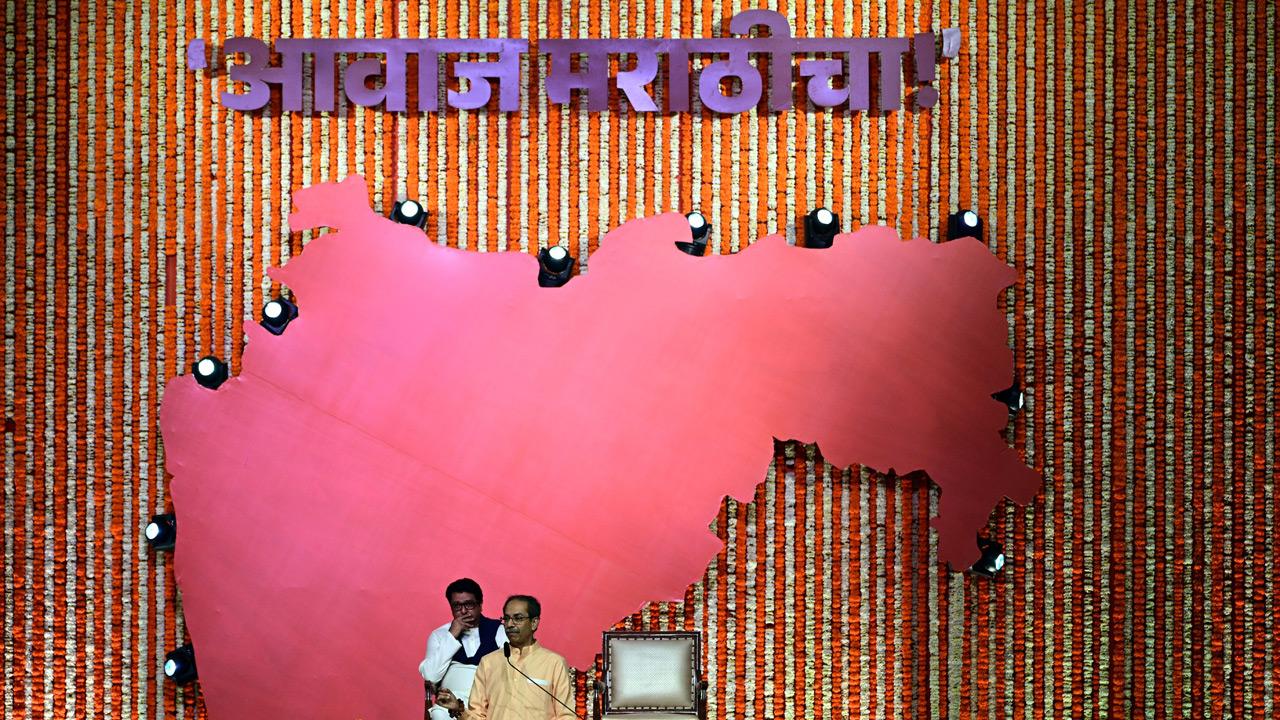
MNS chief Raj Thackeray (left) and Shiv Sena (UBT) President Uddhav Thackeray at their ‘victory rally’ at the NSCI Dome in Worli on July 5. Pic/Rane Ashish
The Hindi language row has shifted from the classroom to the street. In April, the government introduced an academic decision to promote Hindi in primary schools across the state. However, the move to shape young minds has now turned into a Marathi versus non-Marathi row and even redrawn political lines — making the most unexpected things happen, such as bringing the estranged cousins Raj and Uddhav Thackeray together. This reunion has triggered a locals-versus-migrants issue and language politics now dominating Maharashtra’s politics.
The linguistic fight spilling over to the streets is seen as a battle for cultural control and electoral advantage. For example, in a protest march carried out at Mira Road-Bhayandar by traders in support of non-Marathi speaking people, the national pride agenda was clearly visible as those participating in the rally shouted ‘Jai Shree Ram’ slogans. Whereas a show of strength by local Marathi speakers organised by the Marathi Ekikaran Samiti and supported by both Raj and Uddhav saw slogans leaning towards language and regional pride.
The cousins have endorsed violence against shopkeepers in Mira Road for not respecting Marathi and have firmly stated that they will not compromise when it comes to Marathi and Maharashtra. But the ruling Bharatiya Janata Party (BJP) regime has taken a tactical approach to the Hindi-Marathi controversy. Chief Minister Devendra Fadnavis (who also holds the home department portfolio) and Mumbai BJP president Ashish Shelar have categorically said that one has to respect Marathi, but will also not tolerate any attack on non-Marathi speakers.
The BJP’s strategy (supporting Marathi, at the same time pacifying non-Marathis) to handle the Hindi-Marathi controversy is not an accident, but a calculated move. Of the city’s 36 MLAs, 13 (around 36 per cent) are non-Marathi, and notably, seven of them belong to the BJP, indicating the party’s strong influence among migrant communities. Similar is the trend at the micro (ward) level in the Brihanmumbai Municipal Corporation (BMC). In 2017, 72 of 227 elected BMC corporators were non-Marathi, up from 61 in 2012. The BJP alone fielded and won 36 non-Marathi (of the total 82 seats it bagged) corporators, the most of any party.
The BJP accounts for 50 per cent of the total non-Marathi representation in Mumbai MLAs and the BMC, reflecting its deep base in migrant-dominated areas of the city known as ‘Mayanagri’ (city of dreams), as people from across India, especially North India, come to the city to pursue their aspirations.
According to rough estimates, non-Marathi speaking migrants, including Gujarati, Hindi, people from Rajasthan and other states, constitute over 50 per cent of the urban electorate in Mumbai, a critical vote bank that the BJP actively seeks to maintain. The non-Marathi speaking dominance is felt especially in areas like Mulund, Ghatkopar, Kurla, Borivli, Kandivli and areas of South Mumbai. The same is the case in areas of Mira-Bhayandar and Thane, growing cities on the outskirts of Mumbai.
Thus, the linguistic row is now portrayed in two frames – one narrative is of nationalism through religion, and the other asserts local cultural and linguistic dominance in its own land. As Bihar and local body elections in Maharashtra are scheduled at the end of 2025, both pro-Marathi and non-Marathi camps are attempting to extract maximum political mileage from the linguistic divide and the competing narratives it has sparked.
No wonder then when it comes to two different narratives, the BJP is trying to find a balance between Hindi driven nationalism and asserting local pride -- a calibrated approach reflecting its broader electoral strategy that helps the party promote national unity and at the same time keep its political dominance in Maharashtra, which is sensitive to linguistic issues.
Similarly, regional parties like the Shiv Sena (UBT) and the Maharashtra Navnirman Sena (MNS), which are losing their political relevance, are trying to revive their vote bank and polarised political landscape.
MNS even described the current pro-Marathi protest over the introduction of the Hindi language in schools as almost similar to the Samyukta Maharashtra Movement of the mid-1950s. That movement was initiated with the demand for a separate Marathi-speaking state in India. Accordingly, in 1960, Maharashtra was formed. The bifurcation of Bombay state led to the creation of the Marathi-speaking state of Maharashtra and the Gujarati-speaking state of Gujarat.
Since then, Maharashtra has witnessed several agitations centred around the Marathi language and regional pride. Shiv Sena was formed in 1966 to fight injustice against ‘Sons of the Soil’. The late Bal Thackeray had formed the Sena, which split in 2022.
Initially, in the 1970s, the agitation was against the people from southern states. In the late 1990s, the focus shifted to North Indian migrants. In 2005, Raj, citing differences with Uddhav, left the Shiv Sena. Later, in 2006, he formed his own party, the MNS. Then the Marathi versus non-Marathi issue became a rallying point with demands like preference for locals in jobs, demands for Marathi signboards and so on.
Since the formation of the Shiv Sena, the party has been talking about injustice towards Marathi speakers. While the core issue remains the same, the spirit has shifted. Earlier, the fight was for creating space for Marathis, and now it is denying space for fellow Indians and about political survival, making today’s ‘Rajneeti’ more dangerous for the cosmopolitan fabric of India.
Sanjeev Shivadekar is political editor, mid-day. He tweets @SanjeevScribe
Send your feedback to mailbag@mid-day.com
The views expressed in this column are the individual’s and don’t represent those of the paper.
Subscribe today by clicking the link and stay updated with the latest news!" Click here!