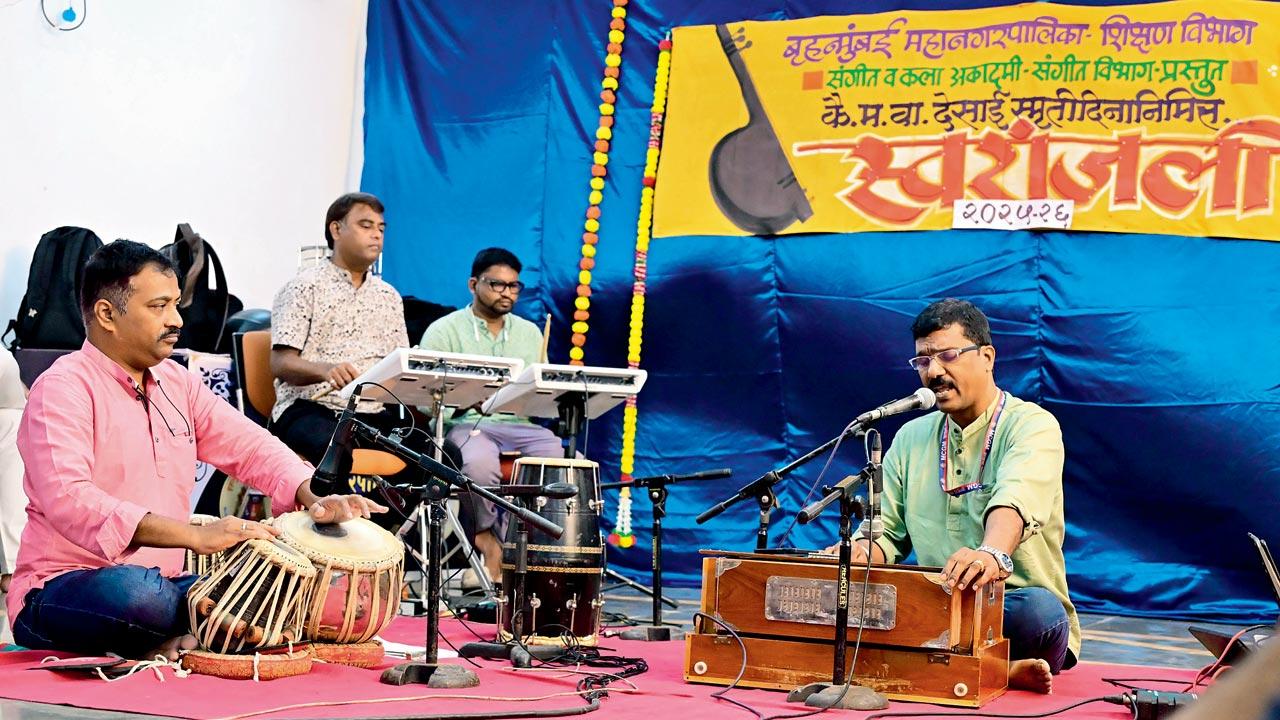
Amid peeling walls and chronic shortfalls, a 51-year-old music and art academy in Mumbai’s municipal schools quietly shapes talent — thanks to teachers who go many extra miles

Teachers from BMC schools during a recent performance at Sangeet Kala Academy’s annual programme, Swaranjali, held at Triveni Sangam municipal school, Currey Road. Pics/Shadab Khan
In three rehearsal rooms — one inside Goregaon’s Pahadi MPS School Complex, one at Vikhroli’s Hariyali Village School, and another at Ganesh Baug Kurla — 30 students are preparing for an unlikely stage a month from now: the Darbar Hall of Maharashtra Raj Bhavan on October 31. Some teachers are fashioning the traditional costumes of Kashmir and Ladakh, others liaising with Raj Bhavan over protocols. Music teacher Abhijeet Kambli, who is directing the Dumhal and Ladakhi dances, is racing against time to set the choreography right within low-cost constraints and a high-pressure environment. “They’ve never seen Kashmir, but they’re learning to carry its spirit,” he says, as he gathers outsourced live music and technical help to make the performance sound as rich as possible. In keeping with the spirit of the occasion, no Bollywood elements are being included — instead, Mumbai’s municipal school students will present authentic folk songs written by their teachers, accompanied live on traditional Kashmiri instruments.
All of this comes under the wing of the Sangeet Kala Academy, now in its 51st year, working within the city’s municipal schools. This year, the academy will present the cultural programme for the Union Territory Formation Day of Jammu & Kashmir and Ladakh, part of the nationwide ‘Ek Bharat Shreshtha Bharat’ initiative in which Raj Bhavans celebrate the traditions of different states and UTs. Governor CP Radhakrishnan (now Vice-President of India) first heard the academy at Shivaji Park, and the talent that impressed him has long won over Mumbai audiences.

Not just at Raj Bhavan, the Academy’s presence is felt across venues — from Shivaji Park to the heritage hall of the BMC headquarters where budget battles and civic clashes usually dominate. In that charged chamber, cultural performances soften rancour, reminding the city that art and politics must coexist — sometimes in harmony, often in tension. The Academy marks occasions like Independence Day, Republic Day, and Marathi Bhasha Diwas here, and mounts presentations on Shiv Jayanti and Maharashtra Day. With scant means, its 50 music and 90 art teachers train, costume, and guide students beyond duty.
One begins to understand the Academy better after stepping into the corridors of the Education Officer’s chamber in the Triveni Sangam Municipal School building on Currey Road. Here, authority meets energy in Kirtivardhan V Kiratkudve, who describes the space that offers what many homes cannot — a first encounter with the arts — where teachers step into the role of parents, nurturing talent with patience and persistence. “Art is a must in life to wage life’s battles,” he says, echoing the belief of MV Desai, the city’s municipal commissioner (1972–75) and the Academy’s founder. For 51 years, that legacy has been shaped by founder-advisers such as litterateur PL Deshpande and Pandit Vamanrao Sadolikar, and sustained over decades by an advisory committee drawn from the finest in their fields. Today, only three of its 12 seats in the music academy remain occupied — vocalist Shruti Sadolikar Katkar, instrumentalist Shankar Abhyankar, and danseuse Sucheta Bhide Chaphekar. The rest were once held by luminaries like Pandit Jasraj, composer Yashwant Deo, veteran dancer Kanak Rele, and actor-director Damu Kenkre, whose vision still echoes in the work of 8500 students across 900-odd primary and 250 secondary civic schools in Mumbai.
BMC students learn music in school. All civic school teachers are trained in art forms at Sangeet Kala Academy
BMC schools function in eight mediums — Marathi, Urdu, Hindi, Gujarati, English, Tamil, Telugu, and Kannada — and this range feeds into the Academy’s ensembles and teacher projects. Music instructor Jyoti Bhat, a Kannadiga by birth, sings in five of these languages. Her favourite is a Gujarati number, Rang Bhari Holi, though she recently composed a song in English. “Every July, we introduce six new samooh geet for teachers. It’s their toolkit to engage students across neighbourhoods,” says Bhat, herself a former BMC student. “It’s lovely to see teachers learning new languages because of these group numbers.”
Principal Shivangi Damle (Music) affirms how simple lyrics energise students and bind teachers. Alongside building a repertoire of theme songs on environment and harmony, teachers are also trained in folk forms so their grasp of Maharashtra’s dances — going beyond the usual Koli choreography — directly enriches students’ learning.
The Academy’s music lessons have long been a launchpad for ambitious productions, some even staged abroad, with roots in Maharashtra’s Sangeet Natak tradition. Founder Desai, a passionate lover of musicals, owned two rare organs and a pair of harmoniums — (later donated to the Academy). The Academy has kept this cornerstone of culture alive by staging Marathi musicals with its own music teachers in leading roles. Over time, 13–15 productions have been mounted, many winning laurels at the Maharashtra State Drama Competitions. Among the most memorable are Mandarmala, Katyar Kaljat Ghusali, Sanshaykallol, Bavankhani, and Dhadila Ram Tine Ka Vani.
Municipal school students get trained in not just fine arts, but also allied professions such as mass media
As former principal Suvarna Ghaisas (who directed quite a few musicals) puts it, “We are not just preserving a tradition, it is like living it — taking Desai Sir’s love for Sangeet Natak from the classroom to the state-of-the-art stage; also demonstrating the magic that can come out of minimal resources.”
Music may be the Academy’s heartbeat, but its spirit flows into the visual and performing arts, where many students discover creativity for the first time. For instance, 450 students built a 40-by-50-foot replica of the legendary Janta Raja play set at NSCI Dome in Worli as part of Indradhanushya 2023, winning Gold at Asia’s WOW Awards. Marking 75 years of Independence, 2000 students linked hands at Ghatkopar’s Acharya Atre ground to form a living map of India. And in Bacche Bole Moraya, 2500 young hands shaped eco-friendly Ganesh idols, carrying tradition gently into the future.
The academy also conducts the BMC’s annual art contests for children, such as the annual Mazi Mumbai Balasaheb Thackeray Drawing Competition, where children make rangoli, sculpt eco-friendly Ganesh idols from shadu clay, and build sand sculptures of Shivaji Maharaj’s forts on Juhu beach
The annual Mazi Mumbai Balasaheb Thackeray Drawing Competition draws nearly one lakh children across 48 city parks. Alongside it thrive traditions that blend art with civic imagination — eco-friendly Ganesh idol contests using shadu (riverbed) clay, sand sculptures of Shivaji Maharaj’s forts by 300 students on Juhu beach, and rangoli competitions engaging students and civic staff. Photography contests bring together municipal employees, city photographers, and young learners, while a three-day Artist Camp for teachers culminates in an exhibition at the Nehru Centre. Each year, 4000–5000 civic school students take Maharashtra’s Elementary and Intermediate Drawing Exams, with pass rates above 90 per cent. The BMC allocates '42 lakh annually for arts initiatives, plus special funds for the Mayor’s contest, within a '65 lakh arts and music budget.
Principal of the Academy’s visual arts wing, Dinkar Pawar, says the sustained effort has produced both first-rate artists and a visually literate audience that now extends into neighbourhoods across Mumbai. “The BMC’s commitment to providing students and teachers with necessary material, without fail and entirely free of cost, makes a huge difference to those who otherwise cannot compete on equal footing.”
The Academy’s student power shines through a big band of professionals (alumni) who pay back in the form of free backstage support. Their presence fosters
a living community — experienced hands stepping in as larger programmes unfold. This culture of continuity is matched by teachers who prepare children free of cost for competitive exams. Each year, nearly 500 students appear (many funded by teachers), including at the Akhil Bhartiya Gandharva Mahavidyalaya, affirming that the Academy extends beyond classrooms into a lifelong rhythm of practice.
In its 51 years, the Academy has weathered many battles, the pandemic among the hardest. Work could have stalled, but then principal Ghaisas and Abhijeet Kamble carried it into the virtual space for the first time. “Those were sleepless nights,” recalls Ghaisas. “We had to build an online routine from scratch, while ensuring our children’s talent and our teachers’ dedication still reached people in those dark hours.”
Ghaisas recalls August 5 — founder MV Desai’s birth anniversary — as a key date for teachers to showcase new contributions, especially in 2020 when Covid forced a shift online. That year, rehearsals moved to Zoom: teachers sent recordings, which Kamble compiled into a presentation for 300 colleagues. Encouraged by the response, Ghaisas launched an online “Music Week” for students — a daunting task when songs had to be taught over mobile phones. Once students learned their parts, instrumentalists recorded harmonium, violin, tabla, and dholki accompaniments from home, sending tracks for mixing. The three-hour programme Nave Kshitij was streamed on the Education Department’s YouTube channel, drawing 7000-plus viewers.
In the Academy’s lifetime, it was extraordinary — proof that even in isolation, art could bridge distances, even if it never made breaking news.
Sumedha Raikar-Mhatre is a culture columnist in search of the sub-text. You can reach her at sumedha.raikar@mid-day.com
Subscribe today by clicking the link and stay updated with the latest news!" Click here!