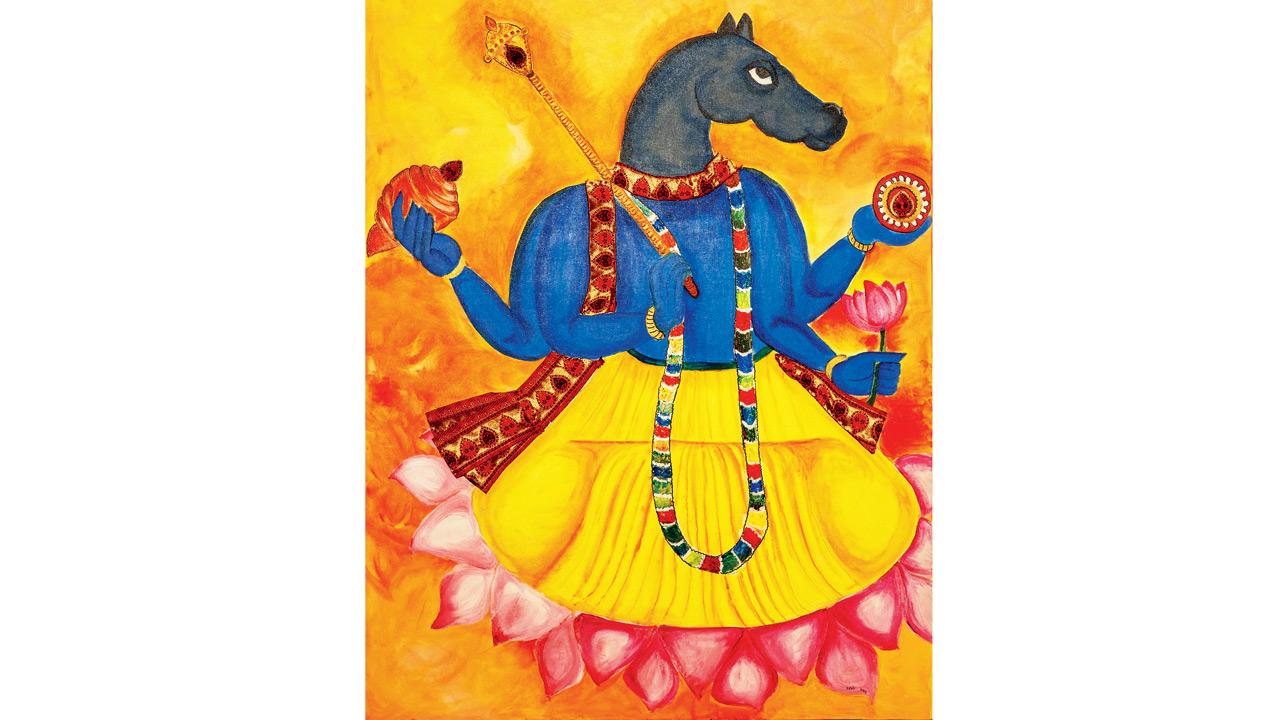
Viswanathan Anand’s son Akhil isn’t following his father’s steps—he instead is venturing into the land of Gond, Madhubani, Warli, and Cheriyal

Some of Akhil’s art works. He has also been to Pingla in Kolkata to study the Kalighat Patachitra and gets inspiration from the works of MF Hussain, Manjit Bawa, Jamini Roy, SH Raza and Sivabalan
It’s hard to imagine five-time world champion Viswanathan Anand saying, “He showed me chess in a way I hadn’t seen it before”. But that’s the legend’s honest admission when you talk to him about the painter in the house — his son, Sai Akhil Anand. Akhil, a class IX student and an upcoming artist, is showcasing his paintings at his solo art exhibition called “Morphogenesis” in Chennai, and the title emphasises his love for patterns that he turns into a piece of art.
The extent of Akhil’s imagination of patterns stunned Anand during an odd game of chess they indulge in. “What I found really interesting was that he looked at some of my chess pieces in certain games and pointed out the patterns that they traced out with their moves. He found those useful for very interesting artscapes,” says Anand, talking to mid-day from his home in Chennai. “So he shows me chess in a way I haven’t seen it before, and that is very enjoyable.”
Akhil developed this penchant for figures at a very young age. His sketches of Mahatma Gandhi and Albert Einstein were what first caught Anand’s attention. Akhil then started training under artist Diana Satish and has since been exploring various art forms, most noticeably from the lockdown days during the pandemic.
“Gond, Madhubani, Warli and Cheriyal are the styles that inspire me,” says Akhil, who has also been to Pingla in Kolkata to study the Kalighat Patachitra and gets inspiration from the works of MF Husain, Manjit Bawa, Jamini Roy, SH Raza, and Sivabalan.

Sai Akhil Anand with parents Anand and Aruna
His portfolio at such a young age also includes a creative clothing enterprise, besides authoring a book titled “The HeART of Math”, which explores mathematical patterns in nature. So it’s only apt that the exhibition of his artwork is titled “Morphogenesis”.
“When we realised that there is a connection between one of his favourite artworks called the UnBinary series (inspired by Dutch painter Piet Mondrian) and morphogenesis, especially patterns on a zebra or a cow and so on, then we explored that topic,” says Anand.
“It (morphogenesis) is something that Alan Turing discovered. Akhil researched about it and found it in many things. So, he decided it should be the title of his exhibition.”
The balancing act
An important role in Akhil’s pursuit of art is played by his mother, Aruna Anand. She is the architect of the balancing act between academics and art, so that none is left behind or ignored. Aruna is also Anand’s manager and now is performing a close-to-similar role for her son. “Akhil is very fortunate to study in a school that also has been very supportive of his art journey. That makes it much easier for the parents to have children pursue their own passion,” says Aruna.
Sai Akhil Anand
“Basically I am almost like an apprentice for him,” she adds with a smile. “So, when he is away at school, he will make me plan his day and keep everything ready so that when he is back, he can get on with it very quickly.”
Beyond art
Art, of course, is slowly becoming a professional choice for Akhil, but he doesn’t want to limit himself to just that.
Inspired by the architect of the Constitution of India, BR Ambedkar, and the works of Nandalal Bose, who illustrated the Constitution, Akhil also wants to become an environmentalist and contribute towards sustainability to mitigate the effects of climate change.
“My other ambition is to become an environmental lawyer like Ambedkar, to fight against climate change and global warming and to be sustainable,” says Akhil. His favourite is the superheroes series “because it explains a lot about animals that are endangered or are close to becoming extinct”.
But growing up around chess boards, one would imagine the kid in the house taking up the game. However, it’s nothing more than a distraction from the routine for Akhil. “He enjoys playing, but art attracted him the most,” says Anand. “In a sense it reminded me of my chess — how much effort I would put in when I wanted to learn something new. For me, the most important thing is that he does what he enjoys,” says Anand.
Aruna completes her husband’s sentiments, when she says, “All of us are involved in the process but the creativity is all Akhil’s.”
Subscribe today by clicking the link and stay updated with the latest news!" Click here!