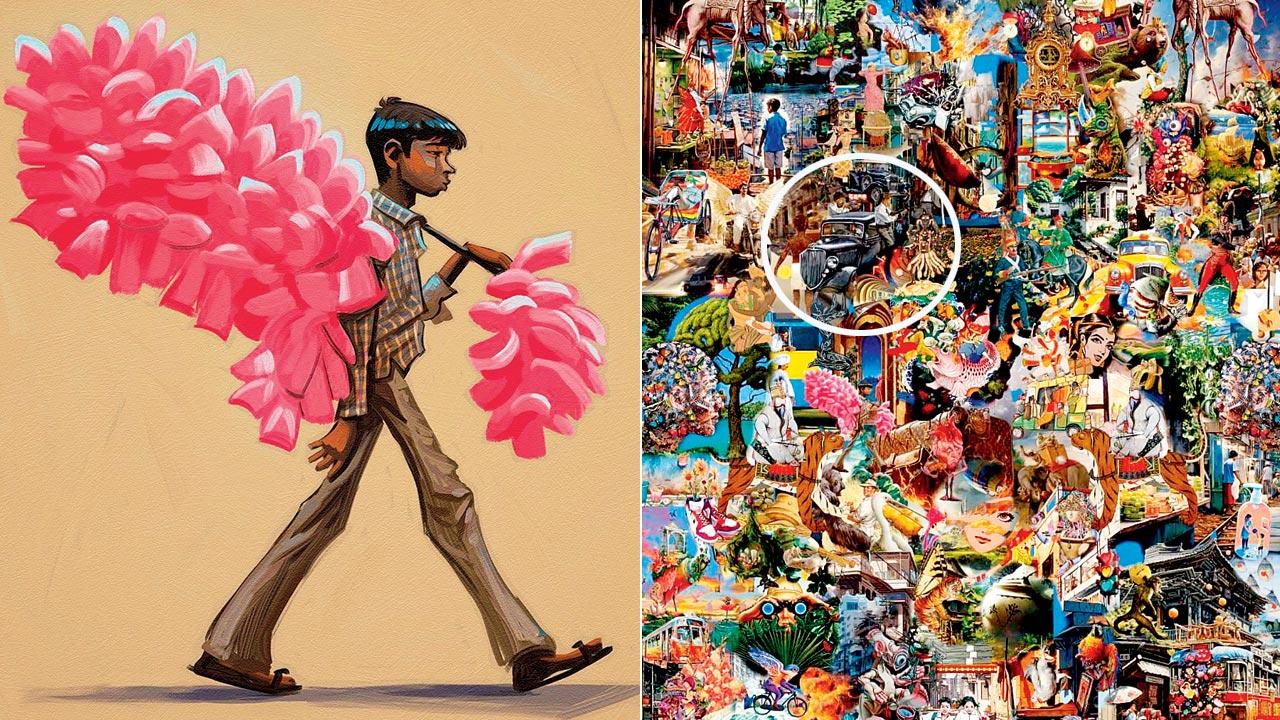
An AI-fuelled plagiarism controversy around the work of a Delhi-based artist has thrown up questions of authenticity, ethics, artistic fulfilment, and vulnerability

Artist Krishna Bala Shenoi’s Cottonboy. Pic/Instagram @krishnabalashenoi; (right) Abhay Sehgal’s All for One features Cottonboy as one of the elements
A few weeks ago, artist and illustrator Krishna Bala Shenoi learnt that an artwork he had made in 2021 had turned up on a painting by Delhi-based contemporary artist Abhay Sehgal. Shenoi’s Cottonboy was, as the Bengaluru-based artist has noted in a now viral Instagram post, “transplanted pixel for pixel onto [Sehgal’s] canvas”.
This isn’t the first time his cotton candy boy has been used elsewhere without permission, Shenoi tells us. Followers have apprised him in the past of the painting appearing as T-shirt prints and even as a mural in a restaurant. “I’m not litigious and I have let it go,” he tells us. “Even with Sehgal’s work [titled All for One], I saw that my painting was a small part of his collage and didn’t initially feel transgressed upon… What bothered me this time around was the caption. It had him talking about it as if it was a painting.”
It is this deception around the creative process that Sehgal has seemingly embarked upon that has prompted several allegations of plagiarism against the artist in recent weeks with side-by-side comparisons of artworks surfacing online. Many believe that instead of simply disclosing that his collage had been made with art found on the Internet and that he had also used AI to generate patterns, Sehgal has continued to fan a narrative of originality. He publicly accepts compliments on his detail-oriented works, and posts work-in-progress videos, all of which have served to create an illusion of authenticity. “I think he creates confusion around his practice because he wants the credit for having painted the work himself,” observes Shenoi.
Artist Stacy LeFevre’s watercolour of a froglike creature with a bonsai tree on its back, and Abhay Sehgal’s A 100M Swim which uses the same bonsai tree from LeFevre’s illustration
Earlier this week, a fellow artist on Instagram alerted US-based illustrator and comics artist Stacy LeFevre to the fact that their art — a watercolour illustration made as a birthday gift for a friend in 2012 — had appeared on Sehgal’s A 100M Swim. In an email interview with Sunday mid-day, LeFevre tells us that this is the first known instance of their artwork being used without permission, but given the vastness of the Internet they wouldn’t be surprised if there were others.
“… I’m glad on this occasion, the portion of my art that was used was recognisable enough to be traced back to me,” they write.
“If you’re deriving something from an original piece, logically you need to take consent or you’ll be infringing. That’s the traditional and conservative view to take,” says Shailendra Bhandare, partner with law firm Khaitan & Co who has worked in intellectual property law for over two decades. Moreover, claiming copyright over a work derived from another’s, he says, goes beyond the realm of originality “because the requirement for copyright protection is that it should be an original work”. “However, the law needs to evolve as there is an argument that if the result/output of the AI works does not substantially reproduce the original work, there may be no infringement of original work.”
Krishna Bala Shenoi, artist
“Where is the originality in a work where there is little involvement of skill, labour or effort, which is the backbone of any IP protection? When an artist claims that the work is unique, people pay money for that uniqueness,” he adds.
In such cases of copyright infringement, Indian copyright laws, he tells us, provide for civil as well as criminal remedies, from injunctions, damages, costs, search and seizure to even fines and/or imprisonment.
What has added an additional layer of complexity to the authenticity question in the controversy around Sehgal’s art are the allegations of covert AI use. Artist Harshit Agrawal, who works with emerging technologies such as AI, sees the issue as two-fold: at one level, there was direct plagiarism for which no heavy technology was required. Using art created by someone else, without modifying it or crediting the original artist, and instead just putting it out as your own work is what’s problematic. “This doesn’t necessitate the usage of AI to be called that,” he shares.
Stacy Lefevre, Shailendra Bhandare and Harshit Agrawal
Plagiarism with AI applies in cases where AI was expressly prompted to generate work in an artist’s style, especially if those artists have not given explicit permission for this. The Studio Ghibli AI art trend, for instance, is an example. In Sehgal’s case, Agrawal points out that AI was used to fill in the gaps and make his collages look seamless, rather than cut-outs put together.
In the face of growing pressure on social media, Sehgal recently put out a statement that he doesn’t paint on blank canvases and instead creates digital collages which he references while painting. Collaging as a technique is an established format, says Agrawal, but “parts of that collage cannot be elements that are other people’s works”.
Agrawal, who has worked with AI in his artistic practice for over a decade now, trains his AI models with data that is his own or openly available in databases
meant for this purpose. “I think you can use AI and still claim authorship of that work as a human artist, because I’m using AI to train the models and do a lot of backend work, like controlling its learning rate or shutting down neurons in its neural network to get different visual outputs. Therefore the usage of
AI itself can be a practice in understanding its depths and then being able to create artistically from it,” Agrawal tells us. The process is the same as what a traditional artist does with their material, he explains. “For me, the craft lies in that process just as someone working with ceramics or clay. When training an AI, I experiment with its parameters in a similar way.”
Harshit Agrawal’s works, such as (Un)Still Life, all use custom AI models
What bothers Agrawal is the reductionist way in which people have begun speaking of AI artists. “AI art is equated to just writing a prompt and getting an image but that is not art. It’s like saying that everyone who has a cell phone is a lens-based artist.”
The path remains precarious for artists dependent on social media for visibility and work, which also makes them vulnerable to such creative violations. LeFevre expresses concern over well-known generative AI models being trained on work from artists who did not consent to their art being used, and points to its impact on opportunities for artists. “I’ve been approached by others to ‘correct’ or redo generative AI art for logos or illustrations, and it infuriates me that they would go to an algorithm rather than a human artist.”
For commissions, LeFevre has begun including a clause stating that their work cannot be used for AI art generators. Over the past year, they have also begun adding watermarks on their artwork: “I also use Glaze from TheGlazeProject [software that prevents artwork from being mimicked by AI models] to protect my art. I question if that is enough… At the very least, I hope that makes it more inconvenient to be stolen.”
Subscribe today by clicking the link and stay updated with the latest news!" Click here!