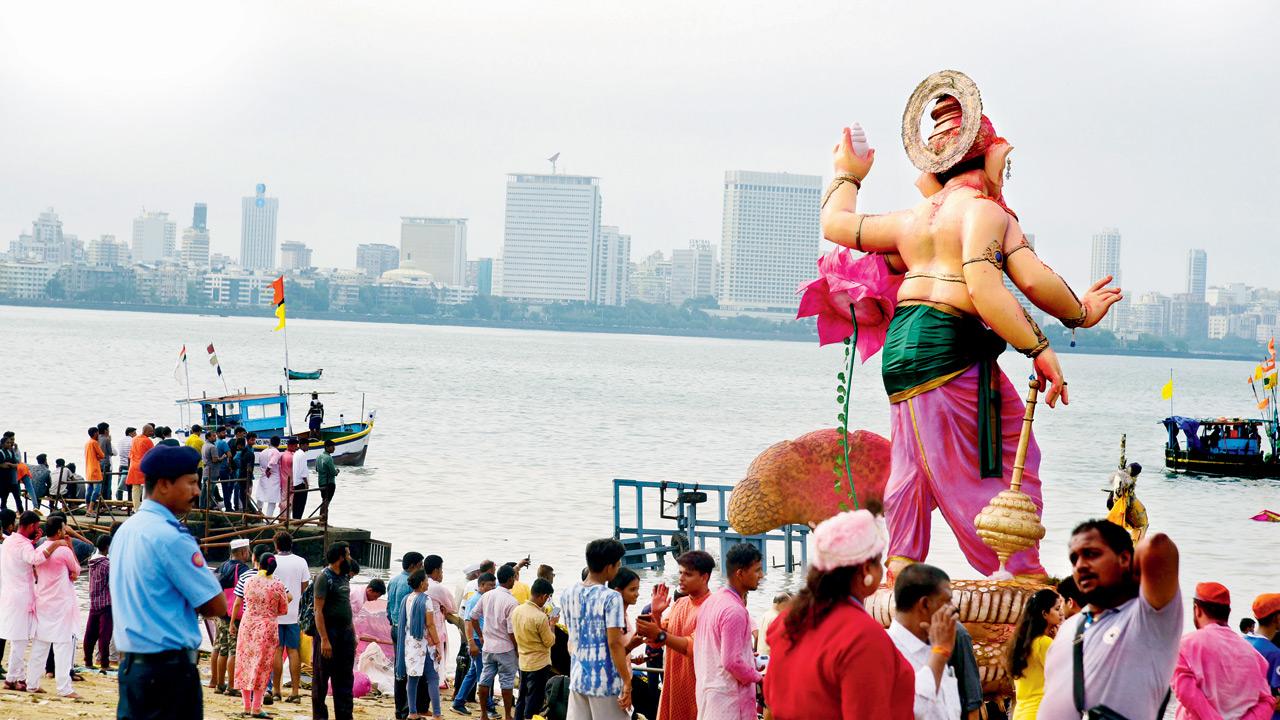
As the High Court rules that Ganpati idols above 6 feet can be immersed into the sea, we ask environmentalists what this means for an already overburdened ecosystem into which we’re dumping tonnes of debris each year

A Ganesha idol is taken for immersion at Chowpatty on the final day of the 10-day Ganesh Chaturthi festival in 2022. FILE PIC/ATUL KAMBLE
In Mumbai one can often forget the meaning of the word rest. And it makes sense that this hustle translates to the city’s biggest festival, Ganesh Chaturthi, when the city literally comes alive as it dances in the worship of the Lord.
The flip side of the coin is the aftermath of this festival. Activists have long argued about the environmental damage caused by the traditional visarjan (immersion) of Ganpati idols into the sea. But last week, as Bombay High Court gave a go-ahead to immersion of idols that are taller than 6 feet to be immersed into the sea, a big part of the city may be celebrating, but another side breathes a sigh of frustration, pondering the ecological damage this will cause.
Historian Sandeep Dahisarkar says, “The story goes that when Lokmanya Tilak saw how Ganpati brought people together in Gwalior, he wanted to revive it in Maharashtra to bring people together.”
Originally, the idols were made of shadu mati or clay, which is “approved by the shastras”, says Dahisarkar. “Mumbai was always a centre for the arts. The revered JJ School of Art was called Bombay School of Art then, and sculptors would come there to learn academic sculpture making and create plaster casts.” Plaster of Paris (PoP) brought a revolution to this art form. It was cheaper, lasted longer, and was easy to mould. “The clay idols were very small. PoP allowed artists to experiment with huge idols. With the background of the freedom struggle, Ganpatis started showing up in the form of freedom fighters like Gandhiji.”
Sandeep Dahisarkar
Ganpati wasn’t always the culture monolith it is today. It was originally a private affair; the sarvajanik celebrations were a later development. “The competition among mandals could be the reason to keep upping the ante [on the scale of idols]. That kind of experimentation, which was more aesthetic in the colonial period, is getting a little bit uglier. For example, if you see now some idols are also getting inspired by Bollywood,” he adds.
The real bustle starts about a month before the festival starts. Stretches of the city are packed with karigars, murtikars, and idol sellers, and the excitement is palpable when we visit Lalbaug to meet some of the murtikars. First stop is at Atharava Ganesh Shilpkala Art. Sidhish Saraonto and Vilas Shekhar have been working at this shop for over two decades. Where Saraonto handles the administrative work, Shekhar is the artist behind their Ganpatis.
“PoP Ganpatis are too easy to make. I could make as many as I wanted to in a day — 15, 20, 30,” says Shekhar. Originally from the Konkan region, Shekhar has been making idols all his life, first at his village, and then in Mumbai. “My brother and I used to make idols together, and he is still there. In my village, they only use shadu mati. But here it isn’t practically possible.”
Saraonto says, “We make 12-foot-tall idols. Clay would take way too long. It would break. Shadu idols are okay for private poojas, but big idols can only be PoP.” Shekhar explains that clay models have to be made with hands and require excellent craftsmanship; a disappearing art. “They take a long time to dry. Only then can they be painted by hand. For PoP, we already have rubber moulds, there’s not much skill required.”
That’s not to say that big idols can’t be eco-friendly. In Chandivli, last year, the Namo Namo Sanghatan was able to put up a 26-foot, entirely recyclable idol made out of tissue paper. This is the tallest recorded eco-friendly Ganpati idol. Sameer Manegaokar has been selling eco-friendly Ganpati idols at Lalbaug for 25 years, at his shop called Morya Kala Kendra. At peak output, Manegaokar is able to sell around 250 idols in a season. When asked why he didn’t switch to selling PoP idols, he says, “I have been doing this for so long, I have the know-how of shadu mati. Plus the people who buy shadu idols don’t even look at PoP idols. Everyone has their own faith.”
Sameer Manegaokar has been selling eco-friendly Ganpatis at Lalbaug for 25 years
Prashant Morey, owner of Kaushik Art, explains that smaller idols are often made of shadu mati. “Ghar mein baithane ke liye shadu hi lete hai. Because you can immerse that at your own home. I myself don’t make idols taller than 3 feet. So most of my sales are from shadu mati idols.” “Ab rakhna padta hai,” he says when asked about PoP idols. “They have become popular now because they are cheaper too.”
Many in this city empathise with the plight of murtikars. One such person is Rohit Joshi, an environmental activist, who has been fighting many cases in the courts regarding this issue. In one Public Interest Litigation of 2024, he brought to light the blatant disregard of Central Pollution Control Board (CPCB) 2020 guidelines in Maharashtra when it comes to the use of PoP in idol making and immersion of Ganesh idols into the sea.
Environmentalist Rohit Joshi with his eco-friendly Ganpati idol at his house in Thane. PIC/ATUL KAMBLE
“I was approached by many clay artisans who ceased making PoP idols since the CPCB guidelines were issued. Because of non-compliance from the authorities, these clay murtikars were making huge losses. So I took them as co-petitioners. We petitioned with nine different clay artisans from nine districts of Maharashtra,” says Joshi.
Joshi has filed petitions before when he found out, through an RTI, that Thane Municipal Corporation was disposing of the debris of Ganesh idols that have been immersed in artificial tanks into Thane creek.
In his research, Joshi has found that, “Ganesh idol immersion is the single largest threat to the flamingos of Thane creek, as stated in the Thane Creek Flamingo Sanctuary Management Plan 2020-21 to 2029-30, by the Mangrove Cell of the Forest Department. Around 6 lakh kg of PoP was dumped into Thane creek alone, last year; 46 lakh kg in the entirety of Mumbai. Our estimate is that around 1 crore kg is going into the sea, in the entirety of Maharashtra.”
A glimpse of the visarjan at Chowpatty in 2023. Around 6 lakh kg of PoP was dumped into Thane creek alone, last year; 46 lakh kg in the entirety of Mumbai. FILE PIC/RANE ASHISH
There is little photographic documentation of just how much debris is collected along the coast as a result of the festival, since photographers are not allowed to take pictures of the beach after visarjan so as to not hurt religious sentiments. The new policy only addresses idols below 6 feet, asking them to adjust to the new guidelines changes. However, mandals with enormous resources who were anyway going to make idols larger that 6 feet are left free. Environmentalists believe this policy change isn’t enough.
“Who is going to enforce it?” questions Stalin D, environmentalist and chief of the NGO Vanashakti, “Who is going to sit and measure the idols? This is merely eyewash.” Carrying the idol and dancing to the sea comprises a large part of the cultural essence of the festival. “It’s the more attractive thing to do than going to a tank for immersion,” says Stalin, “The court order will only encourage smaller idols to go above 6ft and dance all the way to the sea.” Asked why the authorities have only changed policy for idols under 6 feet, leaving mandals free to go as big as they want with their idols, Stalin says, “The authorities don’t want to ruffle any political feathers.”
Stalin Dayanand
With local body polls ahead this year, the festival is a prime issue to woo vote banks in the city. Earlier this year, on May 21, the CPCB also softened its stance on the issue, stating that its guidelines are only advisory in nature. Joshi says, “Current enforcement challenges regarding idol immersion guidelines appear influenced by broader political considerations during election cycles. Municipal governance priorities have reportedly taken precedence over consistent implementation of CPCB’s environmental protocols. This reflects a recurring pattern where short-term electoral objectives inadvertently compromise long-term ecological commitments — a concerning trade-off that deserves greater public deliberation.”
Fort Cha Ichchhapurti Ganesh Mandal boasts a 9-foot-tall Ganesh idol at their pandal. Secretary of the mandal, Rupesh Surve, tells us, “We have always done the visarjan at Chowpatty. Artificial tanks are not big enough for us to fit such a large idol.” “For decades, we have been making big idols, in Khetwadi, in Girgaon, in Lalbaug. Community Ganpatis are at least 9 feet tall. The size of the idol depends on the magnitude of the faith of the person,” adds Surve.
When asked why PoP is the preferred material, he says, “To make such big idols you need PoP. If we made shadu murtis, it would take us two to three months. PoP can be done in under a month. Shadu doesn’t dry in this season because of the rains.”

Rupesh Surve
“For the last few years, there has been talk of not immersing the idols in the sea. But we have always done that. And this year even the High Court has given a go-ahead. Since we were preparing for sea immersion anyway, we won’t have to change anything,” he says, “Immersion tanks seem like a golden solution, but practically it isn’t possible. The idols are too big. The idol doesn’t dissolve into the tanks, so it still needs to be disposed of. I think PoP is the only material that is practically possible. All mandals will have to pay a minimum of four months extra rent if we switch to shadu.”
As Mumbai gears up for another season of grand processions and larger-than-life idols, the High Court’s ruling has once again thrown open the debate between faith and sustainability. Between tradition and tide, Mumbai must now decide how to honour its beloved Bappa without drowning the coastline in the process.
‘Reusing is the key’
What happens once these towering idols meet the waves? This is what marine conservationist Ajay Sawant has to say:
“When you immerse large amounts of PoP, the open ocean may seem unaffected, but the tide pools microhabitats which form a very significant part of Mumbai’s marine ecosystem bear the brunt. PoP does not dissolve, it disintegrates into finer particulate matter that gets ingested by marine organisms. The chemical dyes, many of which contain heavy metals like lead and mercury, enter the food web again.

Ajay Sawant
In Mumbai’s context, local ecosystems like mangroves, already under threat, face additional strain during these emersions. We’re also incurring what’s known as ecological debt — when we overdraw from nature’s ability to recover and replenish the ecosystem services we depend on, like clean air, coastal protection, and oxygen production. Two out of every three breaths we take come from the ocean. That’s the scale of what’s at stake.
Immersion season coincides with the peak spawning period of local fish species like Bombil, Indian mackerel, and Pomfret, which breed in nearshore waters and estuarine zones like Mahim Creek, Versova, and Thane While deeply meaningful, these rituals unintentionally disrupt delicate breeding cycles.
I feel the simplest solution is to reuse these idols over the years. Another effective solution is to have a smaller sculpture of Ganpati made of shadu mati. It might be a little expensive, but it can be immersed every year. Reusing really is the key.”
Policy change
May 2020: Central Pollution Control Board (CPCB) released guidelines banning Plaster of Paris in the making of Ganpati idols
August 2020: BMC clarifies there is no ban on immersion of Ganpati idols into the sea; adds that artificial tanks are just an added service
2024: National Green Tribunal formally asks that idols up to 5 feet in height be immersed in artificial ponds
May 2025: CPCB clarifies that its guidelines are only advisory in nature, not legally enforceable
July 2025: Bombay HC rules that all idols above 6 feet can be immersed into the sea
1 Cr Kg
Amount of PoP estimated to be going into the sea in 2024 from Maharashtra, according to environmentalist Rohit Joshi
45 Feet
Height of 2024’s tallest Ganpati idol, in Khetwadi, Girgaon
Subscribe today by clicking the link and stay updated with the latest news!" Click here!