You heard it here first, folks — the country’s very first gallery dedicated to digital art is set to launch in Worli this year. But is there a big enough market for it in India?

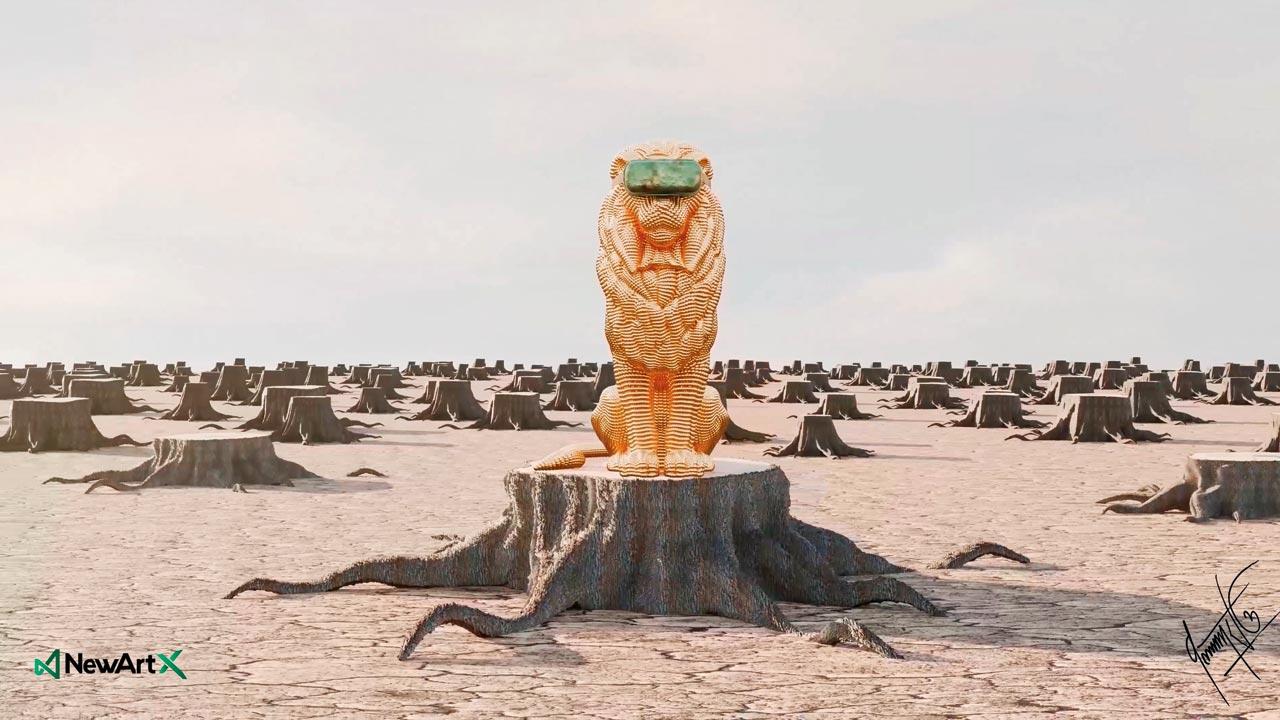
Valay Shende’s untitled digital artwork is based on his metal sculpture of a lion wearing a VR headset. It is a commentary on deforestation. Pic Courtesy/NewArtX
A golden lion sits on a decapitated tree trunk, its eyes obscured by a virtual reality (VR) headset. The whimsical sculpture, crafted in Mumbai-based artist Valay Shende’s signature style by welding metal discs together, is a tongue-in-cheek commentary on how the lion, with its home deforested and destroyed, has no choice but to check out of reality.
The sculpture speaks volumes and, yet, we may never have known what alternate reality the lion chose to tune into had the artist not gone a step further and made a digital adaptation of the artwork. In this 3D-rendered video piece by Shende, we take a peek behind the big cat’s VR fantasy — a green forest, still lush and trilling with birdsong. The video then zooms out to show the lion once again with VR goggles on, sitting in a graveyard of felled trees.
The impact is all the greater because we’re viewing this not on our phone, but on a large, museum-grade screen, framed and mounted like a canvas at the NewArtX studio in Worli, where the country’s very first digital art gallery is set to open later this year.
The NewArtX gallery is currently under renovation and expected to open in November, but the studio gives a glimpse into what art lovers can expect. Pics/Kirti Surve Parade
It’s on hearing the buzz about a new gallery coming up there that we’ve landed at the studio on a rainy July afternoon for confirmation. “We are looking at a November launch, and it will be the first gallery of its kind to showcase digital fine art,” says Suresh Pareek, co-founder and chairman of NewArtX, an online platform and marketplace for digital art, which launched last year.
NewArtX’s three founders: Pulkit Gupta, Suresh Pareek, and Saryu Pareek Gupta
Globally, the digital art movement has taken off in recent years, especially since the COVID-19 pandemic and the rise of NFTs or non-fungible tokens. These are digital tokens that represent ownership of a unique asset — could be art, music, video or other collectibles. It is registered on the blockchain, which provides buyers assurance on the authenticity or provenance of the artwork, while giving artists a way to reach buyers across the world without the need to physically ship their artwork.
“One of the best things about blockchain-backed digital art is that artists can continue to profit from their work through royalties," says Manan Shah, curator at NewArtX, "Each time the artwork is resold, the artist gets a percentage of the amount. With traditional art, this does not happen. Even though art usually increases in value over time and with secondary sales, traditionally, the artist doesn’t get any of it.”
Manan Shah, the curator at NewArtX, is excited about the avenues the digital medium holds for contemporary art
But the question remains, is there a market for this medium?
“Yes!” says Urvi Kothari, South Asian art writer and gallery manager at Tao Art Gallery. “I totally think at a global level digital art has the potential to be a serious art investment avenue. We’re witnessing major art institutions not only acknowledge digital art, but actively collect and exhibit it. For instance, the Museum of Modern Art in New York acquired a set of NFTs from Refik Anadol’s ‘Unsupervised’ series, which uses AI to interpret MoMA’s own collection. The Centre Pompidou in Paris has also added blockchain-based artworks to its permanent collection.”
In India too, particularly in Mumbai and Delhi, there has been a push for digital art in recent years across galleries and art festivals. In this city, younger spaces such as Method and Tao Art Gallery have shone the spotlight on digital artists. In Delhi, the India Art Fair debuted its Digital Artists in Residence programme in 2023, and a year ago, had also featured digital artists in an art pop-up in collaboration with Method Gallery. Art Mumbai 2024 also featured digital artists such as Pune-Berlin based textile kinetic artist Isha Pimpalkhare, who is on Tao’s roster. “At Art Mumbai 2024, I recollect how Pimpalkhare re-coded the rhythm of a kinetic installation all the way from Berlin by connecting to the local network in India… Digital art offers a level of flexibility and immediacy that traditional mediums simply can’t. It’s fast, editable, and easily shareable, which is incredibly empowering — especially for younger artists navigating the Indian art scene.”
Its very nature gives artists an unprecedented flexibility in their work, a way to bridge mediums and formats. "Digital art allows the artist to narrate their message differently, such as things like the passage of time, or the impact of an action," says multi-media artist Gigi Scaria, "In my piece, Phantom Limb, I created a bronze wall sculpture that’s an aerial view of a mountain range, surrounded by bulldozers and trucks that are digging and carrying all the minerals out."
Digital art: Gigi Scaria’s Phantom Limb, digitally produced by NewArtX, expands on the concept of his bronze sculpture
It's a more interactive way to engage with the audience and communicate and idea to them, he says, "especially in these times when social media is taking over every bit of our attention. People are not used to looking at something more than 30 seconds. I appreciate that this is a way to get the younger generation to get interested in art".
For Sam Madhu, an artist who splits her time between Berlin and Bengaluru, the digital medium allows her to connect more meaningfully, both with her South Asian heritage and with her audience on social media. In her current series Reincarnations: Ghosts of a South Asian Past, for instance, Madhu takes inspiration from colonial-era photos of Tamil women and reimagines how they might look in the future, free from the shackles of oppression.
For Sam Madhu, digital art is a way for her to connect to her audience online, as well as her South Asian heritage, with her most recent series reimagining Tamil-origin women from the colonial era in a futuristic avatar. Pic Courtesy/Sam Madhu
“Digital art is more accessible, both to viewers and artists. I grew up online, I've always been an online person. Creating art with digital tools just gives me happiness and allows me to connect with people,” she says.
Sam Madhu
There are pitfalls to it, too, though, such as a very real risk of piracy. “The problem with digital art is once you release an image on the Internet, it doesn’t belong to you anymore; it belongs to anyone looking at it,” she says, adding that she has seen her work be ripped off in the past.
Daytime
Nighttime
Hansika Mangwani’s Softening into reflection (digital work) is a dynamic artwork that changes hues every two hours to capture the ever-changing rhythm of time, from a soft glow at dawn to a slow glow in the late hours
That, though, is why it helps to secure artwork on the blockchain, emphasises NewArtX's Gupta.
Is digital art just a fad then? Or does it have potential? “Ultimately, the medium is secondary. Value comes from the concept, the execution, and the artist’s relevance,” says Kothari from Tao, “Just as photography was once questioned and is now an established collectible, digital art is on a similar path. The institutions are already paying attention — it’s only a matter of time before the market follows more widely.”
Sculpture: Depicting the impact of unchecked quarrying. It depicts miniature trucks and cranes orbiting a mineral-rich mountain, exhausting every inch to extract resources
“Digital, AI-driven, interactive, and immersive works are redefining what we consider ‘fine art,’ but the infrastructure hasn’t fully caught up. We need more platforms, exhibitions, and educational initiatives that not only showcase this work but also demystify it. If we want to encourage experimentation and nurture new voices, awareness and access are key,” she adds.
The need for more awareness is exactly what prompted NewArtX, a virtual platform for digital art, to expand to a physical space where art lovers and buyers can view the art as the artist meant it to be seen — not just on our phones.
As of now, the gallery is under renovation, but to give us an idea of what the experience will be like, Pareek and Shah walk us through the studio, which is like a mini gallery in itself, with digital panels mounted on the walls to showcase art from their roster of artists.
“While the response to the digital art we have on our roster has been overwhelming, some of the feedback we also got was that it was hard for buyers to look at the artwork on their phone or computer screen and gauge how to display it, or how it would look on their wall,” says co-founder Saryu Pareek Gupta, “We’d call them to our studio, and they’d be amazed by how lovely the art looks on the wall. We realised we needed a space to showcase the art.”
Gigi Scaria, Valay Shende, Kaushik Dubey and Urvi Kothari
That’s exactly what happened when Kaushik Desai, managing partner at WSB Real Estate Partners, walked into the studio and laid eyes on Chippa Sudhakar’s piece, Migration. It is a digital adaptation of a canvas artwork, exploring the impact of rapid urbanisation and migration. On the left side of the panel, we see a rural setting — people walking on foot or travelling on bullock carts against an ombre and clay-red backdrop. As people move towards the right, the urban side, they switch to cars and buses, even as the background gives way to a grid-like representation of urban chaos.
Chippa Sudhakar’s Migration, digitally produced by NewArtX, is a commentary on the impact of rapid urbanisation
“I saw it and thought, ‘Wow, that is such a dynamic piece’. I knew it would make a great impression at our office’s reception. Everyone who comes to our office comments on it. For that reason alone, I feel like it has been a good investment. Although I have hope that digital art, too, will rise in valuation in coming years like traditional art,” says Dubey.
Upon purchase, the art can be displayed either on custom-made panels one can purchase from the gallery, or on smart TVs.
Cost is another factor in the medium's favour, says NewArtX co-founder Pulkit Gupta, elaborating, “Take Valay Shende’s work. His sculptures sell for around R50 lakh. But he can make 10-odd digital editions and each of them would instead be sold for R2.5 lakh. It makes art more accessible.”
Shende, the maker of the 3D lion with VR goggles and well-known for his life-size metal sculptures, many of which are themed on Mumbai life such as The Dabbawalas, imagines a future where there are public installations of digital art. “When I was in the US, I remember seeing public installations of screens displaying [British artist] Julian Opie’s artwork [titled Digital Figures] on the streetside. I was so inspired. I thought back to my commute on the highway along Santacruz, where we have so many ad hoardings. What if we could see art there too?”
That said, some in the art world are still sceptical. "I’m not sure how strongly I stand behind NFTs as an artwork in themselves,” says art advisor Teesta Bhandare, “I definitely see more experimental collectors buying digital art. I don’t think it’s part of the mainstream collection journey yet.”
It remains to be seen whether a digital art gallery — pioneering as it is — will change that.
Nov
When the NewArtX gallery in Worli is expected to open
Rs 523 cr
Guinness World Record for most expensive digital artwork sold
Most expensive digital artwork
American graphic designer Beeple aka Mike Winkelmann’s piece, Everydays: The First 5000 Days holds the Guinness World Record for the most expensive digital artwork sold at an auction. The NFT was sold in 2021 by Christies for $69.3 million (about Rs 523 crore as per the foreign exchange rate at the time).
A fresh look at a modern classic
Earlier this month, to mark the 100th birthday of renowned Mumbai artist Krishen Khanna — the last surviving member of the famed Progressive Artists’ Group — SaffronArt held an exhibition in Delhi that also featured a limited-edition digital artwork with an animated version of his most iconic motif, ‘The Bandwallas’ in a lively procession.
Krishen Khanna’s Bandwallahs motif was adapted to a digital version for his 100th birthday. Exhibit by SaffronArt, digitally produced by NewArtX
The artwork was also accompanied by music from an orchestra band playing in the background. The digital adaptation was made in consultation with the artist and his family.
Subscribe today by clicking the link and stay updated with the latest news!" Click here!