shot-button
E-paper E-paper
Home > Sunday Mid Day News > Screamed for a long time The disturbing truth of dowry related violence and death cases in Indias metro cities

‘Screamed for a long time’: The disturbing truth of dowry-related violence and death cases in India's metro cities

Updated on: 31 August,2025 07:27 AM IST  |  Mumbai
Arpika Bhosale | smdmail@mid-day.com

The recent dowry burning case in Noida has shocked us all, and yet activists and experts say it shouldn’t. It’s not an outdated practice that exists only in rural pockets. In metro cities, consumerism has turned it into an insatiable demon satisfied with nothing less than Mercedes, iPhones, or prime real estate

‘Screamed for a long time’: The disturbing truth of dowry-related violence and death cases in India's metro cities

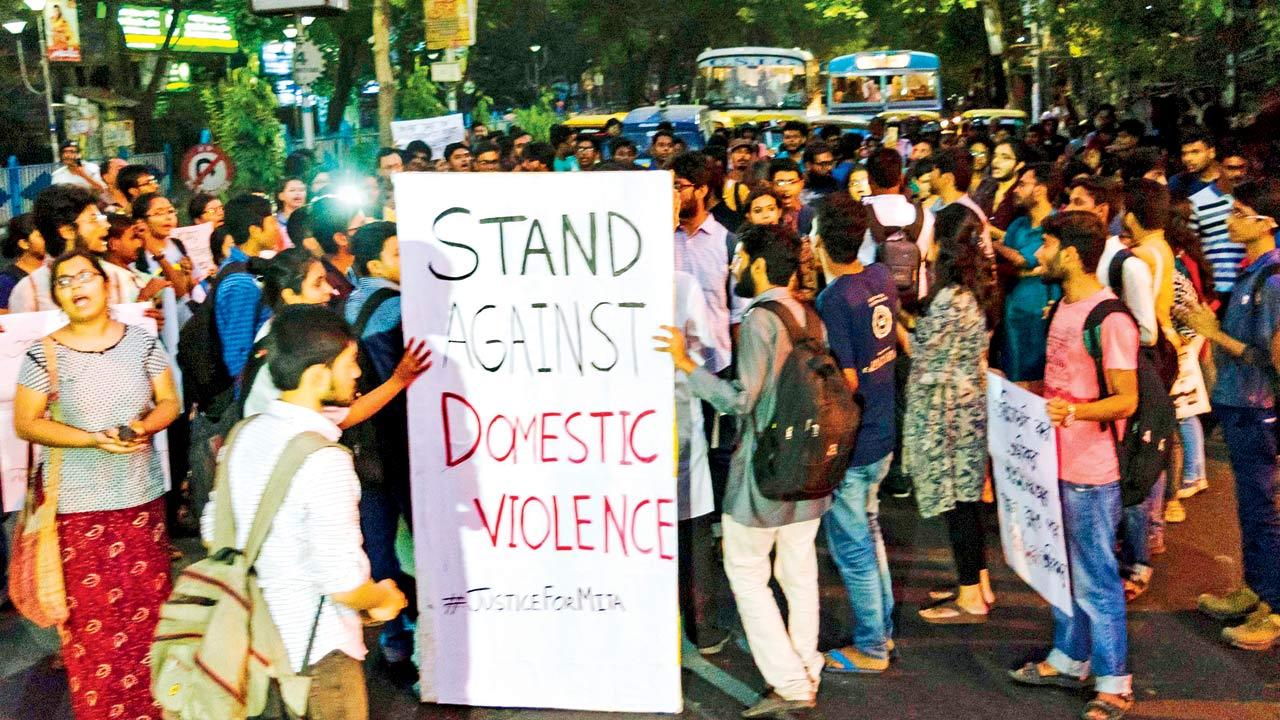
A protest by the students of Jadavpur University against domestic violence after an incident right outside the campus back in 2017. Pic/Getty Images

It was close to New Year’s back in 2012 in the outskirts of Mumbai. Twenty-two-year-old Bhumi (name changed), just a day shy of completing eight months of her pregnancy, was cooking in the kitchen when she felt something wet coat her back.

“I turned around and my husband was standing over me. Before I could react, he lit a match,” Bhumi recounts over a phone call. As she screamed out in pain, her husband, mother-in-law, and father-in-law allegedly backed away and watched. “I felt like I had been screaming for a long time before the neighbours came in and put out the fire on my body,” she says.


Just a little over a year prior to this, in May 2011, Bhumi’s family had paid for the entire wedding, as well as gifts for both sides of the wedding party, and also rented the bus to ferry family members to and from the venue. The problems began when the groom’s wanted more money.


This manifested in everyday aggressions in her marital home. When she was about four months pregnant, she went back to her parents’ home and told them about the harassment, but they told her it was her duty to adjust as the daughter-in-law. Then came the day she was set ablaze in her own kitchen. The trigger? Her sister and maternal aunt had visited, and she had served them vada pav and mithai from her in-laws’ shop. “They didn’t like that I took something from the shop and served it to my side of the family,” she recalls.

But the abuse didn’t end there. Like most dowry victims, Bhumi had faced manipulation and financial abuse by her in-laws, and found herself powerless to even speak up. “I had 75 per cent burns, so I was not in my senses in the beginning,” she recalls. Her in-laws and husband made sure to keep an eye on her and coerced her into silence, claiming that if she didn’t tell the police the truth, they would pay for her treatment as well as the unborn child. “I kept thinking, ‘I need money if my child is hurt. If my child is okay, we need a home to go back to’. So, I told the police it was an accident,” she adds.

Nikki Bhati’s family had been already gifted with a Scorpio and were now asking for Mercedes. REPRESENTATIONAL PIC/ISTOCK

After a fortnight of treatment at the hospital, a doctor and two social workers came to talk to Bhumi. “The doctor came with two women and told me that my baby had died. It was a baby boy,” she says, falling into a long silence. “When they told me that, I felt that there was no point in going back. Back to anyone, anywhere,” she adds, after she regains composure.

One of the two women who broke the news about her baby to Bhumi was Reshma Jagtap, the programme co-ordinator at Mumbai-based Society for Nutrition, Education and Health Action (SNEHA), founded by neonatologists working in gender-based violence against women and children. They have a one-stop centre at Sion and Nair hospitals. “We train those we call ‘change agents’ who train staff in different departments about spotting signs of abuse. Usually, doctors and nurses understand the difference between injuries caused by an accident and those that are inflicted. So when a woman comes in and says that she was injured in an accident, we sensitise and train the nurses, especially in gynaecology, paediatrics, orthopaedics or in the burn ward, about how to approach them,” says Jagtap.

People participating in the world’s longest human chain to create awareness against dowry and child marriage on January 21, 2018 in Patna, Bihar. Representational PIC/GETTY IMAGES

In Bhumi’s case, Jagtap and her colleagues not only helped her lodge a dowry harassment and domestic violence case against her husband and in-laws, but also helped her complete her education so she could support herself. “She finished college and is now a social worker, working with women and children who face what she once did,” she adds. Unfortunately, despite fighting the case for years, her husband was eventually acquitted because of Bhumi’s initial statements absolving the family of any hand in the fire. One may assume that such cases only happen in rural regions, and not in metro cities like Mumbai, where there is greater exposure to education and modern global culture. But it’s merely the nature of the evil that changes.

Shila B Panchangamatha was chopped up and dumped in the Musi river in Hyderabad by husband over dowry demands. PIC/X@feedmileapp

Jagtap points out that Mumbai has not seen many cases of dowry burning — it arouses suspicion too easily. Fuel sources are highly regulated and, therefore, easy to trace. “Instead, we are seeing more cases of women being poisoned, or hanged by the family, presented as suicide,” she says, giving us the chills.

A study — Cause and manner of suspected dowry deaths in a metro city of India — authored by Indrani Dasa and Kanad Bag, looked at a total of 2686 post-mortem examinations in West Bengal, where 32 women had unnatural deaths. The women had been married for under seven years. The study found that 11 had died of burns, 10 of poisoning and eight of hanging, while the remaining three had died of a fall, a traffic accident, and a snake bite. The severity of the social plague feels more tangible when you realise that the National Crime Records Bureau (NCRB) data shows that 35,493 brides were killed in India between 2017 and 2022, which averages to nearly 20 deaths in 24 hours over dowry demands. 

It’s 2025, you might be thinking – sure, dowry is a demon of the past? Data shows though, that far from subsiding, dowry demands seem to have merely become more aspirational in nature. In 2017, Gaurav Chiplunkar from Yale University and Jeffrey Weaver of UC San Diego published a paper called Marriage Markets and the Rise of Dowry in India. The paper examined 74,000 marriages in rural India over the last century to explain how dowry has evolved over time.

It found that the proportion of Indian marriages including dowry payments doubled between 1930 and 1975, and the average real value of payments tripled. The nature of the gifts began to change post 1975, observed the study, with jewellery comprising 91 per cent, kitchen utensils 94.5 per cent, and clothing 95 per cent.

Today, this has become “ghar de do, gaddi de do, branded phone de do,” says advocate Persis Sidhva, director of RATI Foundation, which works with women and children. Increasingly, growing consumerism has led to dowry demands shifting from items of financial assets to white goods like high-end gadgets or cars that can elevate the groom’s status in society.

The practice has become pervasive across religions, she says: “We find the practice prevalent even in communities that never practised it traditionally. When women from those communities approach us for help, they tell me that their community has picked up the custom  because everyone around them is doing it.” And, it never ends. “If the husband demands Rs 10 lakh and the bride’s family gives Rs 5 lakh, the physical, mental, and verbal abuse will continue till the rest of the money is handed over,” says Sidhva. And then, the cycle begins again. “We [society] see only dowry deaths, but there is so much harassment that happens before that,” she adds.

Finally, she points to how women are damned if they do, and damned if they don’t. “We are sympathetic to women when they die due to dowry harassment or other forms of violence. There are a lot of women who suffer for years, but don’t die. When these women file cases and choose to exercise their rights, they are made out to be villains’. So women are either martyrs or villains,” she says.

In a recent case from Noida that has sparked massive outrage over dowry deaths in the country, Nikki Bhati was allegedly burnt alive by her husband, Vipin, reportedly over a demand for a Mercedes or the equivalent of it — R60 lakh. Bhati’s family has also alleged that the day she was burned alive, the couple had fought over a R36 lakh cash demand.

Her family had already given her in-laws two cars — a Scorpio, a Swift Dzire — and 30 tola gold at the time of the wedding. Fresh demands kept coming up during her nine-year marriage, like when Nikki gave birth to her children, when her family again gave her husband a motorcycle and 11 tola gold.

While it will be difficult to do a qualitative study of how consumerism feeds dowry, or vice versa, it’s an unstated fact that “status” is now a big factor, particularly in big cities. Rural India, however, might not be all that brand-aware. 

“There is not enough data on this, but obviously your status will be elevated if you drive a BMW, versus owning three Maruti cars,” says Shweta Wankhede, a criminal lawyer, social scientist, and teacher, “But only somebody who knows the value of that BMW will be able to understand this. And that information comes from a certain exposure, which is probably what’s happening in cities.” 

In the recent alleged dowry deaths of Nikki Bhati in Noida and B Swathi in Hyderabad, both their husbands were unemployed at the time of the tragedy. “In such cases, the onus of maintaining the standard of living and keeping the marriage intact again falls on the woman’s parents. Many of the women are not allowed to work [In Nikki’s case, her husband had objected to her running a salon out of their home]. The parents are obviously going to get tired of giving money continuously  at some point,” adds Wankhede.

Nikki with husband Vipin Bhati

Discourse on dowry is all the more complicated by the fact that many have now taken to comparing it to women claiming alimony after divorce. Wankhede, too, has observed this worrying trend among her law students. “I have come across two instances in the last two academic years where the male student often equated taking dowry to a woman taking alimony,” she says.

Meanwhile, social media is abuzz with reels equating dowry demands with women seeking well-educated, well-earning men. In one such reel, a mother explains why she supports the dowry practice: “Why not?” she says. “You girls want a man that earns well, owns a home and is able to support you, but we mustn’t ask for dowry? Hum toh poochenge!” 

In 2023, amid media reports of cricketer Shikhar Dhawan’s then wife Aesha Mukerji seeking 2.5 million Australian dollars (Rs 13 crores) in alimony, Wankhede was upset not just over the public backlash, but also by a male student’s stand on the case. “I was gobsmacked; all of this information we get about celebrity divorces is from the media. But what are the facts we don’t know in the case?” she recalls, “I had to really break it down to him [the student] how much women give up when they marry. All this without using the words patriarchy and feminism, because they have become triggers and then the point is lost. He did some thinking and he said, ‘I take your point, I should probably read more about this’. And that’s the only thing we can do. Make people read more and question things. But drawing an equivalence between dowry and alimony is a very troubling trend.” While even teachers and lawyers struggle with nuance, Bhumi admits that she is grateful that she is not one of the million statistics thrown around since the incidents have come to light.

“I am so grateful to SNEHA; it was because of their counselling that I came out of the darkest period of my life,” she says. Bhumi never divorced her husband, initially because she didn’t know the procedure, and eventually she just didn’t want to get back in touch with her estranged husband. “It was my kismet, God had other plans for me,” she says, asking to be excused for Ganeshotsav festivities. For here, in her home, Bappa has granted her many blessings — independence, peace of mind, and the chance to help others like her.

‘National shame’

Swarali Marathe, Psychotherapist, Mumbai

Swarali Marathe has seen a lot couples, inlcuding from well-to-do families, where the woman’s body language reveals more than she is letting on during the session. “She might immediately cover it up if the man is challenged in anyway, saying things like ‘He doesn’t do all the time’ or ‘He does help me’.  There is a fear of the fallout she will have to bear if he is challenged during the session,” she says. Even though in-person therapy session are better for getting a read on the dynamics, Marathe, who has switched to almost 100 per cent online sessions, says cues  show up on a screen too. These are equally helpful to gauge how she can go about helping the couple. “Very small things show up on the screen, such as how much spaces the man is taking up, how visible the woman is, or how long she gets to talk, how much he dominates the conversation,” she adds.

Seema Sirohi, Journalist, author of Sita’s Curse (2003)

“Dowry murders are a matter of national shame because they continue with apparent disregard for the law. Shockingly, the capital of India often leads in this horrific crime. While the law has been tightened over the years, conviction rates have stayed alarmingly low because police investigations are slow and often indifferent. Indian society in general doesn’t value women — it hasn’t for centuries, and it still doesn’t.”

In the last 10 days…

August 21, Noida 
Nikki Bhati was allegedly set ablaze in Greater Noida’s Sirsa village by husband Vipin in front of her three- year-old son.

August 22, Jodhpur
Sanju Bishnoi, a school lecturer, set herself on fire along with her three-year-old daughter. While the daughter, Yashasvi, died on the spot, Bishnoi died during treatment. A suicide note claiming she was being harassed by her husband and in-laws for dowry.

August 23, Hyderabad
B Swathi was murdered and dismembered by husband Samala Mahender Reddy. Reddy, who was demanding a dowry, dumped her body parts in the Musi river at Boduppal.

August 27, Bengaluru
Shilpa B Panchangamatha was found dead under suspicious circumstances at her home and was being harassed by husband Praveen and mother-in-law Shantavva for dowry.

"Exciting news! Mid-day is now on WhatsApp Channels Subscribe today by clicking the link and stay updated with the latest news!" Click here!

Did you find this article helpful?

Yes
No

Help us improve further by providing more detailed feedback and stand a chance to win a 3-month e-paper subscription! Click Here

Note: Winners will be selected via a lucky draw.

Help us improve further by providing more detailed feedback and stand a chance to win a 3-month e-paper subscription! Click Here

Note: Winners will be selected via a lucky draw.

women`s safety noida india Sunday Mid-Day

Mid-Day Web Stories

Mid-Day Web Stories

This website uses cookie or similar technologies, to enhance your browsing experience and provide personalised recommendations. By continuing to use our website, you agree to our Privacy Policy and Cookie Policy. OK