shot-button
T20 World Cup 2026 Article Details T20 World Cup 2026 Article Details
Home > Sunday Mid Day News > Valentines Day 2026 When you love an Indian Mumbais beloved mixed race couples reveal how it all began

Valentine's Day 2026 | When you love an Indian: Mumbai's beloved mixed-race couples reveal how it all began

Updated on: 08 February,2026 08:04 AM IST  |  Mumbai
Team SMD |

They are as different in their upbringing, but similar in their passions and approach to artistic life. We spoke to couples who are one half desi and one firangi, and came away with a new understanding of love

Valentine's Day 2026 | When you love an Indian: Mumbai's beloved mixed-race couples reveal how it all began

Karan and Michaela Talwar

Listen to this article
Valentine's Day 2026 | When you love an Indian: Mumbai's beloved mixed-race couples reveal how it all began
x
00:00

‘We manufacture romance’
Dar Gai and Dheer Momaya
Co-founders of Jugaad Motion Pictures

Some love stories begin with a meet-cute. Theirs began with a milonga.


“A very funny story, actually,” says filmmaker Dheer Momaya, “Dar is an incredible Argentinian tango dancer. My uncle claims to be a good one as well, although we’re not that sure,” he jests. What is certain is that the uncle and Dar Gai — Ukrainian filmmaker, theatre director, and now co-founder of Jugaad Motion Pictures — met at a milonga, an Argentinian tango dance party, got talking, and somewhere between steps and conversation, decided that Dar should meet his nephew.


At the time, both Dar and Dheer were finding their footing in cinema. “She was already working in film, teaching screenwriting at Whistling Woods,” Dheer recalls, “I was assisting then. We were both in the early days of our careers.” Their first meeting was professional, almost deceptively so. “She narrated some ideas and I was completely blown away,” he says, “I remember telling a friend I was working with then, ‘I think some day I will marry this girl.’”

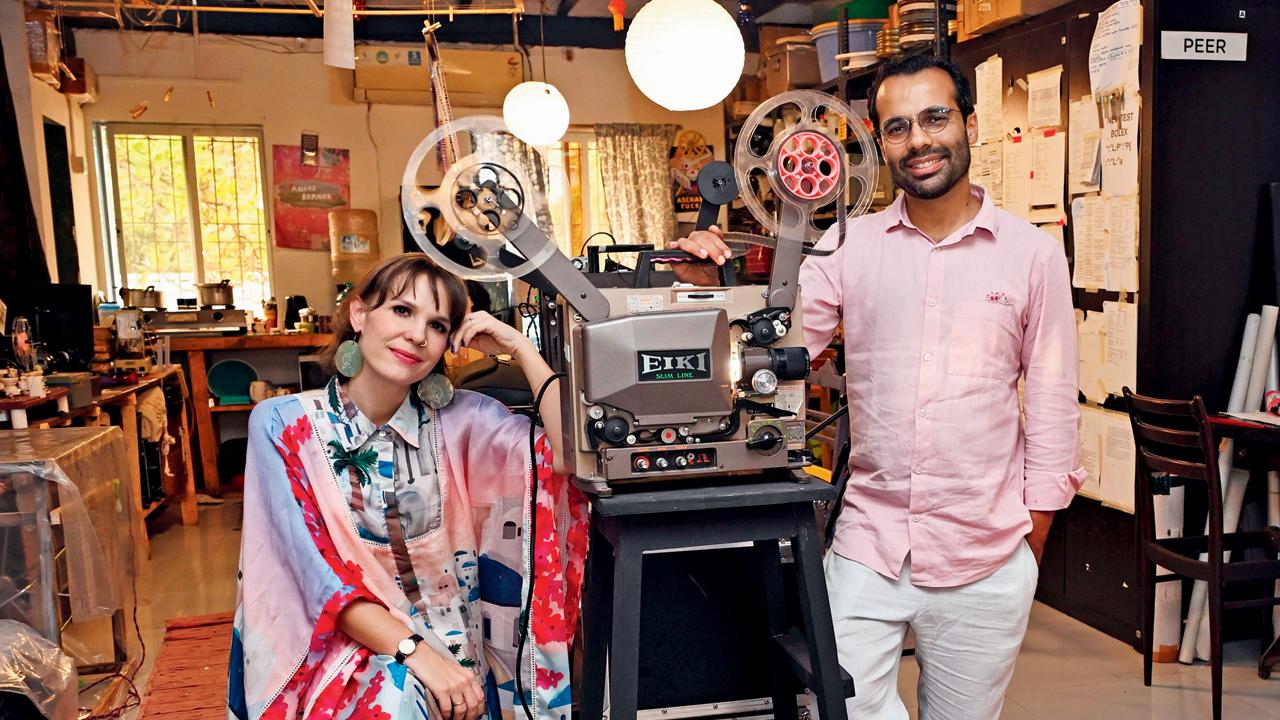
Dar Gai and Dheer Momaya also work together at their production house Jugaad Motion Pictures

Dar laughs when she hears his version. “That’s Dheer’s side of the story,” she says. Hers begins with tango as a hobby and a friendship with his uncle that slowly turned conspiratorial. “He said, ‘My nephew is very smart and he’s also into filmmaking. You should meet him.’ And then everything started.”

Only later did she learn the full truth. “After we got married, he  [the uncle] told me it was actually his plan,” she laughs, “It was almost like an arranged marriage. He just really liked me and wanted me in his family.”

If their meeting feels cinematic, so does Dar’s journey to India. She first came to teach philosophy and direct theatre plays. “I met Anand Mahindra during that time and he really liked my plays,” she says, “He told me I should explore Mumbai. Because of him, I came here. This is how I got to know Indian films, where I started teaching, and then I directed my first feature film.” It was during that first film that she and Dheer began dating. “During my second feature film, we decided we’d get married.”

Ask them about cultural differences and for Dar, they were never as stark as people imagine. “I never felt like a foreigner here,” she says, “Indian and Ukrainian cultures are very similar. We both have deep histories, and most importantly, a love for family.” Having grown up in a joint family, it was almost natural to blend into Dheer’s family. 

“India is obsessed with art and culture. Ukraine is obsessed with art and culture. It felt like an expansion to me.”

And as for Dheer, being a SoBo boy, meeting with Dar gave him a new lens to view the city. “Dar was teaching at Whistling Woods, so suddenly, I was hanging out in MaKaBo a lot,” he jokes. “It gave me a new way to look at the city. Whether you’re coming from Ukraine or Chandigarh, everyone comes to Mumbai dreaming of a flat with a beautiful view,” he says, “And then you open the curtains and see another building. It’s not just adapting to the city, but making the city adapt to you.”

One place where culture did quietly shift was gifting. “Ukrainians are incredible at gifting,” Dheer says, “There’s so much thought behind it. In India, it’s often, ‘Give something expensive and it’s fine.’ I’ve had to learn the art of gifting.” Dar remembers those early misunderstandings vividly. “I would bring gifts for him and his entire family, and he wouldn’t,” she says, “I’d be so angry. I’d be like, ‘Do you not love me?’”

Cut to 12 years later. “My birthday became a five-day celebration,” she says, “It was like a Dar mela. There was a magician, a custom necklace, someone predicting my future. I looked at him and thought, wow, that’s an incredible adaptation to Ukrainian culture.”

They work together, live together, and now parent their child together which means boundaries blur easily. “We’re hardly ever not together,” Dar says, “Even when we’re in the same room, writing or on calls, I still miss him.” Their friction is charmingly mundane. “At the end of the day, he wants to wind down and read. I want to talk — all the time.”

What they’ve learned from each other runs deeper. “She has this spontaneity of creativity,” Dheer says, “The ability to find magic where others see a dead end.” Dar, in turn, has learned patience. “He never rushes to speak. He absorbs people. And he’s taught me to seize the day, not just chase big dreams, but enjoy today.”

The best dates for them happen organically. “We always fight on Valentine’s Day,” Dar says, “It feels forced. Roses, restaurants — we feel awkward.” Dheer laughs, “I’m romantic every day of my life.” Their irony is delicious: they create Valentine’s campaigns for a living. “We manufacture romance,” she says, “So when the world expects us to be romantic, we’re not. But in our everyday life, we are.”

For them, the perfect date is simple. “Being together, reading, discussing our next film,” Dar says. Dheer adds, “We order Smoking Joe’s pizza with extra garlic and chilli, have a beer, wine, or tequila, and watch a film or read. But what we love most is swimming in the sea. We try to spend four or five weeks a year by the ocean, especially at our farmhouse in Alibaug.”

‘Nothing has changed except my last name’
Karan and Michaela Talwar
Married since 10 years with two children

At 7.30 am on January 1, 2012, while most people were nursing hangovers or making lofty New Year resolutions, Karan Talwar opened his door, let a stranger into his house, pointed vaguely at a couch, and went straight back to bed. That stranger was Michaela, now lovingly called “Mika”, co-founder, partner-in-life-and-work, and the only German Karan insists he could ever build a business with. That sleepy, absurd moment was their beginning. “That’s how we met for the first time,” Karan says.

Michaela remembers it as the start of an old-school romance that unfolded not over dating apps, but through letters, time zones, and patience. Falling in love was one thing. Staying in love across cultures was another entirely.

German-origin Michaela was living in Sweden back then. For the first year, their relationship existed almost entirely on paper. “Oddly it was a very traditional courtship. We wrote letters!” she laughs. It was also the year she got her first smartphone, a development she credits only half-jokingly for the survival of their relationship. Letters turned into messages, messages into long-distance conversations, until Karan braved brutal Christmas weather to visit her. But it was a gesture that made her pause and think this might be something real. “The moment where I thought, okay, maybe this could evolve into a relationship beyond writing letters was when he sent me flowers one day while I was at work.”

Michaela moved to India in 2014, and with that came daily negotiations — some big, some small. Food, for instance, became an early battleground. Karan, who grew up in Delhi, cannot wrap his head around Michaela’s comfort with food cooling down. “I love hot food and Mika hates hot food,” he says, still baffled. Michaela counters calmly: steaks and pasta aren’t meant to stay hot forever. “In India, everything is hot all the time,” she notes, half amused, half resigned.

Then there’s the outdoors. Germans, Karan has observed, are deeply committed to hiking — long, uphill walks powered by little more than bread and water. “Why are you doing this to yourself?” he asks. Michaela points out that in Germany, nature is always close. “You can drive to a hike in like 20 minutes.” For Karan, who admits he simply isn’t a hiking person, this difference required acceptance rather than understanding.

Today, the two are married, raising children, and running an alt performance space called Harkat Studios together. It is a setup that sounds romantic in theory and deeply complicated in practice. “The con obviously is that you are together all the time,” Karan says. Work emotions spill into personal life, personal frustrations wander back into the office. “But if you’re comfortable with that then it is what it is. 
What can you do?”

Their German-Indian dynamic plays out sharply at work. Karan jokes that Michaela is the only German he could ever work with. Germans, he says, are methodical, process-oriented, allergic to improvisation. 

There’s no room for jugaad, no skipping steps. “I’ve worked with German clients and they complain,” Karan says. “A lot,” Michaela adds with a laugh, “There is a saying among Germans that if we don’t complain, that’s enough praise.” 

When she first came to India, Michaela admits that living a life where everything — work, love, social life — is interwoven initially felt disorienting. But she now sees it as freedom. “In India, everything is fluid,” she says, “It is more difficult to stay oriented, but it allows you endless possibilities.”

If there’s one place where cultural difference didn’t matter when they moved in together, it was family. Michaela says nothing truly changed after marriage. She knew Karan’s family, felt welcomed, and was included in gatherings as if she had always belonged. “Nothing has changed except my last name,” she laughes.

Somewhere between hot food and cold bread, letters, and WhatsApp, Karan and Michaela have built something rare. A relationship that thrives not despite its differences, but because of them. It’s messy, intertwined, and deeply affectionate. Much like love itself.

‘Get married every 12 years’
Paula McGlynn and Sarang Sathaye  
Co-founders of Marathi YouTube channel Bharatiya Digital Party (BhaDiPa)

Sarang Sathaye, Anusha Nandakumar, and Paula McGlynn began their journey with BhaDipa back in 2016 when the three were tired of the toxic environment on sets, and bad work-life balance. They felt the need to have something of their own. But these founders had something more to their origin story. Other than the camaraderie between the three, Paula and Sarang were, and still are,  very much in love.

Sarang Sathaye and Paula McGlynn, who got married only last year under their favourite tree in the latter’s hometown

“We met in 2012 in Toronto at the Toronto International Film Festival. Paula is from Vancouver, Canada,” says the soft-spoken Sarang, who originally hails from Pune, but moved to Mumbai a few years ago. A year later, Paula was travelling there to meet some of her friends and had worked on the sound for a short film being shown at the festival. Paula chimes in with a sweet voice, “I had to learn Marathi for a role and I also like to learn new cultures. But it’s such a big part of Sarang that it felt like an insight into him,” she says. “I think even though we come from quite different cultures and habits, a big part of our personality is that we are creative so it helps,” she adds. “Well, I froze,” he adds. “I was from Pune, I knew English but hardly spoke it. I didn’t know how to speak to this Canadian girl,” he says, his voice filling with laughter as he recalls the first meeting. “Then, she was on my turf,” he adds.

Jokes aside, Paula admits that the reason she was drawn to Sarang was because while the teasing continued, he never made her feel uncomfortable. “Sarang was actually one of the only guys on the set who was not obsessed with me being a foreigner and wanting to take me out on dates. So, I felt comfortable talking to him and wanted to open up to him,” she says. “As a result, the trust was established and eventually feelings happened,” she adds. 

The couple finally tied the knot last year in a non-denominational ceremony in Vancouver in a place called Deep Cove that Sarang fell in love with.  The couple also used it as an incentive to get Sarang’s mother who had had an accident to work on her recovery so she could fly for the ceremony. “We thought this could be a good sort of inspiration for her to get up and off the bed,” he says.  Working together and living together does get intense, admits Sarang, “But when it comes to functioning at workplaces, we have two completely different ways of doing it. Paula is all prep, knowing everything, having clarity, process-oriented, and I am very instinctive,” says Sarang, which seems to be the energy the couple gives out. Paula is measured in the way she speaks, while Sarang goes with the flow but doesn’t rush either. 
The vibes are a match. It’s not like there aren’t creative clashes at all, though. “There are times when we get into fights and they are nasty fights, but they get resolved the same day,” he says. “Yes I agree, I think Sarang said it well,” adds Paula. Their advice for those actively working on bettering their married life is to “get married every 12 years”, jokes Paula. “No, but on a serious note, what we have tried to do is get away for each other’s birthdays, even if it’s for two days, to keep the romance alive,” says Sarang. 

And what changed after marrying an Indian? “The only thing that has changed is that we can now go to the immigration counter at the airport together!” Paula says. “I hope it will make finding a house to rent easier in the future as well. However, it has only been a few months so the only real difference is that I frequently get asked about how it is to be married! I’m glad there hasn’t been any change. The goal behind getting married wasn’t to prove our commitment — that we were confident about. It was mainly to make life a little easier.” 

We hope this couple stays curious and loving and, yes, gets married every 12 years! 

‘Food first, talk later’
Seefah Ketchaiyo and Karan Bane, Chefs and Co-Owners, Seeran Hospitality

Fifteen years ago, sparks flew in the kitchens of a popular five-star hotel in Worli. Seefah Ketchaiyo, originally from Bangkok, had moved to Mumbai in 2011 to work at the hotel’s Asian kitchen. It was a big leap from home and the early days were not easy. A new city, a new pace, a new food culture all demanded adjustment.

“Somewhere between long workdays and shared meals, it stopped feeling like just work and started feeling like us,” says Seefah. Their first real conversation, Karan remembers, was “about food, work, and life. Nothing fancy, just the kind of talk that made us think, okay, this person gets me”.

For the first three years, convincing Karan’s parents took patience. “After my parents saw how well we worked together, they finally understood that this relationship was good for us,” he explains.

For Seefah, with marriage, “food got spicier, family got bigger and life got louder, but in the best way. It taught me patience, humour and how to adjust without losing myself,” says Seefah, for whom food has always been more than work. It is comfort, tradition, and memory. Karan supported her in the kitchen, and he cooks for her at home too, knowing exactly what she likes and what cheers her up on hard days. 

From Seefah learning to love butter chicken and mastering doodh-chai for Karan, to him wooing her with his skills in Thai and Japanese cuisine, food has remained their love language. Even today, the small ritual that feels most special is asking, “Did you eat?” every single day. 

Marriage didn’t blur work; it actually made roles clearer. “At work, we stay professional, direct, and focused on the food. At home, we switch off and talk like partners, not chefs. When things feel heavy, they take short trips together. The break helps them reset and reconnect. Karan’s calm, honest, and steady nature, she says, has been the cornerstone of their relationship, especially when they are building both a life and a business together.

In their love life, Seefah tells us how easy it is for them to laugh after a chaotic service. “Because teamwork is better than ego. And we’re better on the same side,” says Karan. From the carefree days of working in restaurant kitchens to the added pressures of running a business, being together has changed how they see the future. “Now it’s not just ‘me’ plans. It’s ‘we’ plans,” he smiles.

Seefah adds, “We listen more. We argue less [most days]. We eat better food.” On difficult days, they support each other with a simple rule. “Food first. Talk later. Sometimes silence is enough,” she says.

Together, they are excited to build good food, a strong team, and a life that still feels fun. What should never change, says Karan, “is respect, laughter, and being able to be ourselves, even on messy days”. What is brave, we ask? “Choosing each other knowing life would stay busy,” Seefah signs off.

‘We forgive each other very quickly’
Pratima ‘Mickee’ Tuljapurkar and Manuel Olveira, Founders, La Loca Maria

From their very first meeting at the Elbo Room on March 21, 2014, Pratima “Mickee” Tuljapurkar had a gut feeling about Chef Manuel Olveira, who had been living in Mumbai since 2012 and working with Michelin-starred chef Sergi Arola at Arola in Juhu. “I just knew. Manuel took a little longer — he is five years younger, after all — so I waited for him to catch up,” she smiles.

“For me, it was a trip to Goa,” says Manuel. “Away from work and routine, it suddenly felt obvious. Being with her was easy and fun, chaotic, and that’s when I knew it wasn’t just a phase.”

They married in 2016, celebrating in both Mumbai and Toledo, Spain, blending cultures as seamlessly as the cuisines they would later champion together. “Marrying an Indian introduced me to a completely different way of living, where you don’t wait for things to be perfect, you just make them work. That whole jugaad mindset changed me. There’s always a solution, always a workaround, always a way forward,” says Manuel.

“I think there comes a point where you are of a certain age with a person you love, the concept of marriage is something you actually think of,  chalo, should we? I think for both of us it was basically us asking, ‘Should we get carried away or not?’ There were a lot of practical things on the table, like the age difference, his being Spanish, my being Indian, our different lives and worlds. It felt grown-up, honest, genuine,” says Pratima.

After the wedding, they moved first to Abu Dhabi, where Manuel was Chef de Cuisine at The St Regis, then to the Ritz-Carlton in Dubai, before finally opening La Loca Maria in 2019, named in homage to his mother. It was Pratima who encouraged him to finally act on a long-held dream of opening a restaurant rooted in his heritage and creative voice.

“No matter what’s happening, she shows up, takes charge, and keeps things moving. Life here taught me flexibility. Plans change, systems fail, things don’t arrive on time, and yet somehow everything still comes together,” says Manuel.

“Love felt brave when we decided not to have kids. It was a big, honest choice, one that required clarity and complete trust in each other,” she admits.

“Working together means we don’t always agree, but we always come back to each other. And that’s the easy part,” he says.

What makes them choose each other, again and again, is driving each other crazy, sometimes literally. With the kind of lives they lead, love has become practical in the best ways: respect, patience, and reliability matter more than grand gestures.

“We don’t pretend we have it all figured out; we figure it out together,” says Manuel.

On holding space for each other during difficult days, Pratima says it’s about being the calm one — ‘this too shall pass’ vibes.

“Our shared need for order. It’s a small thing, but it makes home feel peaceful,” he adds.

A quiet, unglamorous moment that sums up their relationship best? “Late nights after service, tired but content, sharing food, talking about the day, planning tomorrow. Nothing flashy. Just real life, shared,” she says.

Marrying ‘Mickee’ has softened Manuel. “There’s an openness to emotion, care, worry, celebration that’s very real.  Love here isn’t quiet or distant; it shows up constantly, in check-ins, food, advice, concern,” he adds. 

And what they hope never changes? “How quickly we say sorry, forgive each other, and move on,” says Manuel.

Story by Akshita Maheshwari, Arpika Bhosale, Tanisha Banerjee and Nasrin Modak Siddiqi

"Exciting news! Mid-day is now on WhatsApp Channels Subscribe today by clicking the link and stay updated with the latest news!" Click here!

Did you find this article helpful?

Yes
No

Help us improve further by providing more detailed feedback and stand a chance to win a 3-month e-paper subscription! Click Here

Note: Winners will be selected via a lucky draw.

Help us improve further by providing more detailed feedback and stand a chance to win a 3-month e-paper subscription! Click Here

Note: Winners will be selected via a lucky draw.

mumbai Valentine`s Day culture news Lifestyle news indian food Arts and culture

Mid-Day Web Stories

Mid-Day Web Stories

This website uses cookie or similar technologies, to enhance your browsing experience and provide personalised recommendations. By continuing to use our website, you agree to our Privacy Policy and Cookie Policy. OK