shot-button
E-paper E-paper
Home > Mumbai > Mumbai News > Article > 2008 Malegaon blast case Justice denied twice over

2008 Malegaon blast case: Justice denied, twice over

Updated on: 01 August,2025 09:07 AM IST  |  Mumbai
Vinod Kumar Menon | vinodm@mid-day.com

Bomb blast acquittals in Malegaon and Mumbai raise serious questions on failed investigations, shattered victims, and India’s broken justice system

2008 Malegaon blast case: Justice denied, twice over

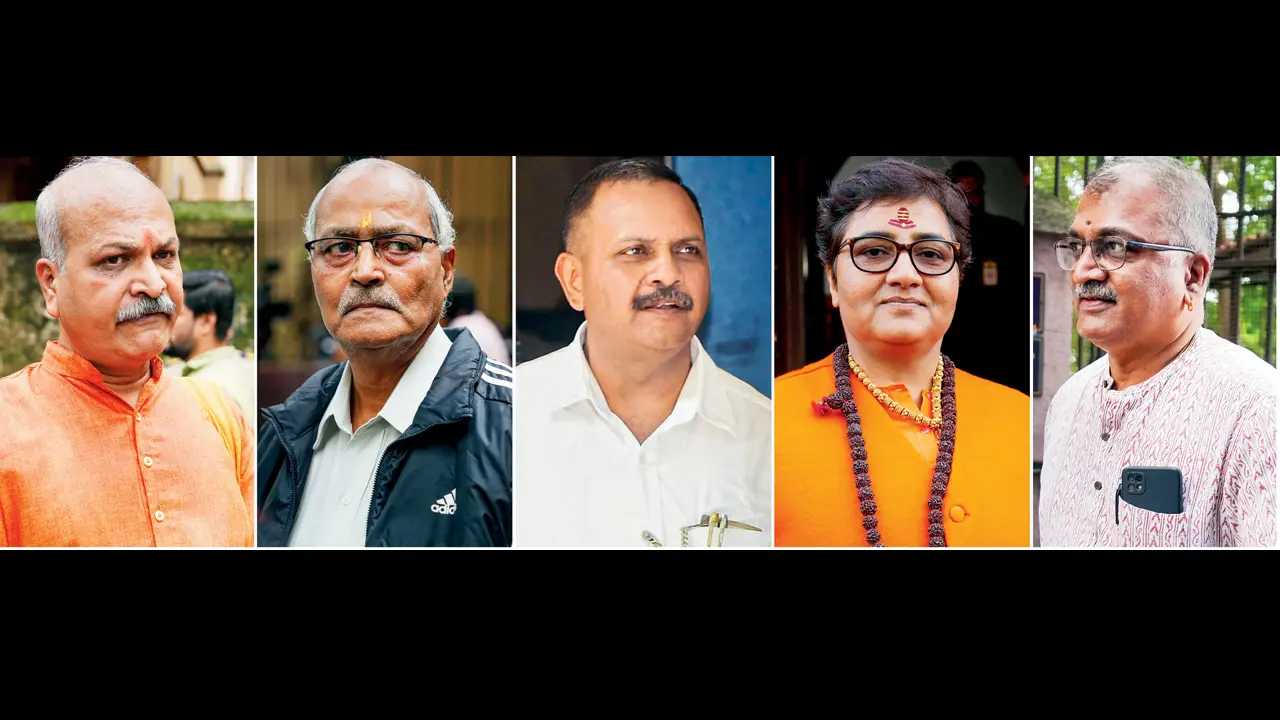
This combo image shows five of the seven accused including, from left, Sameer Kulkarni, Major (retired) Ramesh Upadhyay, Lt Col Prasad Purohit, former BJP MP Pragya Singh Thakur and Ajay Rahirkar, who were acquitted by a special court in the September 2008 Malegaon blast case, in Mumbai on Thursday. Pic/PTI

In a span of just ten days, two of India’s most significant bomb blast cases, the 2006 Mumbai train blasts and the 2008 Malegaon bombing, have ended with complete acquittals. Legal experts, human rights defenders, and policy commentators are sounding the alarm on the state of India’s anti-terror jurisprudence.

Malegaon Bomb Blast | Verdict: July 31, 2025
Incident: September 29, 2008 — Blast killed 6 and injured 100.
Accused: 7 individuals
Verdict: All acquitted by the Special NIA Court, Mumbai.
Court observation: Invalid UAPA sanctions, serious investigative lapses, absence of crucial evidence, and inconclusive forensics.


7/11 Mumbai Train Blasts | Verdict: July 21, 2025
Incident: July 11, 2006 — Bombs on local trains killed 187 and injured over 824.
Accused: 12 men; 5 sentenced to death, 7 to life in 2015
Bombay High Court verdict: All 7 with life terms acquitted; prosecution "utterly failed" to prove charges.


What these acquittals reveal

Experts say the verdicts signal a crisis of justice — both for the wrongfully accused and the victims still waiting for closure.

Ajay Rahalkar, an accused in the blast case, at the Mumbai Session court on Thursday. PIC/PTI

The recent acquittals in two major bomb blast cases, by the Bombay High Court (7/11 blasts) and the Special NIA Court (Malegaon blasts), have reignited a long-standing debate on the failure of India’s criminal justice system.

“Both investigation and prosecution agencies have failed the victims. With no one held accountable for the deaths of hundreds, these cases risk becoming just more statistics in India’s poor terror conviction record,” said Venkatesh Nayak, director, Commonwealth Human Rights Initiative (CHRI). “The government must act quickly to ensure accountability.”

Ignored Supreme Court directive

In State of Gujarat vs Kishanbhai (2014), the Supreme Court had directed states to review all acquittals to identify failures and initiate action against negligent officers or prosecutors.

“RTI findings show most states have ignored this directive. The Malegaon and 7/11 verdicts make it urgent to revisit these reviews,” Nayak added.

Fix the system, don’t abandon it

“Some may now demand we switch from an adversarial to an inquisitorial system like in France. But rather than reacting impulsively, we need to address flaws within our current system. Presumption of innocence remains a vital safeguard,” he said.

On malicious prosecution

“Acquitted individuals can seek redress. The ISRO spy case is a precedent; Nambi Narayanan was awarded R50 lakh plus R1.3 crore in compensation and a court-ordered probe. Similar steps should follow once all appeals are over,” Nayak concluded.

Mohini Priya, advocate-on-record, Supreme Court
 
When acquittal feels like tragedy

“These aren’t just legal verdicts; they are human tragedies. Innocents spend over a decade in jail due to weak evidence, shoddy probes, and procedural lapses. Who protects them? Who’s held accountable when justice is neither done nor seen to be done?”

A crisis of civil liberties

“Laws like UAPA, meant for national security, are often misused. The burden of proof shifts unfairly, hitting marginalised communities hardest and eroding public trust,” she said.

Victims get no closure

“Acquittals also fail victims. When the real culprits remain unknown, families get no justice. The trauma continues, and faith in the system collapses.”

Way forward

Priya recommends:
•         Independent review of failed cases
•         Advanced training for investigators
•         Statutory compensation for the wrongfully accused
•         Accountability for fabricated or suppressed evidence

“Justice must protect the innocent and punish the guilty. That requires bold institutional reform—not just legal fixes,” she said.

Stuti Galiya, solicitor

Constitutional promise vs ground reality

“Article 21 guarantees liberty and a fair trial. But flaws in our system often punish innocents while real offenders go free, undermining public safety and trust,” said Stuti.

Cost of wrongful conviction

“Wrongful conviction isn’t just a legal mistake; it wrecks lives. People lose years, relationships, careers. India has no clear law for compensation. Relief is rare and inconsistent. In contrast, the US, UK, and Germany offer monetary and psychological support.”

Justice delayed, justice denied

“For victims, acquittals after long delays rarely offer closure. Evidence vanishes, witnesses disappear, and retrials, where allowed, are often meaningless.”

Urgent reforms

Stuti’s recommendations:
•         Fast-track trials
•         Retrials if new evidence surfaces
•         Codified compensation law
•         An independent criminal review commission

“Without these, the justice system will not just fail, it will betray,” she warned.

Suhas Chakma, director, Rights & Risks Analysis Group

Chronically delayed, Constitutionally unjust

“Justice is being derailed by delay. India has just 21 judges per million people, well below the Supreme Court’s 2007 mandate of 50. Victims and innocents both suffer,” said Chakma.

Overburdened and undertrained

“Investigating agencies are understaffed, undertrained, underfunded, and vulnerable to external pressure. Without serious investment in the justice system, miscarriages will continue.”

“India must also compensate victims of failed justice, not just the accused,” he concluded.

"Exciting news! Mid-day is now on WhatsApp Channels Subscribe today by clicking the link and stay updated with the latest news!" Click here!

Did you find this article helpful?

Yes
No

Help us improve further by providing more detailed feedback and stand a chance to win a 3-month e-paper subscription! Click Here

Note: Winners will be selected via a lucky draw.

Help us improve further by providing more detailed feedback and stand a chance to win a 3-month e-paper subscription! Click Here

Note: Winners will be selected via a lucky draw.

malegaon mumbai police bombay high court sadhvi pragya singh thakur mumbai mumbai news

Mid-Day Web Stories

Mid-Day Web Stories

This website uses cookie or similar technologies, to enhance your browsing experience and provide personalised recommendations. By continuing to use our website, you agree to our Privacy Policy and Cookie Policy. OK