Chief Minister Devendra Fadnavis maintained that the issue had been resolved constitutionally and would stand in a court of law. Responding to warnings issued by OBC leaders, he said, “We have not touched the OBC reservation quota. So, I do not see any reason for OBC leaders to continue their chain hunger strike”

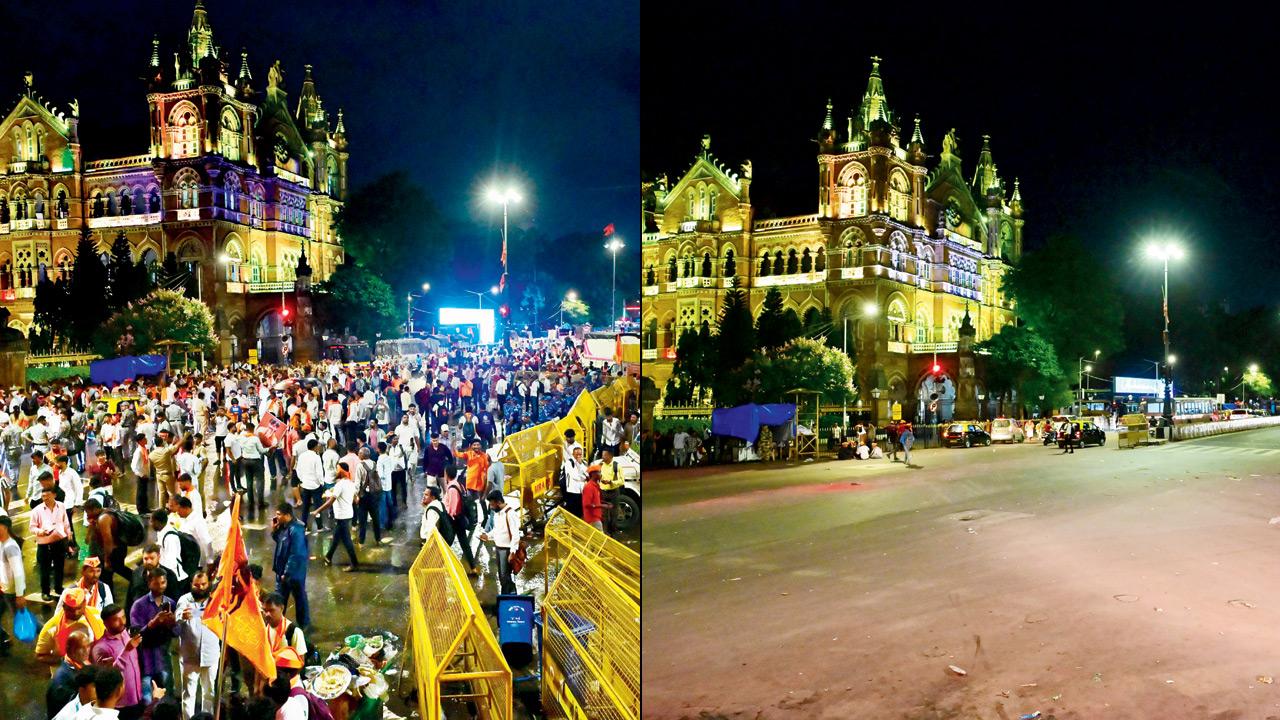
The spot that was crowded on Monday (far left) was cleared on Tuesday within hours of the court ordering protesters to vacate the area and the government issuing a GR on the Maratha quota issue. PICS/SHADAB KHAN
On Tuesday, the Maharashtra government accepted most of the demands of Maratha quota activists, but its real test will be in court, where it must justify the move and pacify the upset Other Backward Classes (OBC) community. OBC leaders have long pointed to past court observations and rulings that went against extending reservations to any community in this manner.
Chief Minister Devendra Fadnavis maintained that the issue had been resolved constitutionally and would stand in a court of law. Responding to warnings issued by OBC leaders, he said, “We have not touched the OBC reservation quota. So, I do not see any reason for OBC leaders to continue their chain hunger strike.” On Monday, senior NCP (Ajit Pawar faction) leader Chhagan Bhujbal argued that the Hyderabad Gazette cannot be the sole basis to issue caste certificates to the Maratha community, warning that he would challenge any such decision.

Maratha quota activist Manoj Jarange Patil addresses supporters as he ends his hunger strike after the Maharashtra government accepted most of his demands. Pic/Sayyed Sameer Abedi
Fadnavis, meanwhile, brushed aside personal criticism in recent days, saying, “I will keep working for all communities — it is my duty. While working, one is sometimes at the receiving end and sometimes praised.” He also expressed satisfaction with the outcome, noting that the decision was framed to ensure “only genuine Marathas will get the benefit.”
The breakthrough came on the fifth day of activist Manoj Jarange’s indefinite hunger strike, when cabinet sub-committee head Radhakrishna Vikhe-Patil, along with other ministers, handed over the Government Resolution (GR) to Maratha leaders at Azad Maidan. After his legal team and community intellectuals studied the GR, Jarange called off the agitation, asking protesters to disperse. “If the government betrays us, we will not allow any minister to visit villages in Maharashtra,” he warned.
Laxman Hake, an OBC leader, told a regional news channel that the decision would certainly affect their reservation and have wider repercussions on society. Hake, known for his strong opposition to Maratha quota activists and campaigner Manoj Jarange, has been a prominent voice in the OBC movement.

Protesters celebrate after the state government hands over the Government Resolution. Pic/Atul Kamble
Jarange had launched this indefinite agitation on August 29 at Azad Maidan, demanding OBC quota for Marathas. His first protest dates back to 2023 at Antarwali Sarati in Jalna. This was his eighth such agitation. The new GR states that the Hyderabad Gazette will be implemented immediately, while the Satara Gazette will follow within a month.
The gazettes
During the British era, many Marathas were recorded as Kunbis in princely and colonial records such as the Hyderabad, Bombay, Satara, and Aundh Gazettes. The Hyderabad Gazette of 1918, issued by the Nizam’s government, had granted “Hindu Marathas” reservations in education and jobs, citing that they were being left out despite being a majority. This document has since become the community’s strongest basis for reservation claims.
Are Marathas, Kunbis same?
The government is yet to decide on this contentious question, with nearly 8 lakh objections received so far. Meanwhile, it has agreed to withdraw all police cases against Maratha protesters, provide financial aid, and offer jobs to families of those who lost their lives in the agitation. The Shinde committee, formed last year to establish Marathas as Kunbi OBCs and create a system to issue certificates, has been asked to expedite its work.
Jarange warns govt
Jarange reminded the government of his previous 2024 protest at Navi Mumbai, warning that he would launch fresh agitations if promises were broken. “Vikhe-Patil saheb, I trust you. But if assurances are not fulfilled, I will protest at your house in Ahilyanagar. It will be much easier than starting an agitation in Mumbai,” he quipped.
He also demanded that Fadnavis and his two deputies, Ajit Pawar and Eknath Shinde, come to the protest site, saying, “There has been bitterness between the community and the CM. If he comes, it will help end it.”
Vikhe-Patil assured Jarange that certificates would be issued soon and the ceremony could be done at the hands of the CM and his deputies, and said, “Trust me, the government will keep its promise. You are always welcome at my home, but for good reasons, and time will not come for any agitations.”
Before leaving the protest stage, Jarange vowed to continue fighting for any Marathas left out of the process. “I have not given up. If needed, I will fight for every region,” he said. Declaring the protest a historic win, he added, “Marathas came to Mumbai, conquered it, and achieved what we were fighting for. It is the biggest achievement for our community.”
CM apologises to Mumbaikars
Chief Minister Devendra Fadnavis apologised to Mumbai citizens for the inconvenience caused by the week-long protest. “For nearly a week, people faced trouble. I extend my apologies,” he said. He also assured that the government would comply fully with court’s observations on the matter.
‘Due to chaos, witnesses didn’t attend, no new applications were entertained, and genuine litigants suffered. Even though courts remained open, staff shortages delayed judgments. The canteen was shut too. No real purpose was served’
Sunil Pandey, Esplanade Court (Killa Court) staff
‘For five days, we’ve cleaned the CSMT protest site, collecting over 125 tonnes of garbage — mostly wet waste and bottles. Nearly 150 sanitation staff are working in shifts’
Deepak Denghle, BMC Ghatkopar N Ward
‘The protests created serious difficulties for Mumbai’s working-class citizens. The agitation made commuting almost impossible. Trains, buses, and daily travel have all turned into a struggle. The real suffering is borne by Mumbaikars, while the agitators seem unaffected. We respect and support the demands, but protests must be conducted in a way that does not trouble ordinary people’
Sushil Tandel, Dombivli
‘I collected 30 kg of plastic bottles in one morning and nearly 300 kg over five days. Selling them has been like winning a lottery for me’
Salim Shaikh, Scrap Dealer
Subscribe today by clicking the link and stay updated with the latest news!" Click here!