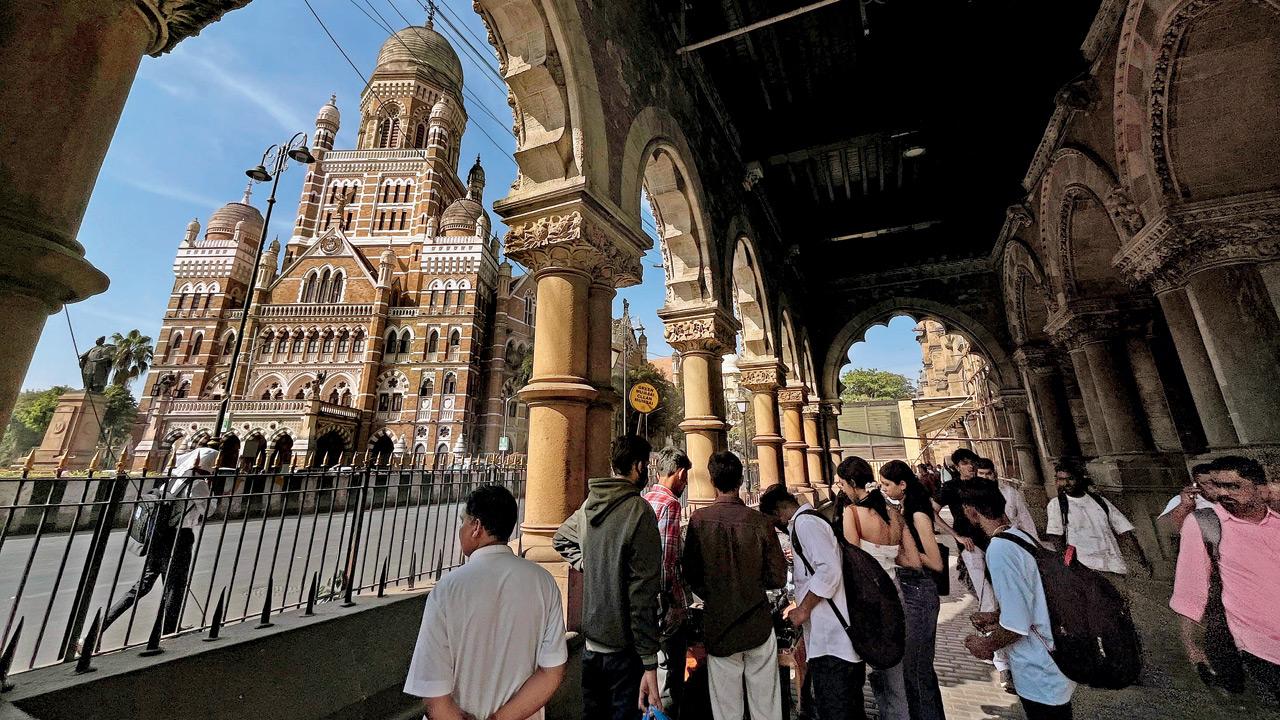
The city - sliced, diced and served with a dash of sauce

PHOTO/ATUL KAMBLE
A things of beauty
A majestic view of the Brihanmumbai Municipal Corporation Building, from the columns of the Chhatrapati Shivaji Terminus at the junction of Dadabhai Naoroji Road and Mahapalika Marg
Mumbai’s water tankers turn into art

The exhibit Seen Unseen showcases water tankers as works of art
Mumbai’s water tankers aren’t usually the kind of city characters that make it to gallery walls. But at 47A Design Gallery in Khotachiwadi, artist Zainab Tambawala turns these giants into protagonists. The exhibit Seen Unseen showcases these tankers along with handcarts, workers, and bus-stop silences into works of art. “I love to look for patterns and stories, and I kept seeing the water tanker. It had suddenly become part of the landscape, increasing in number. For me, they became an element that needed a closer look,” Tambawala told us.
Not your normal love story

Set in rural Rajasthan, Dohri Zindagi is a play adapted from Padmashri Vijaydaan Detha’s story, Bijji
Neha Singh from Why Loiter has adapted and devised a play based on a short story “Dohri Zindagi” by Padmashri Vijaydaan Detha “Bijji”. Narrating a unique queer love story, the theatre producer, director, playwright and actor explains how she was inspired by the story when she read it in 2011. “Back then, the theatre space was heavily male-dominated and there was no representation of lesbian love on stage. I was enamoured by the fluidity of love and sexuality in Bijji’s story,” Singh says. So she set to work producing, acting and making the story come alive on stage. The play opened in 2016 for the first time at the Gender Bender festival in Bangalore and had its first show of 2026 on 2nd January at Rangshila theatre in Andheri. “ It was our 75th show that we performed this week, and we have many more shows all over the country in Goa, Ahmedabad, Bangalore, Pune and so on,” she mentions. A tale of queer love set in rural Rajasthan, the play travels through love, betrayal and questions the bounds of sexuality.
This play doesn’t play around

Eden Creek, Bengal, an adaptation of Dwight Watson’s American play Eden Creek, comes back to theatres on January 10 after a warmly received run at the Prithvi Festival last November. Set in pre-Partition Bengal against the Great Famine and the freedom struggle, the play traces the intertwined lives of five women living along the Hooghly’s tributaries.

Kaizaad Kotwal, (R) Mahabanoo Mody-Kotwal
“The best compliment we got was that audiences didn’t realise it was adapted. They thought it was a genuinely Indian story,” says co-director Kaizaad Kotwal. The play revisits a production first staged privately in 1988 by his mother and co-director, Mahabanoo Mody-Kotwal. “This play is for anybody who has a mother or is a mother,” he laughs.
Rock ‘n’ roll whizzing in

The 1928 Rolls-Royce Phantom I – Chassis 17EX
One of the most iconic pre-War Rolls-Royces in the world, the 1928 Phantom I, Chassis 17EX, is all set to roll into Mumbai on January 25 at the VCCCI Annual Vintage Car Fiesta 2026 at the World Trade Centre in Cuffe in Mumbai. The Rolls represents the pinnacle of Indian royal motoring heritage. The car (sacrilege to call it just a car) has been showcased at the world’s most prestigious events, including Pebble Beach, Villa d’Este, Salon Rétromobile (Paris), Balatonfüred, and Chantilly Arts & Elegance. The car’s desi connection is fascinating. We learn that it had been sold just before Christmas in 1928 to Maharaja Hari Singh Bahadur of Jammu & Kashmir. The Kashmir princely family alone acquired at least 26 Rolls-Royce motor cars. Nitin Dossa, chairman VCCCI said, “this is a moment of immense pride for Indian automotive enthusiasts. Chassis 17EX will be showcased in India for the very first time. This historic appearance marks a significant milestone, not just for vintage car aficionados but for history buffs too. It is about bringing home a powerful symbol of India’s princely past.” It is not just a car but royalty, history and legacy on wheels.
Vintage bats make us nostalgic

Dilip Vengsarkar using a Symonds bat in 1981-82
One gets to see all kinds of cricket characters on Facebook. One such person is Stratis Comino, a bat connoisseur. Recently, Comino put out his first XI of cricket bats that included a Stuart Surridge (SS), Gray Nicolls, County, Kookaburra, Symonds, Slazenger, Brian Lara Gray Nicolls, Newbery, Saint Peter (SP), Millichamp & Hall, and Callen Comino also put out his “Indian made XI.”

The first XI of bats. Pic courtesy/Stratis Comino’s Facebook account
This range presumably emerged from a 1980s collection because all 11 were Symonds bats. There was a time in the early 1980s when a lot of batsmen in the Indian team used Symonds’s Super Tusker. They are no longer seen at sports shops. Times have changed for bats too!

The Indian 12. Pic courtesy/Stratis Comino’s Facebook account
Subscribe today by clicking the link and stay updated with the latest news!" Click here!