


In a detailed proposal sent to transport economist Ashok Datar, researcher Shubham Padave has suggested carving out a red-painted, CCTV-monitored bus-only lane on the arterial stretch, which already sees high-frequency BEST and NMMT services
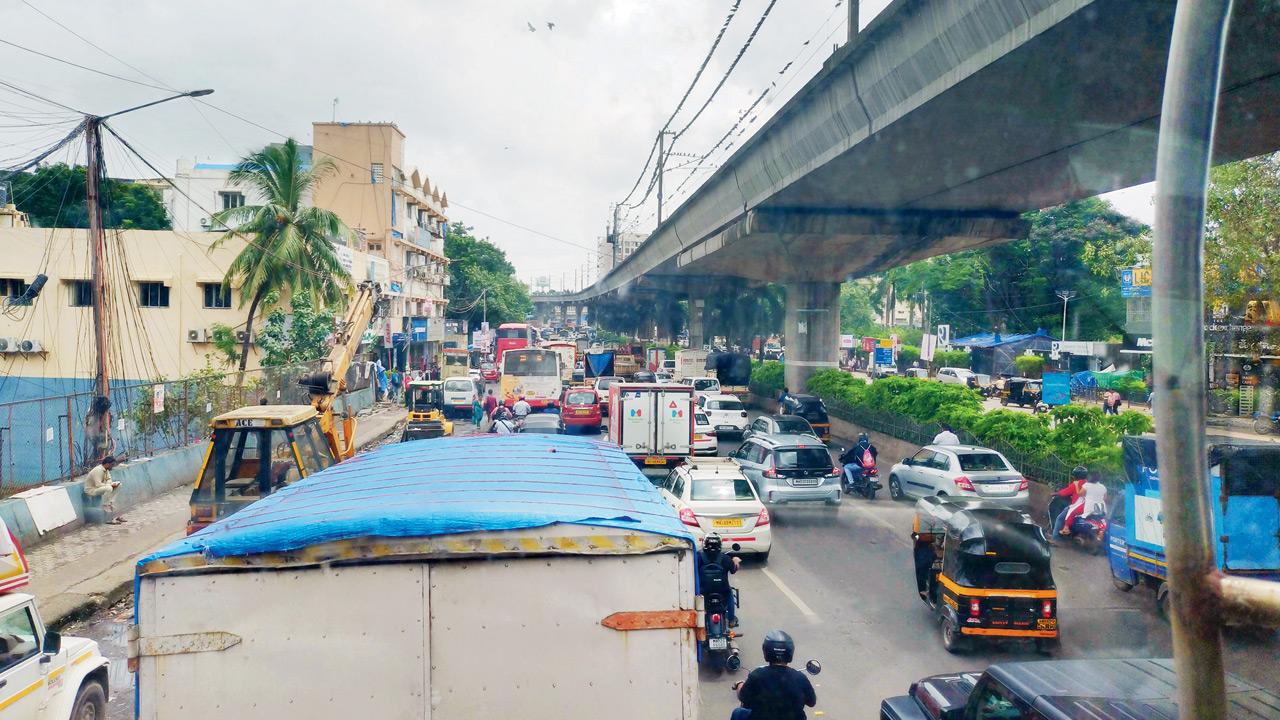
Traffic crawls along the Andheri East-Saki Naka stretch, one of the city’s most congested corridors. Pic/By Special Arrangement
With Mumbai Metro Blue Line 1 continuing to buckle under peak-hour crowding and commuters demanding six coach trains, transport experts have proposed a simple, low-cost alternative: a dedicated bus lane along the 4.8 km Andheri East-Saki Naka corridor.
In a detailed proposal sent to transport economist Ashok Datar, researcher Shubham Padave has suggested carving out a red-painted, CCTV-monitored bus-only lane on the arterial stretch, which already sees high-frequency BEST and NMMT services.
Backing the idea, Datar wrote, “This is a very useful tactical bus lane proposal. Metro 1 suffers because it cannot expand from four to six coaches despite carrying more ridership than 2A, 7 and the Aqua Line combined. A painted bus lane needs no bollards, no major expense. People already recognise its value where parts of the road function as a de facto bus corridor. If BMC and traffic police permit the markings, it will greatly benefit commuters and improve bus ridership.”
Why this corridor?
Live bus tracking from the Chalo app on November 24 showed dense bus presence at Saki Naka Junction and Chakala even during the afternoon. The road has three lanes on each side, making it geometrically feasible to dedicate the extreme left lane to buses and emergency vehicles.
The route links major hubs — Andheri railway station, the airport, corporate zones, Marol Fire Station, and several Metro stations — making it one of Mumbai’s busiest east–west connectors.
How it would work
Phase 1 proposes a continuous bus lane from Andheri Station East to Saki Naka. Phase 2 extends it to Chakala and SEEPZ Village. CCTV-based monitoring would automatically flag non-bus vehicles, reducing the need for on-ground enforcement.
The current BEST travel time on the corridor is 35 to 40 minutes during rush hour. The proposal estimates this could drop to 15 to 20 minutes with a segregated lane. Night-time images of packed Route 332 buses taken around 11.30 pm and 12.20 am highlight how demand continues well past peak hours.
Global style solution
The plan mirrors international practices where quick, paint-based transit lanes have been deployed as inexpensive mobility boosters. With BEST’s expanding AC fleet and robust digital tracking already in place, experts say this corridor is ideal for a pilot.
‘Bus lane’ that already exists
Between the Western Express Highway and Chakala, buses are allowed to travel in both directions even though the stretch is one-way. This long-standing exception has effectively created an unmarked two-way bus lane, strengthening the case for formalising the system.
Official Speak
BEST officials said the proposal cannot be implemented by the undertaking alone. “There are many factors to consider, parking, consultation with residents, road width, future projects, and overall traffic growth. Decisions like these require joint meetings with BMC, traffic police and other bodies,” a senior official said.
 Subscribe today by clicking the link and stay updated with the latest news!" Click here!