City left in a mess by wettest May day in 107 years as monsoon lands 16 days early; yellow alert (moderate rain) for today, more rain likely. The Colaba downpour shattered the previous May record of 279.4 mm set in 1918, while other areas like Bandra, Juhu, Sion, and Chembur saw 30–70 mm by 11 am

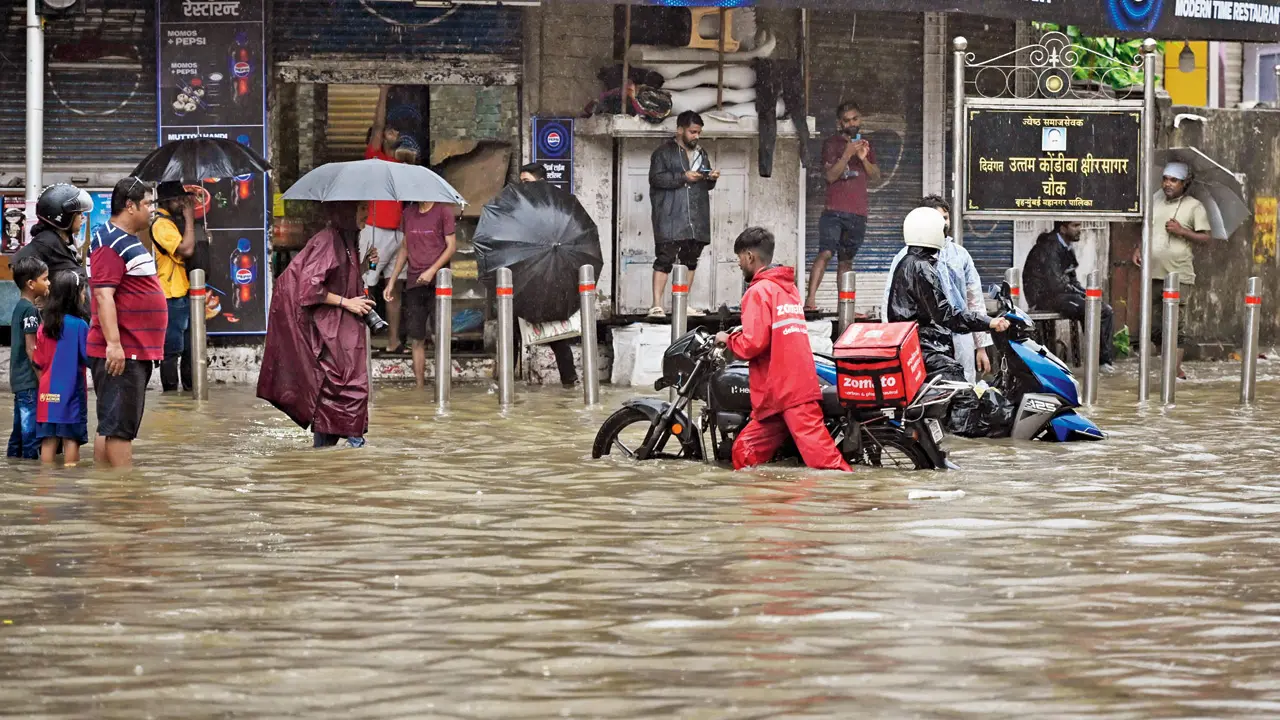
People wading through knee-deep waterlogged road in Hindmata. Pics/Ashish Raje
Mumbai woke up to chaos on Monday as the southwest monsoon arrived 16 days early, bringing the city’s wettest May day in 107 years. With over 295 mm of rainfall recorded at Colaba, the India Meteorological Department (IMD) had upgraded its warning to a red alert on Monday, signalling more intense rain was on the way. For today and tomorrow, IMD has issued a yellow alert (moderate rainfall, be cautious in low-lying areas and carry an umbrella).
The Colaba downpour shattered the previous May record of 279.4 mm set in 1918, while other areas like Bandra, Juhu, Sion, and Chembur saw 30–70 mm by 11 am. The early monsoon onset has left key parts of the city, especially South and South Central Mumbai, waterlogged, disrupting roads, railways, and even hospitals.
What Mumbai can expect next
After Monday’s red alert, the IMD has issued a yellow alert for May 27 and 28, warning of moderate to heavy showers, especially in isolated places. Ratnagiri and Sindhudurg districts remain under red alert for Tuesday, while Mumbai, Thane, and Raigad may see intense rainfall spells during peak hours. A green alert has been issued for May 29 and 30, indicating only light rain.

A tarred road peels right off following heavy rain overnight
“The monsoon set in early due to favourable synoptic conditions, including strong mid-level winds and upper-air cyclonic circulation over the Arabian Sea,” said IMD Mumbai chief Shubhangi Bhute. “All parameters for monsoon onset over Mumbai were met unusually early this year.” The IMD has also advised fishermen to avoid venturing into the sea till May 31, citing rough conditions along the Konkan coast and southern Arabian Sea.
Day 1
The day saw incidents of waterlogging in several low-lying areas like Parel, Sion, Dadar, and Kurla. Even KEM Hospital reported flooding, while the Andheri subway remained shut for hours.
In Mahim, a portion of the staircase and roof of the Haji Kasam Building — a dilapidated Waqf Board property—collapsed. Two residents were rescued without injury. The structure had been served with a demolition notice earlier. Train services on Western and Central lines were delayed, throwing peak-hour schedules off track.
After heavy rain, underground Metro rail services on Aqua Line had to be curtailed up to Worli Metro Station instead of Acharya Atre Chowk, which was flooded.
Infrastructure stress ahead
While the early onset doesn’t guarantee a rain-heavy season, Monday’s scenes offer a glimpse of how strained Mumbai’s infrastructure could become. Overflowing drains, ankle-to-knee deep water at Oval Maidan, and stranded commuters all pointed to the city’s chronic monsoon vulnerabilities.
Still, some residents tried to make the best of it. “My son has been jumping into puddles since morning,” said Colaba resident Miskil Dharmadikari. “We’ve had a few issues, but the first rains always feel special.” But others expressed concern. “We don’t use online apps,” said a senior Kalbadevi resident. “Even getting groceries becomes tough when streets are waterlogged.”
Subscribe today by clicking the link and stay updated with the latest news!" Click here!