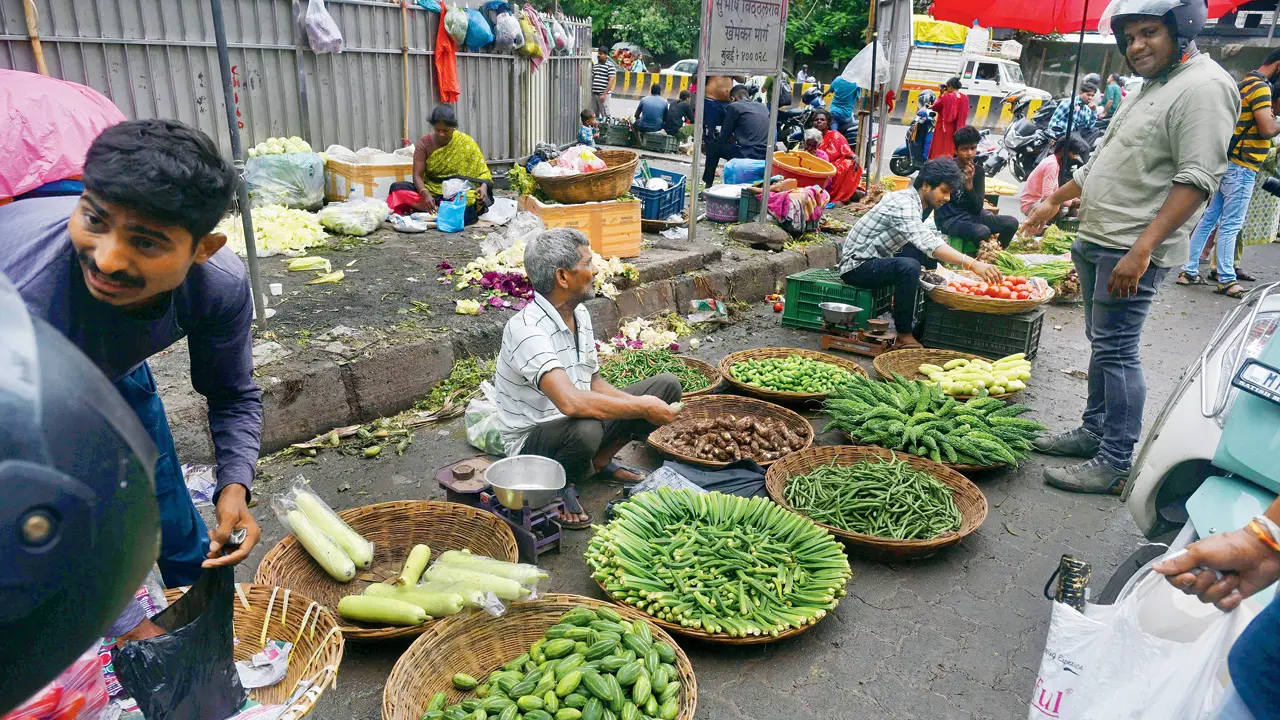
Mumbai rains: Citizens say kitchen staples now burning hole in budgets, with vegetables now costing twice as much. The sudden surge in prices has left consumers scrambling to balance household budgets. For those already burdened by high fuel prices, rising education fees, and transportation costs, this added expense is a serious blow

Prices of vegetables soar at Dadar market, following crop damage across the state. Pic/Atul Kamble
The sharp rise in vegetable prices has once again punched a hole in the pockets of Mumbai’s middle-class families, already reeling under rising living costs. Triggered by heavy pre-monsoon showers followed by the early arrival of the monsoon, the sudden surge in prices has left consumers scrambling to balance household budgets. For those already burdened by high fuel prices, rising education fees, and transportation costs, this added expense is a serious blow.

Prices of vegetables soar at Dadar market. Pic/Atul Kamble
Why are prices rising?
Agriculturist Ashima Potdar from Mahad explained, “The key standing vegetable crops in Maharashtra — tomatoes, brinjal, onions, potatoes, cabbage, cauliflower, cucumber, chillies, and various gourds — are highly vulnerable to erratic rainfall. Earlier, harvesting and supply were relatively steady. But now, due to heavy pre-monsoon and monsoon rains, crops are getting damaged more frequently, affecting their quality and disrupting the supply chain. This naturally pushes prices up.”

Pankaj Gupta, a cauliflower vendor, says much of the stock appears fresh initially but turns out to be rotten due to water damage. Pic/Atul Kamble
Another Mumbai-specific factor is the import of vegetables from other states such as Karnataka, Andhra Pradesh, Bihar, and Gujarat. “There has been an overall 10–15 per cent rise in vegetable prices,” said Digvijay Rathod, deputy registrar and deputy secretary at Mumbai’s Agricultural Produce Market Committee (APMC). “Wholesalers and retailers here don’t rely solely on local produce. Their pan-India network helps ensure supply, especially from states with lesser rainfall impact. But when they procure from outside Maharashtra, transportation costs shoot up — and those costs are passed on to the consumer.”

Gopal Gokul from Bandra says fluctuating demand and high prices have made vegetable sales unpredictable and risky. Pic/Ritika Gondhalekar
Activists ask govt to intervene
"Several key roads have been closed or damaged, leading to transportation delays and supply shortages. For instance, the price of tomatoes in Mumbai has surged from Rs 30 per kg to Rs 60 per kg within a day. If this situation continues, prices are likely to rise even further, putting an additional burden on the middle-class population. Although the state has invested significantly in cold storage facilities and market infrastructure, these measures must now be leveraged urgently.
Vinod Kumar Vaish, garlic vendor, at Dadar market. Pic/Atul Kamble
The government’s initiative of connecting farmers directly with consumers through cooperative outlets is commendable and must be expanded rapidly to control prices and ensure fair access to essential food items. We therefore demand that the state government take immediate and effective steps to stabilise vegetable prices by strengthening direct-from-farm distribution channels and utilising cold storage infrastructure to prevent spoilage.
In addition the state government should be monitoring and regulating middlemen and traders to prevent exploitation thereby ensuring smooth transportation of vegetables despite weather-related disruptions. Timely intervention will not only help stabilise prices but also safeguard food security of millions across the state. We look forward to your prompt and positive action," said Advocate Godfrey Pimenta, trustee, Watchdog Foundation in the letter addressed to Chief Minister Devendra Fadnavis.
Citizens speak out
Many residents expressed frustration, pointing out that despite paying taxes and GST on nearly every product and service, they receive little relief in times of crisis.

Esha Narkar from Vasai was shocked by vegetable prices after stepping out to shop, having relied on online deliveries so far. Narkar said, “We usually order online, but when I had to go to the market recently, I was shocked at the prices. I even called my mom in Dahisar to check if it was a Vasai-specific issue. Turns out, it wasn’t. A week’s groceries used to cost Rs 700–800 including meat. Last week, I paid Rs 635 just for a few vegetables — for two people!”

Girija O from Andheri says her monthly vegetable bill has doubled, wiping out the benefit of her recent salary hike. “How do we survive when our basic grocery bills have doubled?” said Girija O from Andheri. “After a long-awaited salary hike, I felt happy for a moment. But with prices of essentials rising, I’m back to square one. Vegetables used to cost Rs 2000 a month. Now it’s Rs 4000 for a family of four. Improving one’s standard of living feels like a distant dream.”
Some families are switching to cheaper alternatives. “We used to buy 2–3 kg of tomatoes every two weeks at Rs 30/kg,” said a Santacruz resident. “Now we use tamarind instead — no one likes it, but it’s affordable. Tomato prices are just too high.”
Subscribe today by clicking the link and stay updated with the latest news!" Click here!