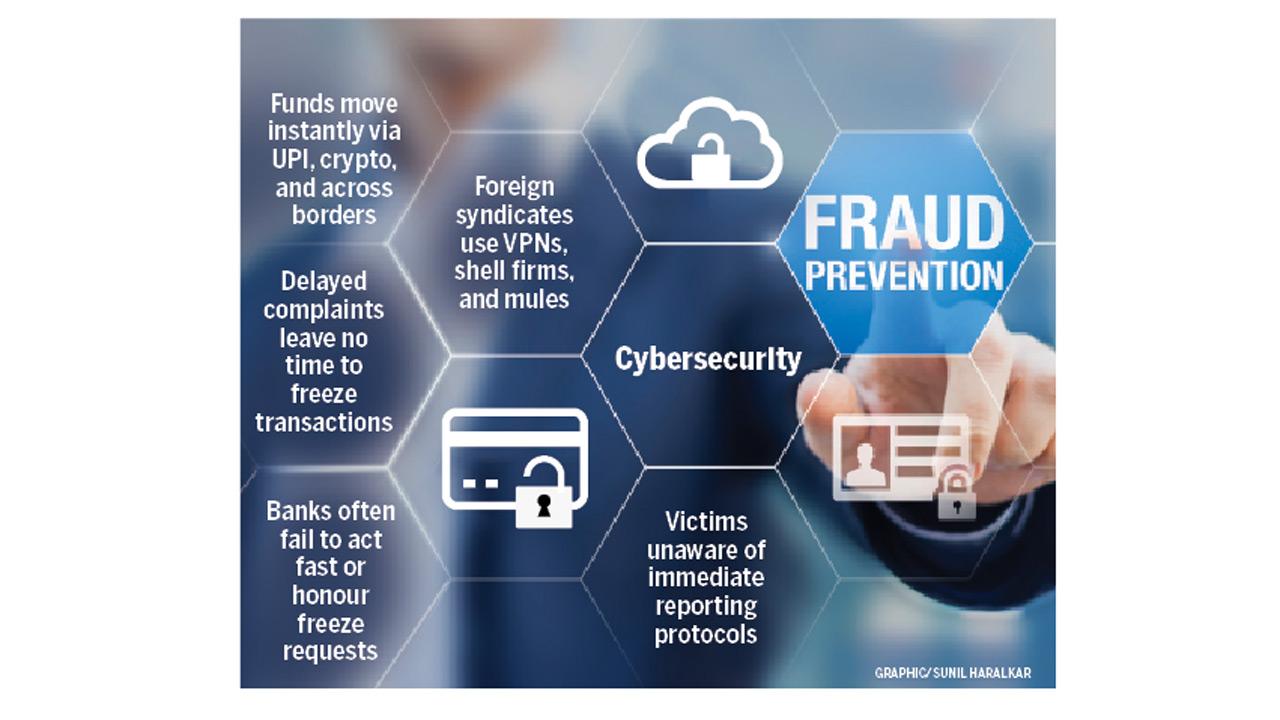
Despite the growth in digital transactions and financial inclusion, the average recovery rate hovers below 3 percent, exposing massive gaps in fraud detection, investigation, and fund restitution mechanisms

Graphic/Sunil Haralkar
There has been an alarming rise in the amount defrauded in online financial crimes in Maharashtra, yet the recovery rate across the state remains critically low. Between 2016 and 2024, online financial crimes, including debit/credit card fraud, SIM swap scams, business email compromises, internet banking fraud, identity theft, online loan app frauds, cryptocurrency scams, and various other digital frauds, have caused staggering financial losses running into thousands of crores of rupees.
Recovery rate below 1%
An analysis of recovery data over these nine years paints a worrying picture: while the volume and value of fraud have surged dramatically, the percentage of recovered funds remains minimal and inconsistent, fluctuating between a high of 6.19 per cent in 2022 and a low of just 0.28 per cent in 2024.
Despite the growth in digital transactions and financial inclusion, the average recovery rate hovers below 3 per cent, exposing massive gaps in fraud detection, investigation, and fund restitution mechanisms. The steep decline in recovery rates in recent years highlights growing challenges posed by sophisticated cybercriminal tactics and the rapid pace at which funds vanish in online ecosystems.
Widening gap
The widening gap between rising fraud losses and meagre recovery rates undermines public confidence in digital financial services and threatens the stability of the digital economy.

Online financial crimes have become smarter, faster, and more diverse over the past decade. The rise of digital platforms, advanced criminal tools, slow regulatory adaptation, and low public awareness have created a perfect environment for such frauds to thrive. Cyber experts stress that without urgent improvements in fraud detection, legal response, and public education, the gap between fraud and recovery will continue to widen, putting the digital economy and public trust at serious risk.
Police speak
“The expansion of internet banking, UPI, mobile wallets, and digital lending platforms has opened up new channels for financial activity. While this has improved convenience, it has also created more entry points for fraudsters,” said an officer attached to the Cyber Cell of Mumbai police.
“Technologies like UPI, instant transfers, and cryptocurrencies allow money to move in seconds, often across borders. Even if the FIR is registered, banks often cannot react fast enough to freeze or trace these transactions. This leads to extremely low recovery rates, even if the fraud is reported promptly,” the officer added.
Speaking about other reasons behind the low recovery rate, another officer from the Cyber Cell of Maharashtra Police said, “Many fraud operations are now run by foreign syndicates using international phone numbers, VPNs, and shell companies. In such cross-border crimes, stolen money is quickly converted into crypto.”
Without a strong, specialised cybercrime workforce, law enforcement will remain reactive, while cybercriminals continue to exploit the system. “Building this capacity is not optional; it is a critical need for national security, economic stability, and public trust in the digital ecosystem,” said cyber expert Ritesh Bhatia.
A senior officer from the Mumbai Crime Branch told mid-day, “Unless legal processes to reverse fraudulent transactions are made faster, recovery rates will always remain abysmally low. We strive to train cybercrime investigators to effectively handle the growing volume and complexity of digital fraud cases.”

Many cybercrime units in police departments remain under-resourced, with limited personnel, outdated tools, and a lack of specialized training, said a tech-savvy youth working closely with law enforcement agencies. “As a result, investigations are often delayed, evidence is lost, and recovery of stolen funds becomes nearly impossible,” said the youth, requesting anonymity.
Gautam Mengle, assistant vice president and security awareness strategist at CyberFrat, said, “There are many reasons for the gap between lost money and recovery, and they involve all stakeholders. For one, victims often don’t realise that lost money can be recovered if a complaint is filed before the fraudster withdraws the funds. If reported promptly on the National Cybercrime Reporting Portal, transactions can be frozen and reversed in coordination with both banks. Despite nearly R1 crore being recovered every year through this process, many victims lose precious time trying to call scammers or gather evidence, or decide to ‘visit the police station the next day.’ That delay is a massive blow.”
“Secondly, cybercriminals have evolved. Previously, gangs created bank accounts with forged identities and sold them to criminals. Last year, scammers immediately used stolen money to purchase expensive gadgets or jewellery for resale. Once the proceeds are spent, recovery becomes harder,” Mengle told mid-day.
“Finally, the dark web has made it easier for even amateur scammers to collaborate with experts. In game-based scams involving fake betting apps, scammers receive money through their own unregulated payment gateways, much like SIM box rackets that acted as parallel telephone exchanges to evade charges,” he added. “Clearly, the lapses are on all sides. Proactive awareness and continuous efforts to flag and fix gaps in the system are essential,” said Mengle from CyberFrat, a Mumbai-based firm specialising in cybersecurity awareness, education, and advisory.
Over the last decade, a wide range of evolving online financial crimes have emerged. Among the most alarming are matrimonial frauds where scammers exploit dating and marriage platforms to build fake relationships and extort money. Loan app scams have surged, with fake platforms offering instant loans and then harassing victims for repayment. QR code scan frauds trick users into scanning malicious codes that instantly siphon funds from accounts. Sextortion, cryptocurrency investment scams, and ransomware attacks all have added layers of complexity and trauma, affecting victims financially and emotionally.
“One major reason cybercrime recovery remains low is the growing use of mule accounts, bank accounts rented by individuals to scammers, often in exchange for commissions. Many people in financial distress are lured by social media ads promising passive income or freelance work. These users unknowingly become part of money laundering networks,” said Indore-based cyber researcher Ketan Raikwar, who tracks rigged betting apps and mule accounts.
“Scammers prefer corporate accounts for their high transaction limits. A single stolen sum can pass through a dozen mule accounts within minutes, making it untraceable. By the time fraud is reported, the money is often withdrawn, turned into crypto, or routed abroad,” said Raikwar, who works with the MP Cyber Police.
“What worsens the situation is how easy it is for scammers to find account holders willing to rent out their details. College students, job seekers, and small business owners are approached on Telegram, WhatsApp, and job portals. Since initial transactions seem legitimate, banks don’t flag them. When the scam is uncovered, recovery becomes a game of catch-up that law enforcement rarely wins,” he added.
Cyber lawyer Puneet Bhasin said, “This is not just a problem of the judiciary or Maharashtra police. It also involves banks, and in some cases, their employees who open mule accounts without proper KYC checks. Despite favourable court orders and police notices, banks often delay or refuse to freeze fraud proceeds. We’re filing contempt petitions to make them accountable. Cybercriminals know these systemic flaws and exploit them.”
Bhatia added, “The speed at which cybercriminals move money makes tracing it extremely difficult. Even if reported in time, the funds are often laundered through multiple accounts, sometimes internationally. Banks also fail to act fast enough.”
“There’s a major gap in coordination between banks and cyber police. Legal red tape and internal delays prevent immediate action. A real-time alert and response system between financial institutions and law enforcement is crucial,” he said. “Finally, many cybercrime units suffer from inadequate training, frequent officer transfers, and too few specialised stations. Basic cyber training isn’t enough for today’s complex financial frauds. Dedicated teams with advanced training and stable postings are essential,” Bhatia said.
As cybercriminals grow smarter and faster, law enforcement and financial institutions must evolve at the same pace. Legal reforms, better training, rapid inter-agency coordination, and stronger public awareness are vital. Without urgent and sustained intervention, the gap between money lost and recovered will only widen, placing millions of citizens and crores of digital transactions at constant risk.
Subscribe today by clicking the link and stay updated with the latest news!" Click here!