What makes this initiative truly remarkable is that it didn’t begin in policy circles or institutions, but with the quiet courage of the Shah family from Santacruz. Anjana Shah, 65, currently battling Progressive Supranuclear Palsy (PSP), has expressed her deeply selfless wish to donate her brain to medical research after her death

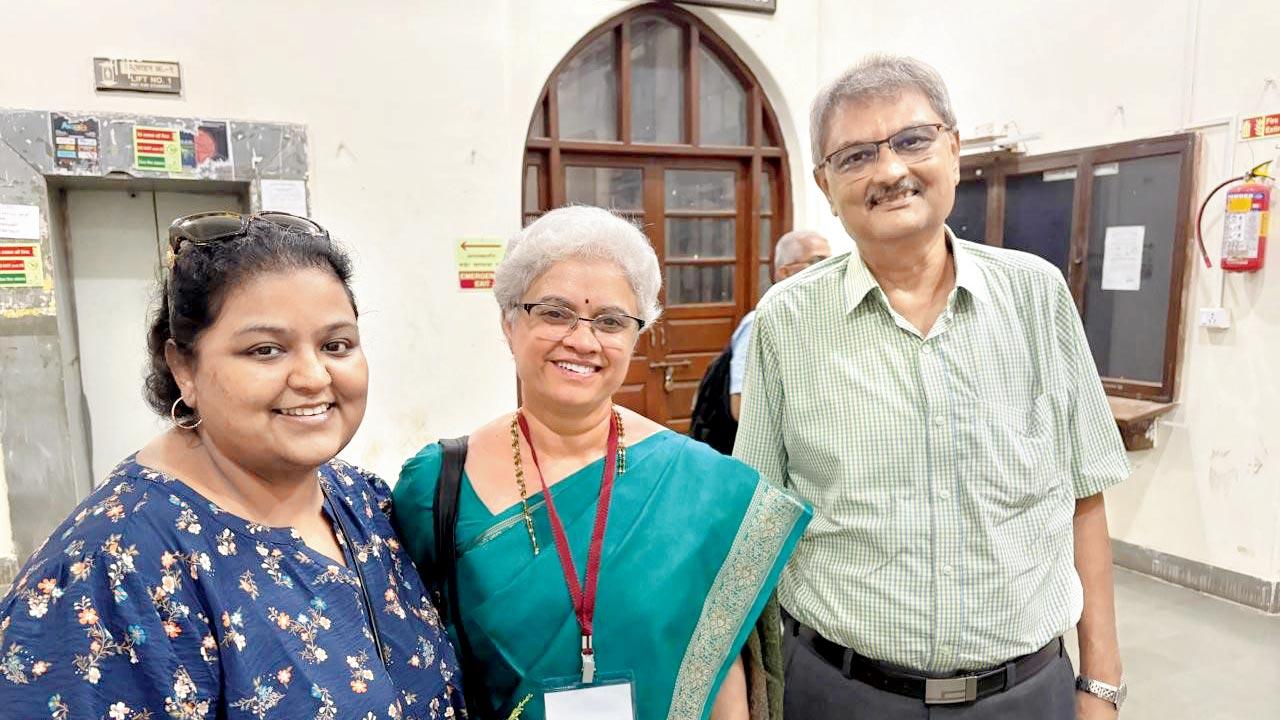
(From left) Asmi Shah, Dr Anita Mahadevan, and Vijay Shah at KEM Hospital last month
If all goes as planned, Mumbai could soon welcome its first brain donation and research facility, the first in Maharashtra as well — a groundbreaking step that could transform the city’s and state’s neurological research landscape.
What makes this initiative truly remarkable is that it didn’t begin in policy circles or institutions, but with the quiet courage of the Shah family from Santacruz. Anjana Shah, 65, currently battling Progressive Supranuclear Palsy (PSP), has expressed her deeply selfless wish to donate her brain to medical research after her death.
However, in the absence of a clear local system for brain donation, covering retrieval, storage, and documentation, the family found themselves lost in a maze of procedures after pledging Anjana’s brain to NIMHANS, India’s premier neuroscience institute and oldest brain bank in the country.
BYL Nair Hospital. Pic/File
mid-day highlighted Anjana’s story in its July 22 article, She Speaks in Silence, which detailed her powerful act of generosity and her family’s appeal for a streamlined donation process.
A follow-up piece, Mind Over Matter, dated July 23, featured Dr Anita Mahadevan, Coordinator of the Human Brain Bank at NIMHANS (National Institute of Mental Health and Neuro Sciences), who emphasised that brain donation could be key to unlocking cures for rare disorders, if only more families knew how to contribute.
Confirming the development, Dr Mahadevan said, “We’ve initiated discussions with Topiwala National Medical College and BYL Nair Hospital, Mumbai Central and while talks are still in early stages, subject to sanction of funding from ICMR, and also the BMC authorities, Topiwala Medical College will become the first operational brain bank centre in Maharashtra. Given Mumbai’s high volume of both medico-legal and clinical autopsies, the highest in the country, establishing a brain bank here represents a major advancement. It will enable families who wish to donate their loved ones’ brains for research to do so locally, contributing to crucial scientific progress.”
Dr Shailesh Mohite
ICMR has funded two other brain banks at AIIMS Bhubaneswar and PGIMER Chandigarh as satellite banks, with NIMHANS as the nodal centre, to form the first network of brain banks in India, she added.
“A single donated brain can support multiple research studies and significantly deepen our understanding of brain disorders. Historically, brain donation has seen cultural and institutional barriers, unlike eye or skin donation. NIMHANS is committed to changing that by simplifying protocols, raising awareness, and encouraging brain donation as a vital step toward future medical breakthroughs,” said Dr Mahadevan.
Dr Shailesh Mohite, Dean of Topiwala National Medical College, said, “About a month ago, the family approached me expressing their wish to donate the brain of a terminally ill patient to NIMHANS. However, they were unsure how to proceed — whether the patient should die at home or in the hospital, and how to handle the brain removal and transportation logistics.
Anjana with her daughter Asmi and husband Vijay. Pic/Atul Kamble
“I explained that, much like donation of organs such as eyes, skin, etc, under the Human Organ Transplant Act (HOTA), brain donation should not be a problem. The main concerns were about who would remove the brain, where it would be removed, and how to transport it if the patient died at home.”
He added that in typical organ donations, the hospital where the organ is retrieved maintains custody, and then the organ is officially transferred. “But in this case, since the brain is for research and not for transplant, there was uncertainty,” he said.
Often, people pledge to donate their organs or even their entire body. However, in this case, the pledge to donate brain for science and research was made to NIMHANS, Bengaluru, while the family resided in Mumbai. The main challenge was determining who would retrieve the brain and where the retrieval could take place in the event of death at home.
The human brain bank at NIMHANS in Bengaluru. Pic Courtesy/Dr Anita Mahadevan
Dr Mohite said, “Since the brain had already been pledged to NIMHANS, and it was not feasible to identify a local centre for brain retrieval within the jurisdiction of the donor’s residence, we are of the view that Mumbai should have designated brain retrieval centres. We have expressed our willingness to assist in making this possible at Topiwala National Medical College and BYL Nair hospital.”
In such cases, no autopsy is performed, and the relative’s consent is sufficient. There are two kinds of autopsies: medico-legal (MLC) and clinical. For brain donation under non-MLC circumstances, no police NOC is required — only family consent is necessary, he added.
The donation process can be simplified with a living will or an advance directive, Dr Mohite explained.
“When a person is conscious and of sound mind, they can declare that in the case of a terminal illness or vegetative state, they do not wish to undergo resuscitation or invasive treatment. Such directives should be notarised, and a copy submitted to the local police station.”
Dr Sweety Shinde, Associate Professor of Pathology at Topiwala National Medical College and BYL Nair Hospital, expressed her support for the initiative: “We are definitely interested in the proposal to establish a brain bank or brain donation centre at our institution, subject to receiving all requisite consents and approvals.”
Dr Shinde has completed a month-long observership under Dr Mahadevan at NIMHANS, where she gained valuable insights into the functioning of India’s first brain bank. This exposure has provided her with a clear understanding of the facility’s structure, protocols, and significance.
When asked whether she or her team is currently engaged in research involving human organs, Dr Shinde explained, “At present, our work is limited to studying biopsies for in-house patients for diagnostic purposes, along with histopathological examinations in clinical and medico-legal autopsy cases.”
She emphasised that a brain donation centre at Nair Hospital would address a crucial gap in neuro-research infrastructure and would also be highly beneficial for families in and around Mumbai who are willing to donate their loved ones’ organs for research purposes.
“Once all legal formalities, documentation, and institutional approvals are in place, with a dedicated and trained team, such a centre could be made operational and would evolve into a vital and impactful unit for the study of the human brain to uncover answers to unresolved questions, particularly in cases of neurodegenerative diseases and their underlying causes,” said Dr Shinde.
NIMHANS Brain Bank
Established in 1995, the NIMHANS Brain Bank has been a cornerstone of neurological and psychiatric research in India, providing ethically sourced, high-quality human brain tissues. It supports studies on conditions like Alzheimer’s, Parkinson’s, schizophrenia, dementia, epilepsy, infections, and stroke, many of which are rising with India’s ageing population.
Despite advances in diagnostics, post-mortem brain analysis remains crucial for confirming neurodegenerative diseases. Each donated brain aids in identifying biomarkers, improving diagnosis, and developing treatments.
Beyond research, the Brain Bank fosters public awareness, promoting brain donation as an altruistic contribution to science. A single brain can fuel many studies, driving breakthroughs in understanding brain disorders.
Traditionally, pledging organs for research has faced cultural and institutional resistance. Unlike eye or skin donation systems, brain donation for research remains underdeveloped. NIMHANS is working to change this by simplifying the process and encouraging broader support for organ donation. Donations, made voluntarily by individuals or families, are handled with dignity and preserved under strict protocols.
Brain Bank Network Initiative
Launched in October 2021, the ICMR-funded “Brain Bank Network India Initiative” aims to establish satellite brain banks at AIIMS Bhubaneswar and PGIMER Chandigarh, linked to NIMHANS Brain Bank as the nodal centre.
Biobanks are vital for advancing neuroscience research. India, despite its vast population and diversity, had only one brain bank at NIMHANS, limiting access to brain tissue for research. In contrast, the US and Europe operate dozens of such facilities through established networks.
Limited autopsy rates and geographical constraints on NIMHANS further emphasise the need for satellite centres. AIIMS Bhubaneswar and PGIMER Chandigarh, with strong autopsy and neuropathology infrastructure, were chosen for their ability to collect, store, and share high-quality brain tissue.
Milestones (2021–2024)
. Satellite brain banks established at AIIMS and PGIMER
. Harmonised protocols, a national sample database, and tissue-sharing guidelines developed
. Annual autopsy and biobanking workshops held; manuals and training videos created
. NIMHANS Brain Museum expanded its outreach; mounting technology and workshops shared with new centres
. Brain museums initiated and school outreach started at AIIMS Bhubaneswar
Subscribe today by clicking the link and stay updated with the latest news!" Click here!