The procedure for revising the state’s electoral rolls resembles that laid out for preparing the National Register of Citizens, sparking fears of large-scale denial of citizenship and disenfranchisement

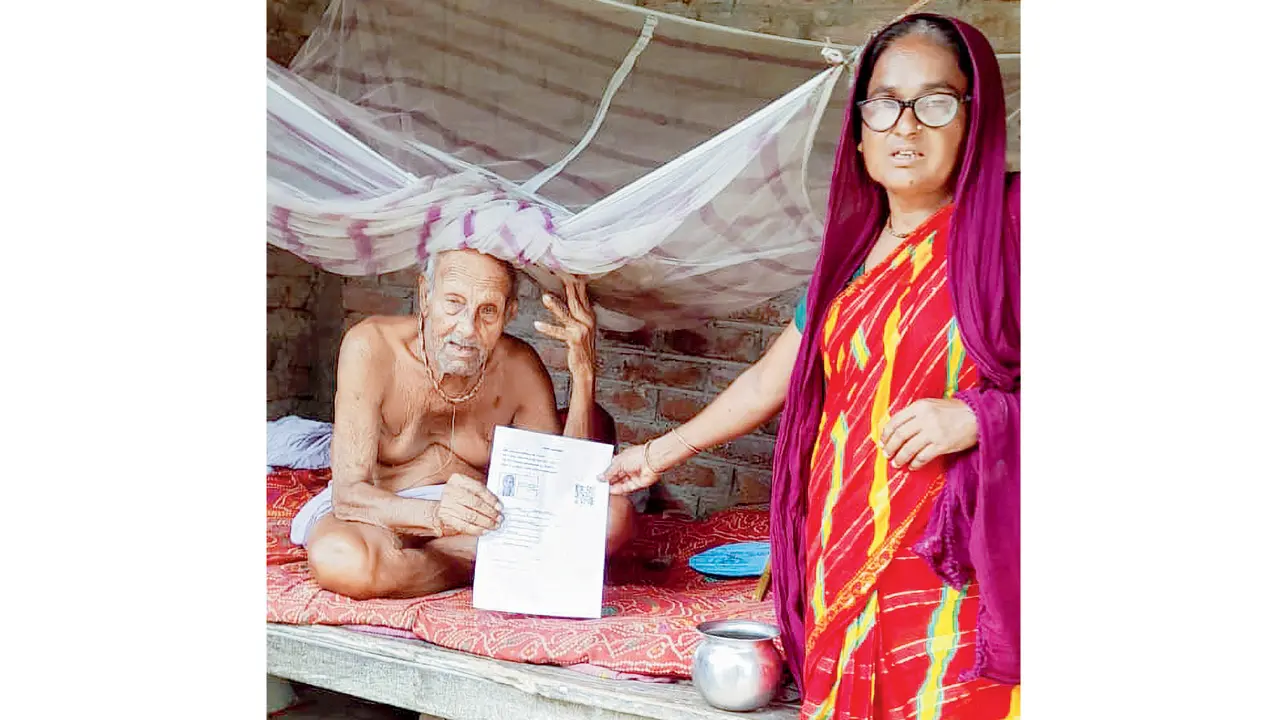
A booth-level officer hands over an enumeration form to an elderly voter in Madhubani, Bihar, amid the Special Intensive Revision of electoral rolls in the state. Pic/PTI
When the Modi government notified the population enumeration and house listing phases for the 2027 Census, but not for updating the National Register of Population (NPR), it seemed the Bharatiya Janata Party had abandoned its 2019 idea of creating a countrywide National Register of Citizens (NRC). The NPR constitutes the foundational data for the NRC. Without the NPR updation, it was assumed the NRC exercise couldn’t be undertaken.
This assumption has been belied, with the Election Commission of India ordering a Special Intensive Revision of Bihar’s electoral rolls, last done in 2003. The ECI order is unprecedented, for it introduces a citizenship test for all those who were not in the 2003 rolls or have never been voters. They will have to submit one of the 11 documents the ECI has listed for proving their citizenship.
Until now, people wanting to become voters were required to provide proof in support of their date of birth and place of residence. The new requirement will turn the revision of Bihar’s electoral rolls into an NRC-like operation, largely because of the ECI’s complex process of authenticating citizenship.
Those not in the 2003 electoral rolls will have to submit an Enumeration Form with documents proving their citizenship. Those born before July 1, 1987, will have to furnish evidence of when and where they were born. In addition to this document, those born between July 1, 1987, and December 2, 2004, will have to provide a document certifying the place and date of birth of either of their parents. They will have to do the same for both their parents in case they were born after December 2, 2004.
These three categories of people automatically arise because of the amendments to the Citizenship Act, 1955, carried out in 1986 and 2003. Until then, anyone born in India after January 26, 1950, acquired citizenship. In addition to this criterion, the 1986 amendment stipulated that to acquire citizenship, a person had to have a father or mother who was an Indian citizen at the time of the former's birth. After the 2003 amendment, a person became a citizen if at the time of his/her birth, both his/her parents were citizens, or if only one was a citizen, the other shouldn't have been an illegal immigrant.
Since only persons born in 1985 or before could have qualified for the 2003 electoral rolls, a massive number of people in Bihar will have to submit documents to prove their citizenship. A perusal of the list of documents the ECI will accept as evidence of citizenship shows the landless, the non-matriculate and daily wagers will be particularly disadvantaged. They may not have felt the need to obtain and preserve their own birth certificates, let alone those of their parents. Forget the subalterns, do readers of this column possess citizenship documents of their deceased parents?
All those who submit the Enumeration Form, along with requisite documents, will be listed in the draft electoral roll, which the Electoral Registration Officer (ERO) is required to put up in his/her office, and also publish on the ECI website. Anyone can file objections to the inclusion of persons in the electoral rolls.
Those against whom objections are raised will be heard by the ERO, who can also institute a suo moto inquiry into the citizenship of any person. The ERO’s decision can be appealed against to the District Magistrate, whose verdict, in turn, can be challenged before the Chief Electoral Officer. It’s mandatory for the ERO to report his/her suspicion about a person’s citizenship to the “competent authority” described in the Citizenship Act.
The electoral revision process in Bihar borrows elements laid out for preparing the NRC. Under the Citizenship (Registration of Citizens and Issue of National Identity Cards) Rules, 2003, the local registrar of citizenship registration scrutinises the self-declaratory information of individuals recorded in the population register — and informs those whose citizenship is deemed doubtful. They have the right to be heard by the local registrar. Those still aggrieved can go in appeal to the subdistrict or taluk registrar.
As in Bihar, for the NRC too, the draft of the local register of citizens is published for inviting objections from the public. Those with their citizenship challenged get two opportunities for proving their bona fides, before the District Registrar finalises the local register of citizens, without the names of those who failed the citizenship test, and transfer it into the national register of citizens. The simplest way for people to prove their citizenship is to submit documents proving they and their parents were born in India.
The belief that such documents are not possessed by umpteen Indians triggered a powerful movement in the months following the July 2019 notification for carrying out the NPR updation in 2020. The NPR exercise was, however, aborted due to the COVID pandemic. Large-scale rejection of citizenship and disenfranchisement of those belonging to subaltern groups were feared as outcomes before the government abandoned the entwined exercise of updating the NPR and preparing the NRC.
That fear will now likely grip Bihar — particularly those areas where the Opposition’s traditional supporters are numerous — and thereafter the rest of India, as the citizenship-based revision of electoral rolls will be extended to all states. A season of panic and discontent awaits citizens.
The writer is a senior journalist and author of Bhima Koregaon: Challenging Caste.
Send your feedback to mailbag@mid-day.com
The views expressed in this column are the individual’s and don’t represent those of the paper.
Subscribe today by clicking the link and stay updated with the latest news!" Click here!