


New York mayor-elect’s victory shows that a leader can neutralise the politics of hate while being unapologetic about his identity and stir the masses’ conscience by embodying the concept of unity in diversity
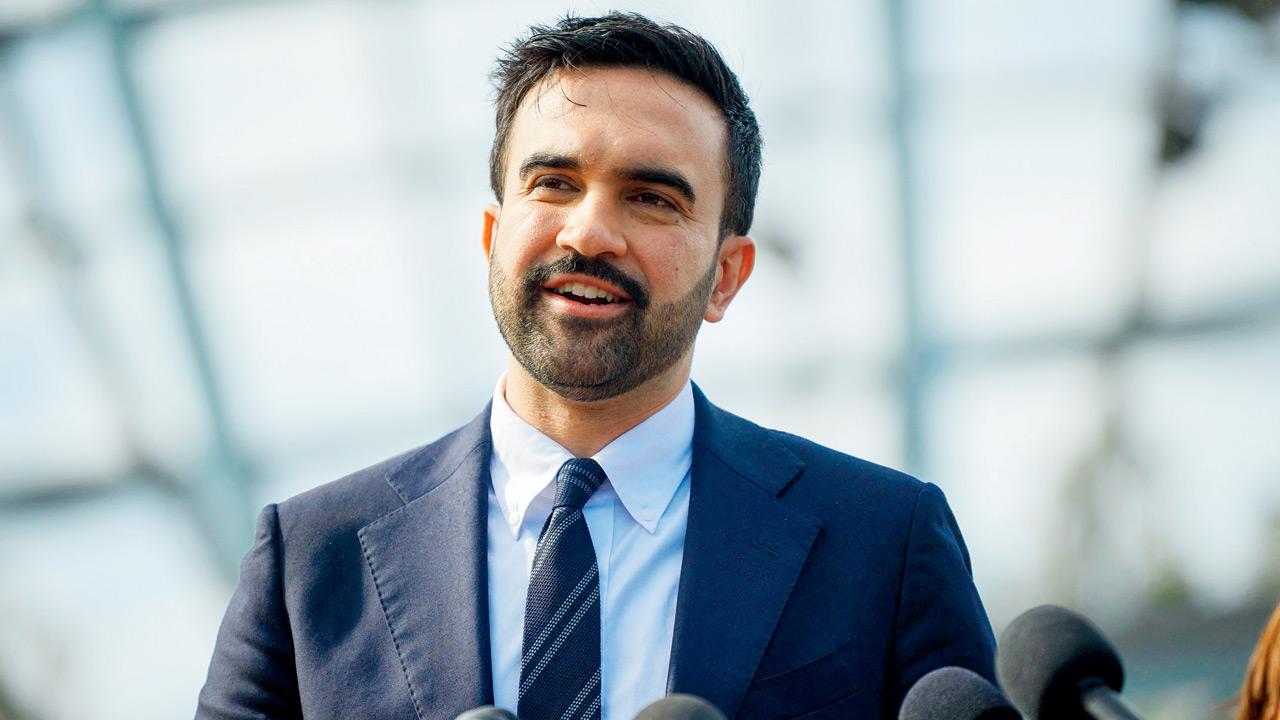
Zohran Mamdani after winning the New York City mayoral election last week. Pic/AFP

Among the many lessons India should learn from Zohran Mamdani’s rousingly successful campaign to become the new Mayor of New York City, perhaps the most significant is the strategy he adopted to neutralise the politics of hate. He chose to flaunt his religious identity even as it was vilified by his rivals. In his victory speech, Mamdani explained why he was seen as far from being the perfect candidate: “I am young… I am Muslim. I am a democratic socialist. And most damning of all, I refused to apologise for any of this.”
In India, though, the opponents of Hindutva seem to believe its rise has as its drivers a heightened Hindu religiosity as well as hostility to religious minorities. This has made them pander, in fits and starts, to the ‘Hindu sentiment,’ or rather their perception of it.
Not too many years ago, Congress leader Rahul Gandhi went on a temple-visiting spree, declared he was a Lord Shiva devotee and a Brahmin who wore the sacred thread. Changing tack, he now employs the radical rhetoric of caste representation and equality to challenge the Bharatiya Janata Party’s project to unite Hindus by othering Muslims.
Or take Aam Aadmi Party leader Arvind Kejriwal, whose triumph in 2013 was pivoted on making life in Delhi, to use the catchphrase of Mamdani’s campaign, “affordable.” Kejriwal subsidised electricity and water charges and made healthcare cheaper, before he turned Lord Hanuman into almost his party’s deity, and began participating in elaborate Diwali pujas.
Gandhi and Kejriwal’s strategy sought to promote through their makeover the possibility of being Hindu without baying for religious minorities. This is true of almost all other leaders of the anti-BJP formation. Implicit in their strategy is the hope that once their Hindu credentials are established beyond reproach, Hindutva can’t overwhelm the appeal of their agendas.
But what they fail to grasp is the necessity of directly addressing, and dispelling, the anxieties and resentments that Hindutva stokes, for these emotions are too powerful to be simply wished away.
Contrast their method to that of Mamdani, who unapologetically embraced his Muslim identity in a city as much in the grip of Islamophobia as India is, and where his community is just four per cent of the electorate. He refused to retreat “into the shadows of the city” to practise his faith, defiantly declaring he wouldn’t stop being who he is.
His defiance was combined with an appeal to the residents’ conscience, whether they’d continue to accept a narrow definition of being a New Yorker that makes smaller the number of people guaranteed a life of dignity. Mamdani reposed faith in the New Yorker’s common sense to distinguish between right and wrong, in contrast to Indian politicians seemingly believing the antipathy of Hindus towards the minorities is permanent.
Even more tellingly, Mamdani located Muslims in the matrix of a singular working class not divided by religion or race, or instigated to fight against each other by the billionaires. His strategy promoted “unity in diversity,” once an article of faith in India, by establishing the commonality of interests among social groups.
The effectiveness of his strategy was reflected in 33 per cent of Jews voting for him, despite his repeated condemnation of Israel for carrying out a genocide in Gaza. Mamdani’s rise is a reflection of the world opinion turning against Israel, whose oppression, typical of settler colonialism, was being condoned just three years ago.
This fact should worry the Modi government, for it has been unstinting in its support of Israel, both because of foreign policy pragmatism and the ideological affinity between Zionism and Hindutva regarding Muslims. The Modi government needs a reality check on the Palestine-Israel issue.
A reality check should also be prescribed for Hindutvawadis living in the United States, for they funded and amplified the hate campaign against Mamdani. Their grouses against him include his criticism of Hindu nationalism and its exclusion and demonisation of religious minorities, and his public comments against the violent targeting of Muslims during the 2002 Gujarat riots under Narendra Modi, whom he once compared to Israeli Prime Minister Benjamin Netanyahu. They also crib, rather falsely, that Mamdani doesn’t display enthusiasm for the Hindu cultural inheritance of his mother.
Mamdani’s victory is a lesson for Hindutva supporters, too. For one, opposition to Hindutva and Modi can’t be construed as being anti-India or anti-Hindu. A clutch of leading Hindu organisations in New York did endorse Mamdani’s candidature, underscoring Hindutva’s propensity to divide the Indian diaspora. For another, they need to understand that Hindutva’s anti-Muslim rhetoric may win them electoral victories in India, but it can’t become a morally persuasive argument for those Hindus who, living overseas, resort to the universal language of equality to fight discrimination and establish their rights.
Mamdani’s victory in the citadel of capitalism is remarkable as he is a democratic socialist, reinforcing the sagacity of a political thought which says the rise of the Right can’t be countered with a Centrist position, but by opting for a more pronounced Leftist agenda. This is mirrored in the Left’s sudden expansion in Germany, France, and the Netherlands. Really, India’s Opposition needs to stop fearing what they seek to battle.
The writer is a senior journalist and author of Bhima Koregaon: Challenging Caste
Send your feedback to mailbag@mid-day.com
The views expressed in this column are the individual’s and don’t represent those of the paper.
 Subscribe today by clicking the link and stay updated with the latest news!" Click here!