shot-button
BMC Elections 2026 BMC Elections 2026
Home > News > Opinion News > Article > Media in the time of Modi

Media in the time of Modi

Updated on: 01 December,2025 07:42 AM IST  |  Mumbai
Ajaz Ashraf |

It’s a wonder this column survived in an era when freedom of the press is no longer guaranteed, and owners, fearing raids and cases, often rein in the few feisty journalists who are still doing their job

Media in the time of Modi

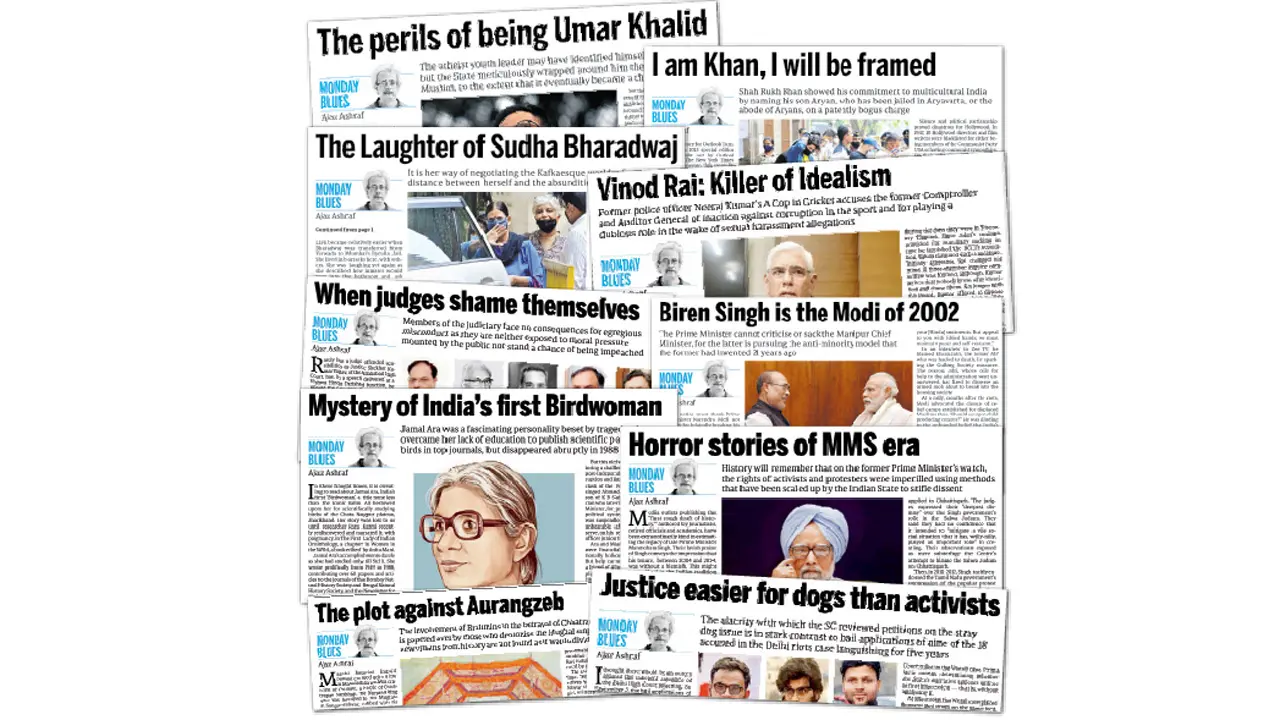
A few thought-provoking Monday Blues columns that ignited meaningful conversations

Ajaz AshrafIt’s tempting to write an obituary of Monday Blues, which will gasp for breath one last time, and then die, unceremoniously and unlamented, as soon as you finish reading today its last instalment. I will, however, confine myself to crediting mid-day for mostly allowing me to freely articulate my opinions, including even those that are anathema to the ruling regime, which smells and sifts media outputs with the diligence and ferocity of a watchdog. Not your fault in case you think I’m being ironical.

Journalist friends would ask, “How come you are allowed to write what you do?” Surprising as this question is in a democracy, I’d be reminded of American journalist AJ Liebling, who famously said, “Freedom of the press is guaranteed only to those who own one.” The owners, indeed, decide the extent of freedom journalists working for him/her should enjoy. I’ve enjoyed utmost freedom to date.


Yet, ever since Prime Minister Narendra Modi swept to power, in May 2014, the freedom of the press is no longer guaranteed to even owners. Ask Anuradha Bhasin and Prabodh Jamwal, the wife-husband duo who owns and edits the Kashmir Times, which had its life taken out, bit by bit, by denying it government advertisements. The newspaper shut down before it was reinvented, in 2023, as a small digital operation, which attracts around 52,000 visitors daily.


Decidedly a media bee, in contrast to the behemoths of the fourth estate, the Kashmir Times buzzed against the excesses and mistakes routinely committed in Kashmir, goading the State into raiding its shuttered Jammu office and discovering, incredibly, arms and ammunition stored there. The raid was conducted to investigate charges clubbed under the category of anti-national activities. The State has lassoed yet another watchdog of democracy, an honorific befitting the Kashmir Times, for treatment the Supreme Court has reserved for the strays. The methods of silencing independent media voices are limitless.

Although owners themselves, the freedom of the press couldn’t be Bhasin and Jamwal’s because they also happen to be feisty journalists, now an increasingly endangered tribe. Most owners are businesspersons, who censor their journalists, blanking out news. They fall in line because they fear raids and tax evasion cases, although their silence earns them revenue through advertisements the government gives them. At least in their cases, the government, with its enormous powers, can be partly blamed for breaking the media’s nib.

This can’t be an excuse for corporate giants, for they have entered the media to influence policies and for salvaging their reputation that’s sullied because of being the beneficiaries of crony capitalism. Compromising media freedom is a necessary precondition for acquiring power and pelf. It’s inevitable they’d spin the ruling party’s unethical conduct, as in the recent Bihar elections, as a masterstroke.

Fear and greed apart, ideology, too, has turned the media into becoming the government’s voice, an aspect that came across in Modi’s speech in the sixth Ramnath Goenka Lecture. He hailed Goenka, the founder of the Indian Express Group, for his courage in opposing the British and then, decades later, Indira Gandhi during the Emergency. But he also, in the same breath, vividly described Goenka’s proximity to the Rashtriya Swayamsevak Sangh and the Bharatiya Jana Sangh, the previous incarnate of the Bharatiya Janata Party, which won him a Lok Sabha election on its ticket. Modi, in a way, affirmed that Goenka’s opposition to Mrs Gandhi was as much about fighting for press freedom as it was about bolstering Hindutva.

A large segment of owners of legacy media belongs to a social group that has traditionally patronised the RSS and its Hindutva ideology. Torn between the demand for journalistic objectivity and their ideological inclination, much of the media resembles the trapeze artist engaged in a torturous balancing act. The tension of this conflict shows: Articles mildly critical of Modi are offset by a barrage of Page one headlines on even his most hackneyed comments, and a slew of pieces extolling his genius.

Affinity to Congress ideology was also a media feature during its decades of dominance. It, too, made media owners legislators. Worse, the Nehru government introduced a clause on “reasonable restrictions” in Article 19, in a misguided reaction to fiery criticism from the Organiser, a Sangh mouthpiece, and Romesh Thapar’s Cross Roads, a left-wing publication. Yet the party’s inherent liberalism, often compromised but never effaced, restrained it from compelling the entire media to become its cheerleaders. The Congress government, in the 1960s, gave advertisements to even the Organiser, as Abhishek Choudhary points out in his biography of AB Vajpayee.

It is no surprise that a large number of journalists have quit TV channels and floated their YouTube channels in recent times. Journalism, without fear or favour, is largely practised in the digital space, strapped though they are for funds, having to rely on donations. They, too, have experienced the government’s sharp edge, with the deepest cut inflicted on NewsClick, whose more than 80 employees and contributors were raided one morning in 2023. In this gloomy ambience, it’s a miracle that Monday Blues lived for six years — an apt epitaph for this column, which bids, with its last breath, goodbye.

The writer is a senior journalist and author of Bhima Koregaon: Challenging Caste
Send your feedback to mailbag@mid-day.com
The views expressed in this column are the individual’s and don’t represent those of the paper.

"Exciting news! Mid-day is now on WhatsApp Channels Subscribe today by clicking the link and stay updated with the latest news!" Click here!

Did you find this article helpful?

Yes
No

Help us improve further by providing more detailed feedback and stand a chance to win a 3-month e-paper subscription! Click Here

Note: Winners will be selected via a lucky draw.

Help us improve further by providing more detailed feedback and stand a chance to win a 3-month e-paper subscription! Click Here

Note: Winners will be selected via a lucky draw.

mumbai columnists Ajaz Ashraf mumbai news

Mid-Day Web Stories

Mid-Day Web Stories

This website uses cookie or similar technologies, to enhance your browsing experience and provide personalised recommendations. By continuing to use our website, you agree to our Privacy Policy and Cookie Policy. OK