shot-button
E-paper E-paper
Home > News > Opinion News > Article > The pig and the pauper

The pig and the pauper

Updated on: 05 August,2025 06:45 AM IST  |  Mumbai
C Y Gopinath |

For every five Indians who don’t know when to stop eating, there are two who go to bed hungry. And then there’s the food we throw away

The pig and the pauper

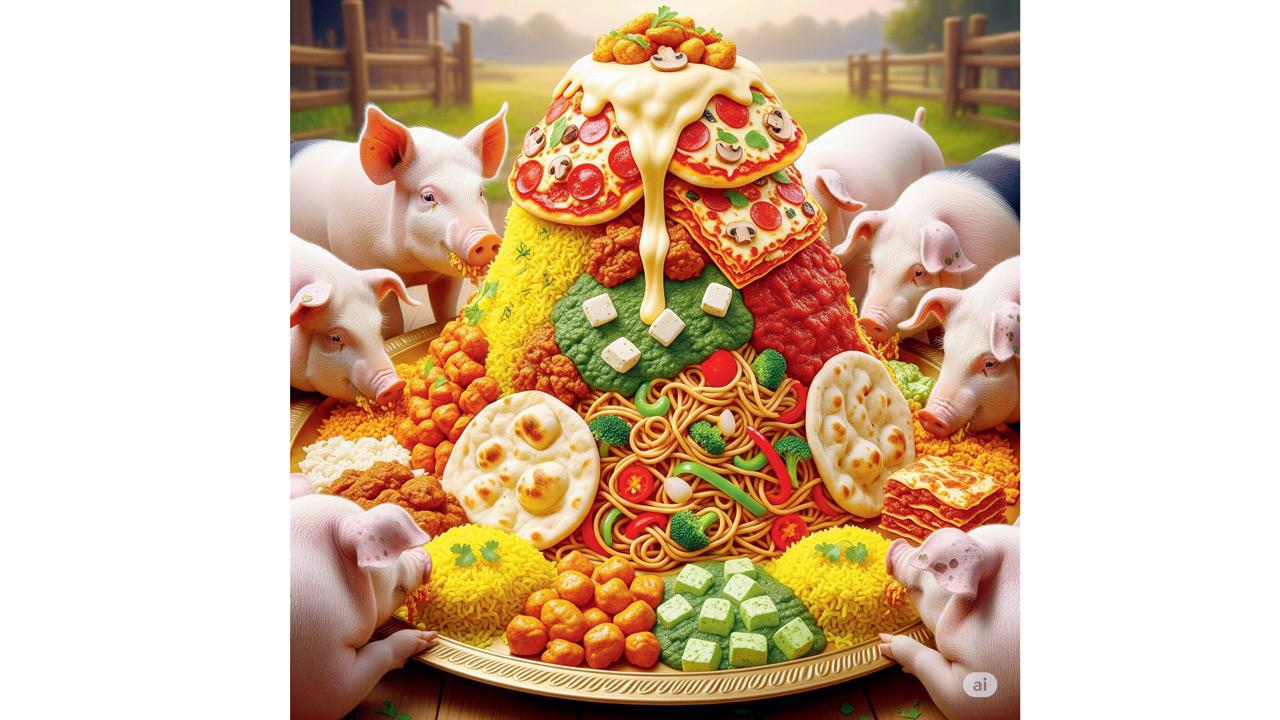
The average Indian restaurant menu is a gallery of excess, serving a customer who wants to drown in choices, mesmerised by variety more than taste. Illustration by C Y Gopinath using AI

C Y GopinathSometimes you meet numbers that stop you in your tracks. I met three last week.

About one-fourth of the world is obese or overweight.


About one-fifth — roughly 1.05 billion tonnes — of edible food is wasted or discarded globally every year.


About one-tenth of the world goes to bed hungry daily.

Switching to plain English, one person in four eats way more than they need, and grows fat. For every five such gluttons, there are two hungry human beings who will have eaten nothing all day. Some of them will pick up shreds of that uneaten food from waste bins while the hog sleeps an uneasy sleep, punctuated by belches of acid reflux. A significant number of these ‘foodies’ leave food on the plate, to be thrown away.

Since India is always the golden exception to every global statement, maybe we ought to check about fatness, hunger, and food waste right here at home.

Like the rest of the world, about one-fourth of Indian men and women are obese, overweight, or both.

In 2024, India scored 27.3 on the Global Hunger Index and ranked 105th out of 127 countries with a ‘serious’ level of hunger. Our children are the hardest hit. We top the world in stunted children (one in three kids has low height for weight) and children who are wasting away — nearly one in five suffers from low weight for height.

Let’s talk about Bombai. Click the QR code above to join my WhatsApp group to share your Bombai stories for my book—and perhaps answer some of my Bombai questions.

While gross gluttony and crippling hunger dance together on one side, Indian households throw away nearly 69 million tonnes of food every year, or about 50 kg per person. Restaurants, hotels, and caterers discard about 11.9 million tonnes.

As a nation, we waste around 74 million tonnes of food annually, including grain that rots in godowns.

Numbers are boring, I know, but by now you should be sitting up with a frown on your face. There’s a question in here: why are we so deeply into excess?

Let me take you to the next stop in this journey, a tandoori restaurant in Bandra where I ate last night. There were 28 distinct chicken dishes in the Mains section. Here are a few: Chicken Reshmi, Chicken Afghani, Chicken Aftab, Chicken Bhuna, Chicken Patiala, Chicken Angare, Chicken Peshawari, Chicken Rogani, Chicken Rasheeda, and Chicken Lajawab. There are 18 more. I felt a moment of dizziness, and then refocused on the list.

You might recognise some through past encounters. Afghani, Reshmi, Malai, and Korma were probably white, based on cashew-based spice mixes. Hariyali and Pudina would likely be green, though it’s anyone’s guess what a Peshawari, Haryanvi, Patiala, or Nawabi would look like.

Our brains are not designed to deal with so many choices. I did what any gobsmacked Indian in my position would do: I ordered a plain tandoori chicken. It came and it was perfect.

I emerged with a question. Why do we crave too much of everything we put into our mouths?

The average Indian restaurant menu is a gallery of excess, serving a customer who wants to drown in choices, mesmerised by variety more than taste. Eventually, he will look at the right-hand side, see the price, and his mood will grow sober. He will quietly order a few things he has eaten before.

As in all sectors of life, the Pareto principle will finally prevail: 80 per cent of the people will order only 20 per cent of the items on the menu. The rest is excess.

On Bhaudaji Marg in Matunga, standing side by side, are Cafe Madras, with its modest 40-or-so-item menu, and the newly opened Radha Krishna, with close to 200. Like the tandoori grill, this one presents staggering lists of everything, each paired with every combination of masala, cheese, ghee, podi, Szechuan, and Manchurian hot sauce.

The lunchtime buffet of nearly any hotel or restaurant is a blunt instrument of overwhelming culinary force. The customer, no matter how respectably dressed, is genetically programmed to stuff himself on every item since, after all, he is paying for it all. ‘All you can eat’ is an invitation to pig out and leave bloated, eyes popping out of the skull.

The love of overabundance is ancient. The Indian thali is not a balanced meal; it is a crowd of tastes, nothing curated, designed to cover every square inch of the thali. You are rude if you do not take a second helping of each.

The Japanese figured out the solution, as they always do, and it was elegant, refined, and subtle, like so many Japanese things: eat until you are 80 per cent full. It sounds like a perfect formula for life to me.

Let restaurants make their menus 80 per cent smaller, and serve their food on plates 80 per cent smaller. Cook less food, offer less variety, curb your reckless creativity, and do not be a slave to quantity.

And you, diner, fill your plate with less than you can eat, and stop when you are less than full. You won’t eliminate hunger by eating less, but you might dent the embarrassing wastefulness of our dining habits.

So leave nothing behind. Go home wishing you had eaten more.

You can reach C Y Gopinath at cygopi@gmail.com
Send your feedback to mailbag@mid-day.com
The views expressed in this column are the individual’s and don’t represent those of the paper.

"Exciting news! Mid-day is now on WhatsApp Channels Subscribe today by clicking the link and stay updated with the latest news!" Click here!

Did you find this article helpful?

Yes
No

Help us improve further by providing more detailed feedback and stand a chance to win a 3-month e-paper subscription! Click Here

Note: Winners will be selected via a lucky draw.

Help us improve further by providing more detailed feedback and stand a chance to win a 3-month e-paper subscription! Click Here

Note: Winners will be selected via a lucky draw.

mumbai columnists C Y Gopinath mumbai news

Mid-Day Web Stories

Mid-Day Web Stories

This website uses cookie or similar technologies, to enhance your browsing experience and provide personalised recommendations. By continuing to use our website, you agree to our Privacy Policy and Cookie Policy. OK