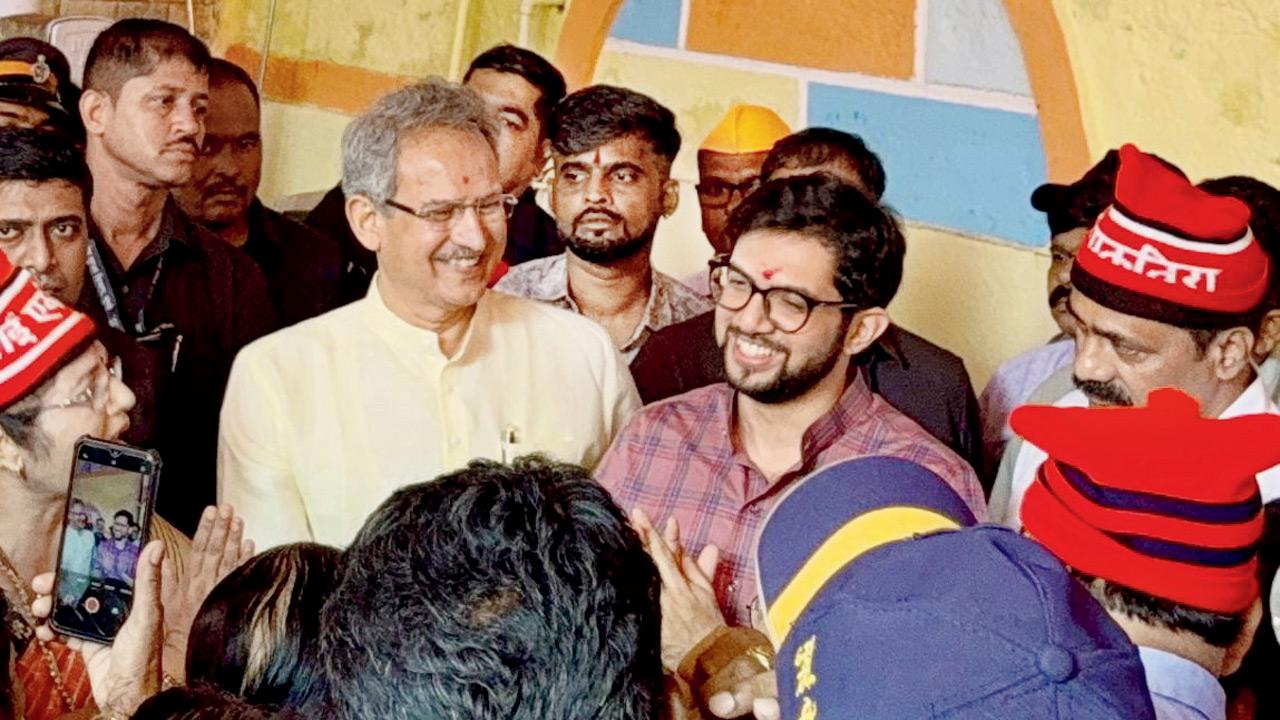
Aaditya Thackeray's father was the 19th Chief Minister of Maharashtra, Uddhav Thackeray, judged India’s most popular chief minister in a survey of 17,500 people from 13 Indian states

Aaditya Thackeray (in checked shirt) at a protest by Koliwada residents against Dharavi’s acquisition by Adani for redevelopment. Photo by C Y Gopinath

Please sit here,” said the young politician, indicating a three-seater sofa. “You will be more comfortable.”
“I am fine here,” I demurred. The sofa faced the cold blast coming from the air-conditioner.
“Or try this side,” he said, pointing to another sofa.
“Honestly, I’m fine here,” I said, as politely as possible.
“Better to move, Gopiji,” he said, softening his voice. “That’s my father’s chair.”
His father was the 19th Chief Minister of Maharashtra, Uddhav Thackeray, judged India’s most popular chief minister in a survey of 17,500 people from 13 Indian states. The father’s father was Balasaheb Thackeray, the controversial, influential founder of the Shiv Sena in 1966. I was in the room with his grandson, 35-year-old Aaditya Uddhav Thackeray. In December 2019, aged 29, he became the youngest-ever cabinet minister in Maharashtra’s history, holding the portfolio of environment, tourism, and protocol.
Such a long journey.
In 1969, when my parents moved to Bombay, the Shiv Sena, recently formed, was campaigning against South Indians, whom Bal Thackeray casually called yendugendu wallahs. For four chilling days in February 1969, everyone stayed indoors; the streets were deserted.
Two generations later, the grandson is in the lights, and there is speculation and rumour, questions and opinions.

Let’s talk about Bombai. Click the QR code above to join my WhatsApp group to share your Bombai stories for my book—and perhaps answer some of my Bombai questions.
One lot is openly admiring. He listens, he understands, he works with facts. He’s approachable. He’s the future. They talk about his two years as a minister, his Climate Action Plan, and the complete makeover of BMC schools, among others.
Another lot says, Sorry, agree to disagree. He’s entitled, like the rest of his generation. He’s a party animal. He has a dark side.
They will tell you about his 2010 protest against Rohinton Mistry’s novel, Such A Long Journey, which had upset many Maharashtrians with its remarks about the martyrs of the state. The novel was swiftly withdrawn from the required reading list. His critics said Aaditya had made his political debut with an act of censorship, a precedent for confrontation rather than dialogue.
Fifteen years after that protest, I was finally granted a couple of hours with Mumbai’s youngest millennial politician for a glimpse of who he is today.
The smile is wide and unguarded, and there’s a boyishness under an unruly crown of black hair. His plain, black-framed glasses give him a bookish air and a certain intentness, but there is a contagious energy under the studious exterior. Here are three things that stuck out from our conversation.
Three months before his tenure ended in June 2022, he gave the city its first Climate Action Plan, charting a 30-year path to net-zero emissions by 2050, by when Mumbai would also be battling extreme floods, extreme heat, landslides, air pollution, and coastal threats. Rich in data, insights, and actionable plans, it has become the touchstone of Mumbai’s policy and city planning.
He showcased a next-level education makeover for children by rebranding municipal schools as Mumbai Public Schools (MPS) and affiliating them with international curricula such as CBSE and ICSE. Around the end of his ministership, 11 civic schools had made the transition, and he was in talks with the International Baccalaureate board in Switzerland.
As of this writing, 18 of Mumbai’s 21 MPSs offer the CBSE curriculum, and one school each offers the ICSE, IGCSE, and IB curriculum. CBSE schools offer 1122 seats for admissions, and newer IGCSE and IB schools offer 28 seats per school. The only ICSE school has 68 seats available.
In a city that recently saw a migrant worker thrashed because he did not know Marathi, Aaditya seems to envision a more diverse, global child. His MPSs offered Marathi, Hindi, Gujarati, Urdu, and English, and three optional South Indian languages, Tamil, Telugu, and Kannada.
A senior functionary of the Shiv Sena who has been a member almost since its formation thinks Aaditya is the new, inevitable face of politics.
“My generation followed Balasaheb’s tenets,” he said. “If we didn’t like Valentine’s Day, we’d go after college kids and say, ‘Don’t do this, it’s not our culture.’ But this would not be acceptable to Aadityaji’s generation.”
Pankaj Joshi, architect and long-time environmental activist, after working closely with Aaditya on several civic projects, says, “He’s passionate, ambitious, and tuned to environmental issues. He’s learnt from his father. He brought environmental education to municipal schools. My daughter has never asked to burst crackers because she knows the pollution impact. That’s the kind of curriculum change we need.”
Politicians evolve. If you live in a hornet’s nest, you must understand honey but also know how to sting, and Aaditya may one day show up hidden behind a mask. But for now, our conversation felt like a waft of fresh air and energy in a jaded world. Mumbai needs someone who cares about what’s best for the city rather than how much more it can be squeezed for personal profit.
“Who does Mumbai belong to?” I asked him. “There are nearly 50 different communities and professions here, some prominent, some not, from the Kolis to the Parsis to the Gujaratis.”
He didn’t think too long. “It belongs to Maharashtra. But everyone who has made the city what it is, they are a Mumbaikars.”
Perhaps this is where the grandson is in lock-step with his grandfather.
You can reach C Y Gopinath at cygopi@gmail.com
Send your feedback to mailbag@mid-day.com
The views expressed in this column are the individual’s and don’t represent those of the paper.
Subscribe today by clicking the link and stay updated with the latest news!" Click here!