The 135th birth anniversary of Sangeetsurya Keshavrao Bhosale warrants renewed attention from anyone facing the odds in the arts

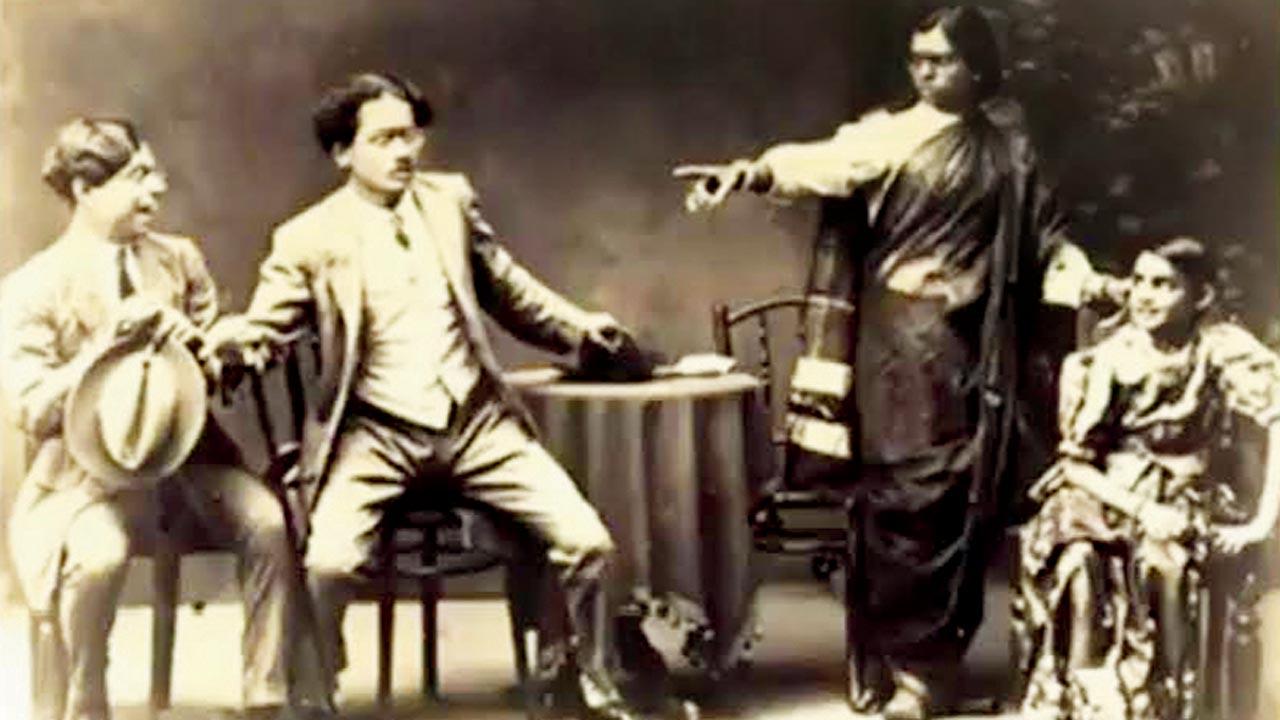
A scene from Hach Mulacha Baal
“Just hearing the name Keshavrao would send a shiver down my spine.” Thus begins Bal Gandharva’s stirring recollection of sharing the stage with Keshavrao Bhosale — his fellow actor, rival in magnetism, and a performer whose sheer brilliance could eclipse even a legend. In fact he adds that advisors had warned him against a collaborative venture with Sangeetsurya Bhosale because the latter would definitely turn superior. At Bhosale’s funeral, Gandharva noted, prominent figures jostled to carry the 32-year-old genius. “Who knows what will happen at my death?” he added. “Will anyone even be there to carry me to my final abode?”
This memory, delivered with candour, is the most striking moment quoted in a slim new book, Sangeetsurya Keshavrao Bhosale by Dr Satish Pawade (available in Marathi, Hindi, and English), on theatre icon Keshavrao Bhosale’s life and legacy. The book’s relevance feels just right as we mark his 135th birth anniversary — a moment to reflect on this lost diamond who deserves more than a theatre named after him in Kolhapur, which incidentally was gutted in a fire last year. The rebuilding is underway, but at a slow and uncertain pace.
Keshavrao Bhosale
Just a few months ago, I watched a spirited retelling of the backstory of Samyukta Manapaman, the iconic collaborative play that sparked Bal Gandharva’s nervous awe. In this updated staging, two young actors stepped into the formidable roles once played by Gandharva (1888–1967) and Bhosale (1890–1921) — one as Bhamini, the other as Dhairyadhar. That original energy hovered in the air, especially once the famous natya-geet padas began earning encores. Rushikesh Wamburkar vividly evoked Bhosale’s presence. The play explores the hollowness of appearances in an image-obsessed world. It also reaffirms why Sangeetsurya’s brilliance lay as much in collaboration as in performance. Meaningful theatre is rarely a solo act.
As a columnist, it is rewarding to read Bhosale’s own words and those of his contemporaries — witnessing, across decades, their fierce commitment to theatre arts. The recent play and this new book complement each other — they complete a conversation across time. At the heart of this renewed engagement is Dr Satish Pawade, the Wardha-based playwright, director, and critic, who is ready to go to any length to commemorate a legacy.
Author Satish Pawade (left) with Sangeetsurya Bhosale’s great-grandson Ashok Patil
Two of Dr Pawade’s students are currently writing their theses on Bhosale — a matter of pride for him, and a sign that Bhosale’s legacy has young takers. The book honours the past. And perhaps, in looking back, we find a little more courage to look ahead — especially in a post-COVID, resource-strapped world where theatre still grapples with uncertainty.
Keshavrao Bhosale carved a singular path in Marathi musical theatre; his voice could take on both male and female roles. Trained in the Gwalior gharana under Balkrishna Buwa Ichalkaranjikar, he evolved his own grammar through taankriya. His ability to blend emotion with vocal acrobatics won accolades. His diction and dramatic instinct gave him a stylistic autonomy that even Bal Gandharva didn’t command.
Born in Kolhapur in 1890, Keshavrao stepped onto the stage at age four, and by 10, stunned audiences with his full-length debut as Sharada in Sangeet Sharada — earning a dozen encores in one night. At 18, he formed his own troupe, the Lalit Kaladarsha Natak Mandali, and later co-founded one of Maharashtra’s earliest cooperative drama companies. He staged canonical works — Sangeet Saubhadra, Vidyaharan, Rakshasi Mahattwakanksha (where he sang 24 songs), and Satya Harishchandra.
Bold in both form and staging, he once performed Mruchhakatika in a wrestling stadium before 20,000 people; introduced Maharashtra’s first woman playwright Hirabai Pednekar; he brought Shakespearean, Ibsenian, and Artaudian techniques into Marathi theatre. He revived Rakshasi Mahattwakanksha in Urdu as Kamal-e-Hirsa, showcasing his multilingual range. In just 32 years, he played 52 roles across 31 plays. When he received the news of his wife’s death, he chose to finish the show before grieving.
Short and not conventionally handsome, Bhosale amplified his presence through a commanding baritone. He portrayed multiple roles in a single play with seamless shifts, using costume as a narrative tool — from Kolhapuri pagdis to high-heeled shoes — and performed with breath control. His role as David, a Christian convert from a Dalit background in Sanyasacha Saunsar, revealed an empathy that was rare among actors of the time. As a mentor, director, and administrator, he launched new talent, took on progressive scripts such as Garibache Lagna, and expanded theatre’s reach beyond Maharashtra to Hyderabad, and even Gujarat.
“While researching the influence of absurd theatre in Marathi drama for my PhD, I first came across Keshavrao Bhosale. I realised how little had been written about this sculptor of modern Marathi theatre — partly, no doubt, due to his own indifference to self-promotion,” says Pawade.
Keshavrao Bhosale’s story cannot be told without acknowledging the social realities of his time. As Pawade highlights, Bhosale was a Maratha working in an industry long controlled by upper-caste gatekeepers. This made his path to success much harder — and his memory easier to overlook. Pawade points out how certain castes have historically had fewer opportunities in Marathi theatre. Bhosale’s experience reflects quiet but real barriers that those from disadvantaged backgrounds face — struggling not just against poverty or obscurity, but also against the unspoken rules about who gets remembered and who doesn’t.
As Pawade notes, the government’s attempts to honour Bhosale remain grossly inadequate. Apart from naming a few auditoriums and a state-level theatre competition after him, and dedicating a lone issue of the state’s official Lokrajya magazine, little has been done to preserve his memory.
Determined to change this, Pawade is now spearheading a campaign to institutionalise Bhosale’s legacy in meaningful, lasting ways. He is working to set up theatre study centres in Bhosale’s name beginning with Kolhapur and Amravati universities, places deeply tied to Maharashtra’s musical theatre traditions. He is also in touch with 80-odd relatives — Sangeetsurya’s descendants who share a deep sense of pride but lack the means to navigate the bureaucratic hurdles alone. Pawade steps in as both advocate and archivist.
The Sangeetsurya project gives young performers and scholars a much-needed role model. At a moment when the performing arts face fatigue and fragmentation, Bhosale’s journey breaks the tired pattern of whom we choose to remember — and whom we leave out.
Sumedha Raikar-Mhatre is a culture columnist in search of the sub-text. You can reach her at sumedha.raikar@mid-day.com
Subscribe today by clicking the link and stay updated with the latest news!" Click here!