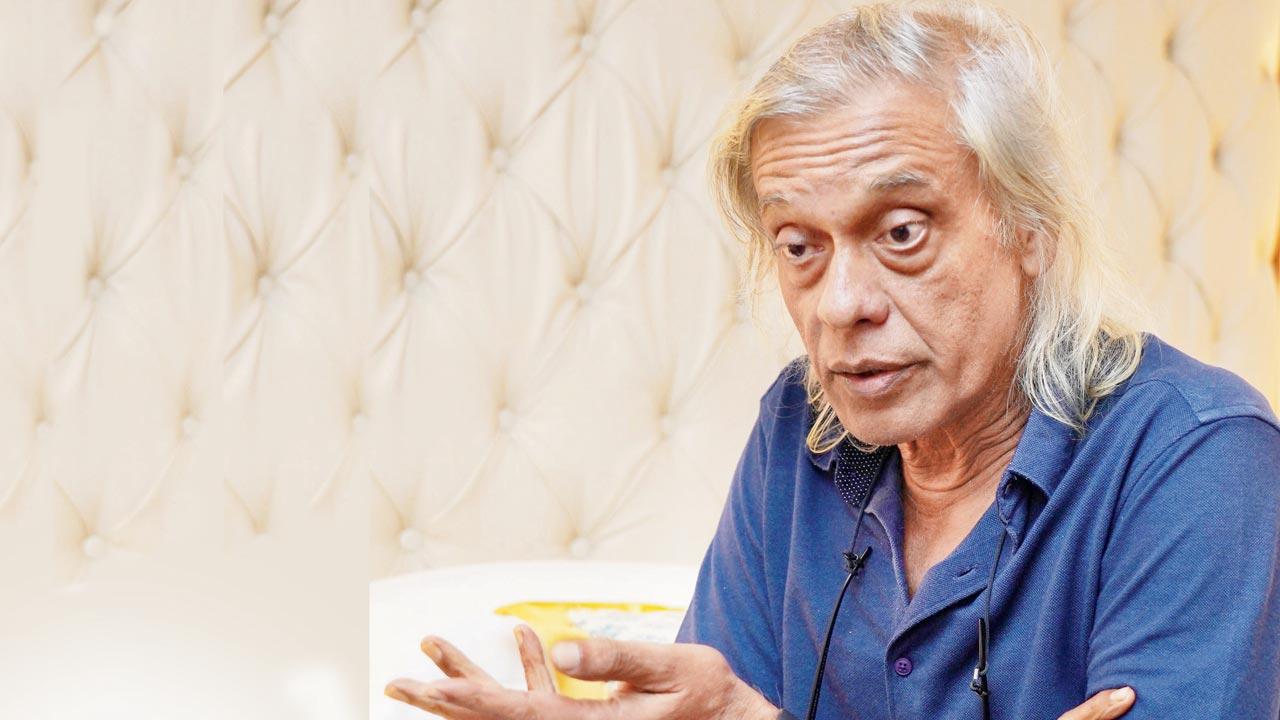
Filmmaker Sudhir Mishra has adapted his grandfather DP Mishra's memoir for his eight-part series Summer of 76. He talks to us about how it is absolutely possible for different viewpoints and polarising opinions to peacefully coexist in a healthy democracy

Sudhir Mishra’s new eight-part series, Summer of ’76, is an adaptation of his grandfather DP Mishra’s political memoir. Pic/Getty Images
On Samvidhaan Hatya Diwas, June 25, a reminder of the Indian Constitution’s suspension during the Emergency, we sat down with filmmaker Sudhir Mishra at his Versova bungalow to discuss his Sony Liv series, Summer of ’76. It’s supposed to be an adaptation of a political memoir by his grandfather Dwarka Prasad Mishra, former CM of Madhya Pradesh — Living an Era.
He clears the air right away saying “it’s not just based on my grandfather’s book”. Then what is it? For Mishra, it’s a retelling of a time that’s never studied with the clarity it deserves. “I have an intimate understanding of the power politics of the Congress and in a very odd way, the politics of India in general. My grandfather had been active since 1939. I’m not totally in agreement with his politics. I’m also my father’s son. My father’s a mathematician. For me, you know, there’s a hypothesis, and it has to be proved. DP Mishra may have been opposed to or followed another kind of politics, like the socialist movement. There was someone called Ramesh Dixit, one of the students who was arrested. So, we took the rights to his life. He’s very close to me, almost like an elder brother. There’s this person called Pushpesh, who is a writer. He was a professor. So he’s also an activist,” he says.
Sudhir Mishra in a behind-the-scenes moment with Rajat Kapoor
The series is a work of imagination based on the lives they have studied. As Mishra says, “It is roughly based on memories. I was 15 when the Emergency happened. We also have the benefit of hindsight. The Emergency, for me, becomes a metaphor. It’s when the powerful stop listening. What happened during the Emergency was that the connection to the ground was lost. There’s a whole generation of people who did not agree with the idea of India that was being handed down to them by their parents. They thought it was problematic. Summer of ’76 is a bit of everything. It’s a rebellion. It’s a rebellious time, which confronts people in power.”
The eight-part series for Sony Liv begins in a university in Delhi. That’s where the confluence of varied ideologies starts. Mishra says, “Everyone is from different backgrounds. There are characters from Dalit backgrounds for whom political commitment is not a choice — it’s a necessity. There are also Muslims whose parents chose to remain in India, and they wanted to participate in this development. It’s a flux of people who accidentally meet and then it becomes their story — a story of passion, of youth, of young people, and excitement..”
A still from Summer of ’76
A common dialogue about Emergency is the blatant unconstitutional censorship. Censorship has been a constant in India regardless of the party in power. Mishra tells us, “Artistes find a way to tell their stories. Many times, we are censoring ourselves. There’s also market censorship. ‘You can’t make this film because people say it won’t run’. Or, ‘You can’t make a film with a woman protagonist because it won’t work’. When I was making Yeh Saali Zindagi, the head of the CBFC asked why the title should have ‘Saali’. Even when I was making Hazaaron, they said, ‘Take out the name of the Congress party’. But if you’re not a sensationalist, and if you have facts behind you, you can make it work. I’m not saying I want censorship, I’ve always opposed it. But sometimes it forces you to avoid the obvious and do something else. There’s a line I use all the time, ‘The shortest distance between two points is a straight line, but the shortest real distance between two points, taking obstacles into account, is never a straight line’. There are always obstacles. So, you have to mark that path and navigate it.”
But censorship in cinema in 2025 has been alarming. A few days ago, mid-day reported how the CBFC’s e-cinema website, which listed all the cuts made to films, went down due to a technical issue. And now it’s clear that people will no longer be able to access what cuts or changes are being requested by the body. Films like Punjab 95, Santosh, Monkey Man, L2 Empuraan, have faced the ire of the CBFC, most not even making it to the release. Mishra says filmmakers need to fight for each others’ rights regardless of their own beliefs. “We’ve all retreated into our own rooms and platforms. We don’t meet each other like we used to. Something changed after the pandemic. The lockdown disconnected people. That community feeling is gone, which is sad. We have stopped fighting for each others’ right to exist regardless of differences of opinions! Politics has become quite polarising. But contrast that with the 1970s during the Emergency. People were still taking stands, even if they were ideologically opposed.
Everyone should have views, but we must also support the right to another view. Now, obviously, there are extremes — like supporting rape or genocide. I cannot support that. But if we disagree on how the world should be better, and we’re both coming from good faith, then that’s a healthy disagreement. I had a very good friend, we used to have massive fights. We’d yell and scream at night, but in the morning, it was fine again.”
Even at 66, Mishra constantly wants to be challenged. “I’ve had people come up to me and say, “That’s the crappiest film I’ve ever seen.” And I didn’t agree, but they had their reasons. I remember one boy once told me, ‘Your film was like the binding on a canteen’s menu—it’s ugly.’ It’s the best criticism I’ve ever heard! It’s about having a view, engaging with the film. Now everything is about “likes.” That word has become a four-letter word. Instead of provoking thought, we want likes. Even among left-leaning or liberal artistes—there’s a kind of toxicity that mirrors the right. I’m not into constant negativity either. A lot of critics sound like there’s nothing to celebrate in India. But I want to celebrate India more. And I have issues with nepotism too—especially the kind of liberal nepotism where people believe genius comes from genes. Nobody owns cinema. It belongs to all who love it. There are kids in Darbhanga making films now.”
One of the prototypes that came out of the ’70s was the Angry Young Man, which everyone says was born out of the rage the common man was feeling at the time. Was there an antithesis to the Angry Young Man? “The angry young man broke the established monopoly and turned everything on its head. He broke the rules because that was the only way in. That’s why he was called a fixer — because there was no other way for him to enter the system. Not everybody was angry, but a lot of people were. They were not being heard. That’s what the Congress didn’t get at the time. The anger wasn’t directed at a specific figure — it was because people weren’t getting justice. They weren’t receiving what was promised. That’s what the Angry Young Man represented — especially in the Salim-Javed films, right? There were people before that too — like Guru Dutt and Bimal Roy — who had already begun questioning society. Popular filmmakers back then were very connected to the people. They came from among them. That’s not the case now. And that’s the criminal act of nepotism — today, cinema has been handed over to people who have no real connection to the audience. How will you make popular cinema if you’re not connected? Cinema needs healthy popular storytelling. For a while, it happened — with people like Vishal Bhardwaj, Anurag Kashyap, and Imtiaz Ali. They all came from small towns and had that connection. But then those doors shut again. Every few years, the industry needs a correction. Back in the day, the state supported cinema. Pather Panchali wouldn’t have been released without government support. That support made Indian cinema what it was.”
Subscribe today by clicking the link and stay updated with the latest news!" Click here!