










In a heavily masculine rap space, these Mumbai girls and queer folk are trying to weave their way into the scene. And they are here to stay
Representational Image
On a Sunday afternoon in Kurla, the crowd at a street cypher thickens around a narrow lane plastered with graffiti. Someone taps a beat on a Bluetooth speaker; the bass bounces off the walls. Dozens of boys huddle close, smokes in their hands, waiting for their turn to spit bars. In the middle of them, a sixteen-year-old girl steps up, adjusts herself, and begins to rap.
“Just wanna be hip-hopper let my story be known / Bawe jake puchte hai ye Kaamkhaas hai kon [bros around ask who is Kaamkhaas] / Buland hai mera hosla aur choti inki soch [my courage is high, their thoughts narrow] / On this path to success I can never gonna wrong,” she spits, as oohs and claps ripple through the circle.
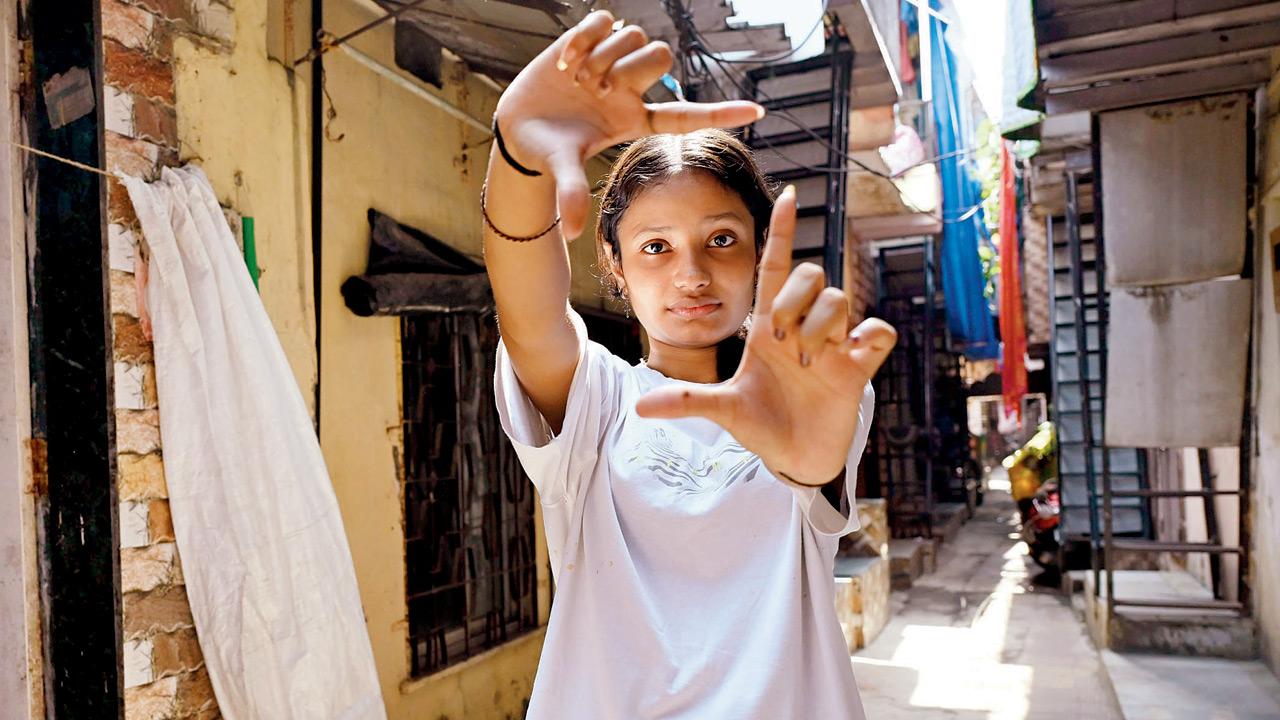
Subhadra Mishra aka Kaamkhaas started out when she was 14 years old, and has been receiving hate online. PIC/SAYYED SAMEER ABEDI
Her name is Subhadra Mishra, alias Kaamkhaas. She raps in Hindi about her parents fighting for her passion, her neighbours’ gossipping about her, and the ache of trying to study while dreaming bigger. “Mere gully mein char aunty baithi rehti [In my lane, four aunties sit around],” she raps, sketching the daily life of her neighbourhood. “Saidham society naam nhi brand banti [The name of Saidham Society isn’t a name; it’s a brand]” — a nod to how ordinary streets and chawls hold stories larger than life.
Globally, the music industry remains heavily male-dominated with 64 per cent of music creators being men, 32 per cent women, and only 6 per cent identifying as gender-expansive, according to TuneCore’s 2025 Be the Change report. The imbalance mirrors what artistes in Mumbai’s underground hip-hop scene experience daily.
“When I go to cyphers,” Mishra says, “there are more than 200 boys and I’m the only girl. Some comment, some push, some even touch without consent. But most hype me up. I forget everything when I rap.”
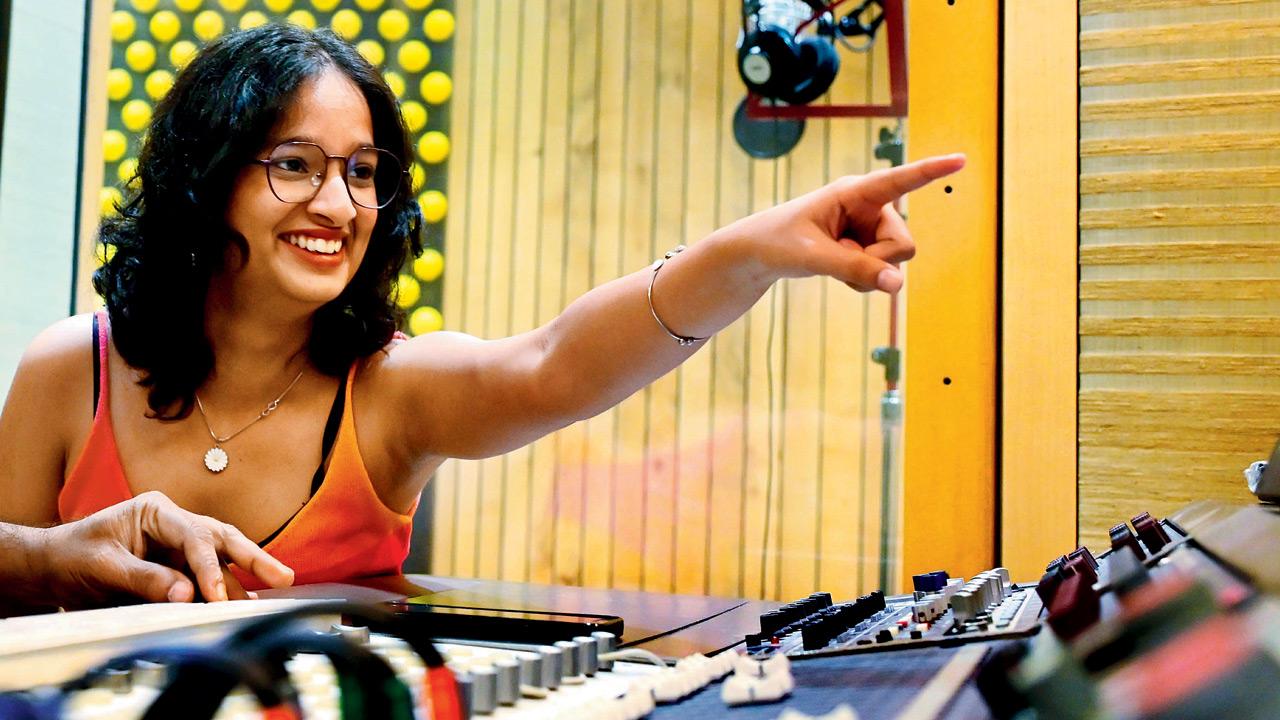
Gamak Sinha discovered rap when she decided to narrate her poetry in Kathak kavith style. Since then, she has not stopped. PIC/NIMESH DAVE
Her journey began with a phone at 14 and a love for poetry. One Instagram reel went viral with over 2 lakh views and the trolling began. “People said I only get views because I’m a girl,” she says. “Even my male rapper friends said it. But I too forget to sleep, spend hours writing. I work just as hard, maybe harder.” Her parents stood by her. “They just ask me to also focus on studies. They saw me getting trolled and still told me, ‘Keep doing it.’ That’s where my inspiration comes from.”
At just 16, Mishra represents a powerful shift in Mumbai’s underground hip-hop scene. Women are no longer just consumers of rap. They are creators, storytellers, and truth-tellers. In a space historically dominated by men, they are finding language for anger, aspiration, and everyday survival.
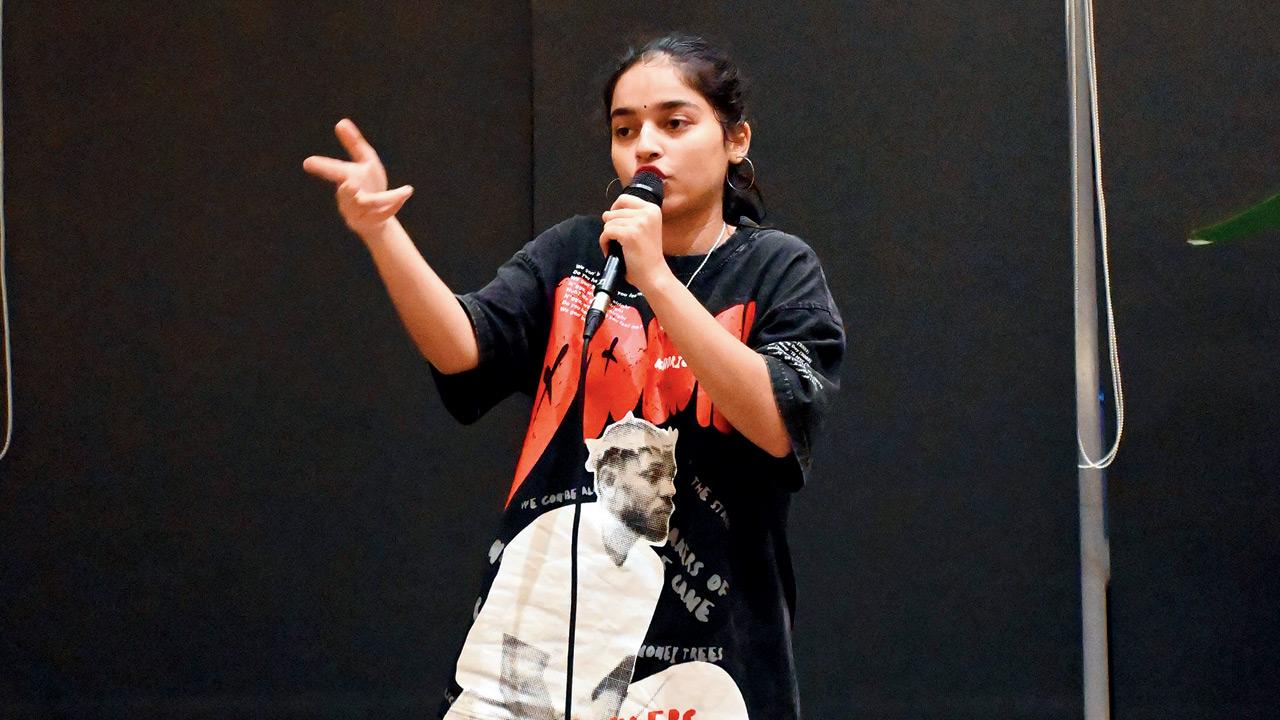
Pranavi Gunti (Pranaviii)
Mumbai’s gallis have long been the cradle of Indian hip-hop. After the movie Gully Boy in 2019, the rap scene exploded, but the gender imbalance remained stark. Out of hundreds, only a handful are women. Now, slowly, a new generation is competing with the mic. Platforms on Instagram have become digital homes for these artistes, casting a limelight to their work beyond tight local circuits. Twenty-somethings, rapping in Hindi, English, Marathi, even Gujarati, are writing their own rhymes of their battles.
Take Gamak Sinha, 22, who shuttles between Pune and Mumbai for gigs. Originally from Uttar Pradesh, she lived in Mumbai for 11 years before moving to Pune. Born into a family steeped in performing arts, rhythm and performance were always part of her life. “We have kaviths in Kathak which are sixteen-beat stories from Hindu myths,” she explains. “I used to write poetry, and when I combined it with kaviths, I discovered rap though I didn’t even know it was called rap at the time. Later, I listened to more artistes and developed my style.”
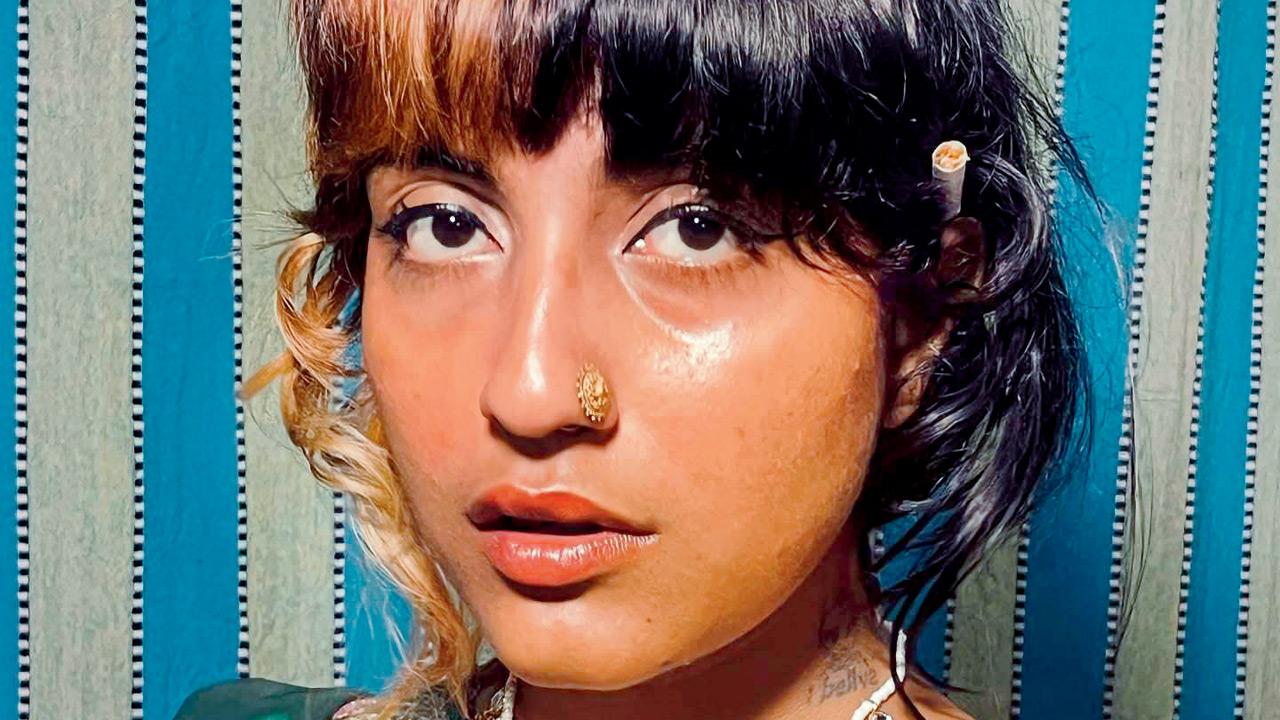
Driti Panchmatia (Demyth)
Sinha completed a degree in hotel management but quickly realised that a 9-to-5 job wasn’t for her. She started performing rap only eight months ago, blending acoustic melodies with her raps. Her first cypher video went viral overnight, taking her from 200 followers to 75,600. “It all happened too fast,” she says. “I felt like a gazelle surrounded by crocodiles.”
Fame came with challenges she hadn’t anticipated. As her lyrics point out, “Is waqt ke aage tu bas sar jhuka [right now hold your head down]/ sadh chuka, kalakaar mar chukka [rotten away, the artiste has died]/ Ya phir hai chhupa [or has been hidden].” “People wanted to manage me, make me a business,” she recalls. “I got stuck in a very unfair contract. They wanted to manipulate my music; my art stopped sounding like my art. They sent me alone to shoots, far away. Once, they even told me to sleep in a chawl because they couldn’t book a hotel for me. I didn’t go. It’s very important for a famous artiste to have a manager, to look out for you. That’s not negotiable.”
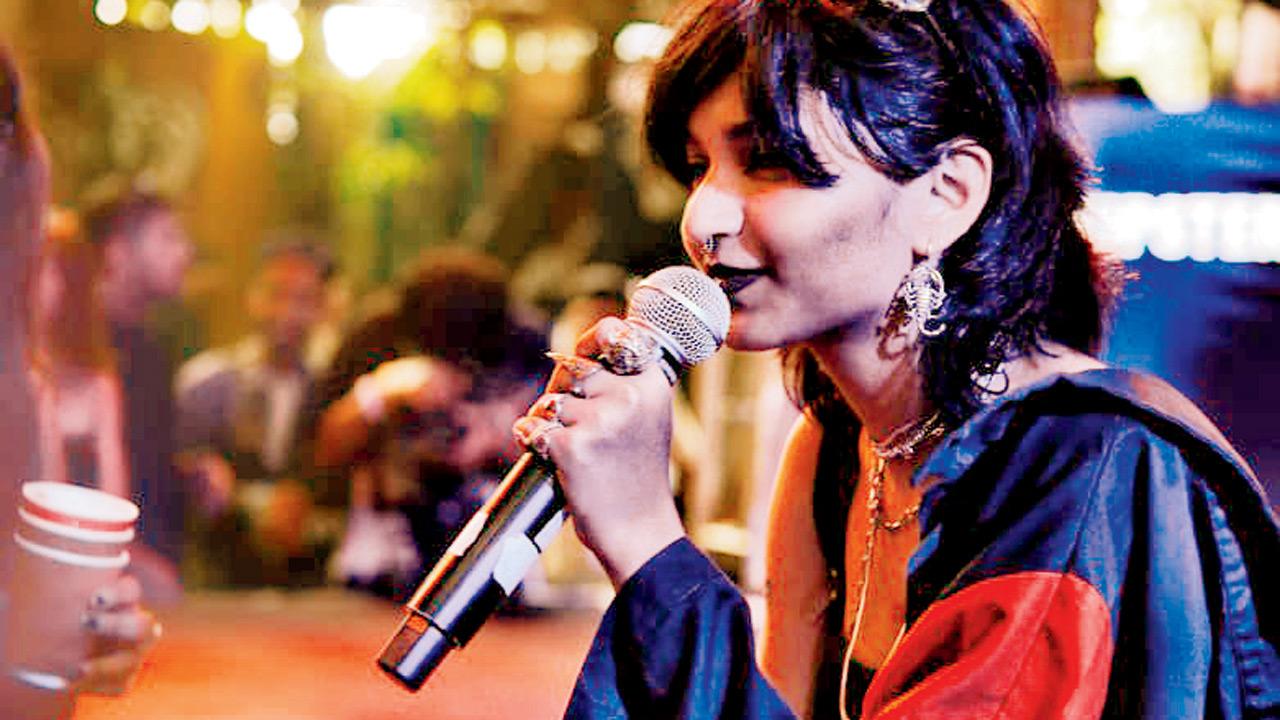
Arson
Sinha also experienced betrayal from peers. “I lost male friends who wanted to collaborate but then edited my parts or blamed me if the song didn’t work out. The industry does objectify women, even subtly,” she says. And yet, she refuses to let it dictate her style. Today, with her manager Sameer Inamdar, she is recapturing her music and her confidence. Sinha’s raps are a blend of self-expression and discipline, rooted in her artistic upbringing and sharpened by the harsh realities of the industry. “I’m still learning,” she says. “But I know my voice is mine, and I won’t let anyone take that away.”
For Arson, a 20-year-old rapper from Jamshedpur who identifies as non-binary (he/him), moving to Mumbai in 2024 was a conscious step toward pursuing music full-time. Originally a poet, Arson’s early fascination with rhythm came from listening to Badshah, but he quickly gravitated toward rap after seeing how lyricism and beat intertwined. “I had a friend guide me through it,” he recalls. “The beauty of rap was that I could combine poetry and storytelling with rhythm and it just clicked.”
Arson dropped out of college after two semesters to focus entirely on music, dedicating himself to building his voice in a space that is still overwhelmingly male-dominated. “My first cypher had 100 guys and not a single woman,” he says. “There are barely any women in the scene. You have to work harder to be seen. You’re judged more harshly, opportunities are fewer, and you constantly feel like you have to prove yourself.”
The challenges extend beyond gender. Being non-binary in India’s underground rap scene has brought ridicule and ignorance. “I haven’t transitioned yet, so people just don’t understand. They mock me, call me names, and try to put me in a box,” Arson explains. “Shows are unsafe. There are creeps, there’s touching, mocking. You have to earn your right to be respected.”
Despite these challenges, Arson channels his experiences into his music. “I have anger in me, which is constant.” His performances, often raw and rhythmically intense, are personal manifestos, turning pain into poetry. He also brings a multidimensional creative background to his work. Outside rap, Arson is a stylist, creative director, and production designer for a theatre company, and this artistic lens informs his music videos and stage presence. “I write now in Hindi too, because building an audience in India for English-only rap is harder. My words are my armour and my weapon. If I don’t fight for my space, no one else will,” he says.
If Arson channels rage, Driti Panchmatia, 22, performing as Demyth, channels resilience. She raps in four languages and has been performing for seven years. “I quit Hotel Management after a year and focused entirely on music. I’ve worked from deliveries to outdoor catering to support myself,” she says. Her journey began after her father’s death, when a friend took her to a cypher to lift her spirits. “I realised there were people like me; people who had lived like me. I felt seen.”
But belonging is complicated. Panchmatia has faced sexualised comments and objectification from male performers. “There’s a lot of hate,” she says. “People tell me to shave my armpits, text me after shows with sexual undertones. I intimidate those who try to intimidate me because I won’t play scared.”
For her, rap is a way to articulate female lived experiences. There’s a stark perception gap that while 50 per cent of women and 41 per cent of gender-expansive artistes report experiencing discrimination in the industry, only 16 per cent of men acknowledge it exists according to the same TuneCore report. This disconnect underscores the challenges female and non-binary rappers face in being recognised and respected for their craft. “A man can’t relate to female music. They know what we go through, but not the nitty-gritties. That’s what we bring to hip-hop,” Arson explains.
Pranavi Gunti aka Pranaviii, 23, from Andhra Pradesh, found rap during lockdown as a release from the chaos of exam pressure. “There was so much pressure in my mind. Writing helped me vent. It made me feel like I existed,” she says. College life introduced her to performing spaces, often as the only female rapper in a group. But anxiety followed her. “I’m conscious of unfamiliar venues. I’ve felt unsafe, claustrophobic, surrounded by men. That anxiety doesn’t affect my performance but ruins my health.” However, she also emphasised that while some try to differentiate, many male rappers have supported her too.
Gunti’s rap is mostly in English — a choice that has brought both privilege and prejudice. “Someone once told me, ‘Venue dekh ke rap karo’ [watch where you rap]. Like English belongs only in certain spaces,” she laughs. Yet her verses carry social commentary. “My rap is edutainment — a little education with entertainment,” she explains. Her lyrics reflect the mental load, social struggles, and aspirations of young women in India.
Every woman in Mumbai’s underground hip-hop scene is fighting battles that go beyond rhythm and rhyme — against harassment, tokenism, and invisibility. “Women in this industry / A rare sight to see / Fight with thyself and then / Fight with the society / Now break your chains and / Set yourself free / Fight for my people / My community,” Gunti’s words echo.
Mishra’s viral fame came with trolling, but she channels it into rhythm. “Ga ga re sa sa re gama nahi hora mere se bro [I can’t keep singing doremifasolati] / Ye expect kar re the gana gau badal diya mene flow [They expect me to sing, I changed the flow] / Now they follow every move where I go / Dreams turning true let the whole world know,” she raps defiantly.
For Sinha, the fight is creative ownership. “Shani chaahe raah pe chalna [Saturn wants you to walk on a path] / Kar karam chala kalam abhi mat phisalna [Keep working, don’t let the pen slip] / Rahu kahe kya hi karna [Rahu says you have nothing to do]/ Kaha hai parinaam [Where is the result] / Sab paise pe palta [It all rolls with money],” she recites, a gentle reminder that control over art and self-expression is still a
daily struggle.
Yet, there is progress. More women are turning up at cyphers. More local collectives are pushing female artistes forward. Social media has made underground fame possible without gatekeepers. As Gunti notes, “The ratio’s still jarring, but at least we’re not invisible any more.”
More women, more power
An A&R (audio and repertoire) expert highlights the importance of female voices in rap. “From a female perspective, it’s frustrating to see stories dominated by men. Women need to make more music; we lack global-level figures like a Cardi B or Charli xcx. When women put their narratives forward, other women join in,” she says, on condition of anonymity. She notes the gender gap shapes the stories told. “The ratio of men to women is huge. Most rap remains masculine because there are so few women. When female artistes are platformed, more join the industry. Families are often more supportive of sons pursuing music than daughters due to industry realities.”
Representation matters for listeners too. “Hip-hop documents life experiences. Women growing up have few female artistes to relate to, which leaves a gaping hole. We need to empower these voices to ensure the female perspective is recorded. The industry is young, but culturally, we’re still catching up. It’s a long journey toward equality, but pushing this narrative is essential.”
No respect for the FemCs
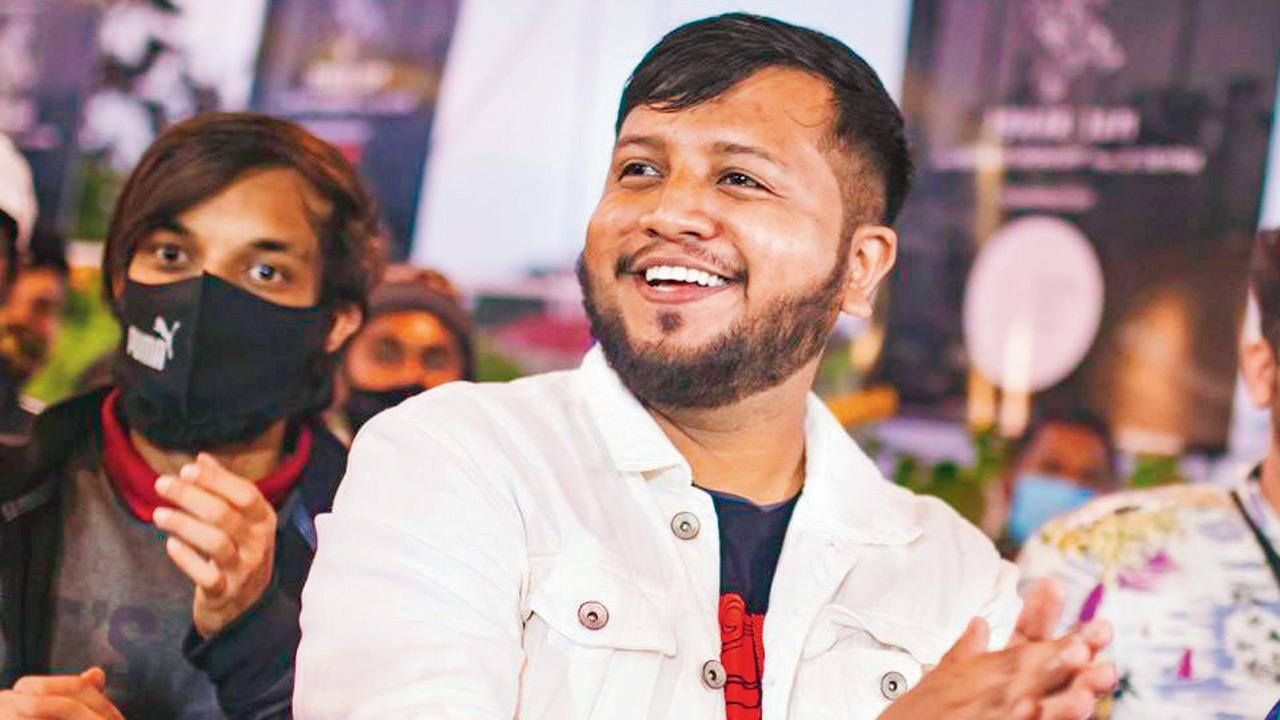
Sameer Inamdar (Rapture)
Sameer Inamdar, 28, aka Rapture, battle rapper from Dharavi and founder of Allegionz, manages and mentors emerging artists. “Male rappers rarely talk about female artistes respectfully. They objectify a woman aggressively if she dares to express herself fully. It’s never logical criticism,” he says. “Female performers have to navigate safety, late-night gigs, and unaccomodating organisers just to get recognised. Organisers or volunteers don’t care about female fans and their conditions in fan pits. They don’t even do the bare minimum of crowd control to make it an inclusive experience for everyone.”
Ajay Bhandare, who runs the Instagram page Cypher_kurla70, adds, “Only two or three women turn up regularly. We try to make them comfortable, manage the crowds, and protect them. When harassment happens, we immediately step in, separate the artiste from the situation, and ‘explain’ to the offender that such behaviour is unacceptable. Male rappers often judge women for using street language or cursing, even though men get fame doing the same. It’s hypocrisy.”
Both highlight that while Mumbai’s underground hip-hop is expanding, female rappers constantly navigate unequal scrutiny, harassment, and objectification. The presence of mentors and responsive organisers is crucial to help them own their space, perform safely, and be respected in a male-dominated scene.
 Subscribe today by clicking the link and stay updated with the latest news!" Click here!


