Finally, the Holy Cow interview

18 November,2025 06:55 AM IST |  Mumbai  |  C Y Gopinath

In 2031, after it came out that cows were not only holy but could communicate with humans, I was privileged to be the first journalist to interview one

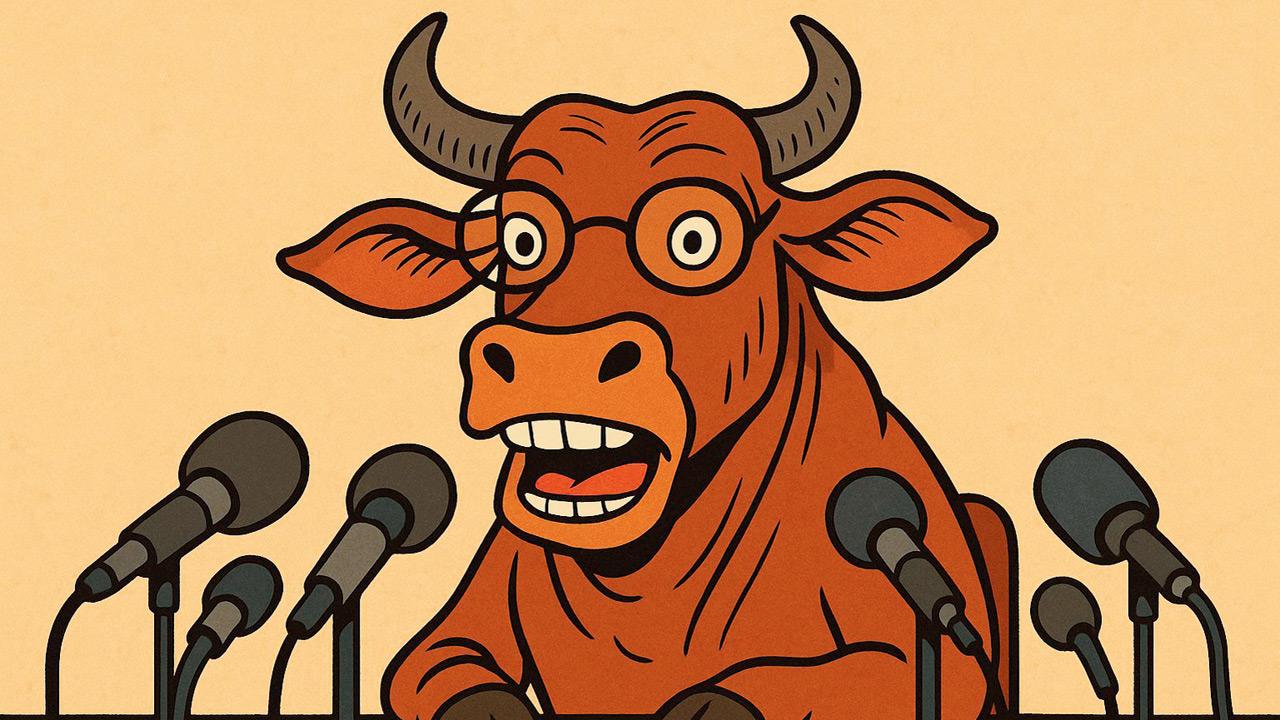
Now beef is banned for all Hindus — and thank God. We cows in a good place today. I mean, imagine if they’d decided goats were holy. illustration by C Y Gopinath using Ai


Your browser doesn’t support HTML5 audio

The Rashtriya Godhan (Cowherd) Mahasangh held its annual summit last week from November 5 to 9 at a stadium near India Gate, Delhi. It was attended by policymakers, dairy experts, and gaushala representatives, along with an exhibition of cow-based products like panchagavya, made from pure cow dung, cow urine, milk, yoghurt, and ghee. The event was so epic that Mr Balaram Pani, Dean of Colleges of Delhi University, long regarded as a bastion of free speech, spoke up loudly, sending a memo on October 31 to principals encouraging students and faculty members to attend this ground-breaking conference.

To make sure that there were no distractions, the university cancelled a scheduled seminar on Land, Property, and Democratic Rights, part of a university lecture series that has been running for six decades. How could that possibly be more vital to the national interest than the welfare of cows?

In 2031, thanks to the huge investments made in researching every aspect of this sacred animal, we learned that holy cows can communicate, using a sophisticated language close to telepathy. It also came out that all cows are thoroughly conversant with Sanskrit. It was a matter of time before the world's first university for the higher education of cows was opened, the Gomata Mahavidhyalay, on a campus near Varanasi. I was privileged to have the first-ever interview with a holy cow, this one the Dean of Colleges at said university. I spoke to her as she grazed peacefully, occasionally snorting.

"If cows are holy, why do we exploit them so much?" I asked. "We take all their milk, their urine, and their dung. Do we call cows holy just to make them feel good?"


Let's talk about Bombai. Click the QR code above to join my WhatsApp group to share your Bombai stories for my book - and perhaps answer some of my Bombai questions.

"All wrong, Mr G," said the cow. "Only certain Indian cows, the ones with humps, are considered holy. Specifically, they include the breeds called Ongole, Gir, Sahiwal, Haryanvi, Kankrej, Red Sindhi, Rathi, Lalkandhari, Gangatiri, Hallikar, Ponwar, Nimari, Golao, Vechur, and Deoni. They're the ones with humps, called zebu cows. The rest are just, well, unholy cows."

"But - " I began.

The cow burped. "Indians worship all cows just to be safe. I bet you couldn't tell an Ongole from a Deoni or Hallikar."

"What's the big deal with the hump then?" I asked.

"Ah, that," she said, swishing flies away with her tail. "Like Indian farmers, zebu are designed to survive weeks and months of hot dry spells with no rain, drawing on food and water stored in their humps. They also stop lactating and some become barren."

"You don't say, ma'am," I said.

"Little factoid about the milk," she continued. "Holy cows produce less than half the milk Indians drink. India's source of steady, high-quality milk is the female water buffalo, whose milk has higher butterfat content."

"Should the female water buffalo also be holy then?"

"Uno momento," she said. "The real reason why cow slaughter is banned is that cows produce calves, some of which will become bulls. Castrated bulls are oxen, the single most important animal for the Indian farmer.
They're docile, trainable, safer to handle and incredibly rugged and strong. Without his oxen, the farmer is finished. They're his tractor, thresher and family car combined."

"So oxen are also holy?"

"No," said Madame Cow. "It's the cow that is holy, because she produces the bulls that can be turned into oxen. Oxen are just the labour class, to be exploited."

I must have looked blank, because she continued. "Let me explain again. In a drought, cows become dry and barren, and many poor farmers kill them off rather than struggle to feed them. But here's a little secret - many of those cows will become fertile again once the rains come, and resume producing calves."

"Calling them holy prevents their slaughter," I said, as light dawned. "But wait - wouldn't this mean that ageing, unproductive cows also survive?"

The old lady released a gust of methane. "Holy cows may not be slaughtered. But this ruling applies only to card-carrying Hindus," she said cryptically. "As we say in Sanskrit, Tvam ganitam karoshi. You do the math."

"I get it. A farmer could tether an old or barren cow and let it starve to death."

Burp.

"Or yoke a calf with a wooden triangle that would irritate the mother's udder so much that she would kick it to death."

Burp.

"Or quietly drive useless cows across the border to Bangladesh at night, knowing they would be skinned, cooked, and converted into bags."

"You're very clever," said the grand old bovine. "Are you sure you're not a cow?"

A final question came to me. "But what's even holy about you?"

"Nothing. We weren't holy 4000 years ago," said Her Bovine Majesty. "Hindus used to slaughter us for sacrifice, and eat us happily at ceremonial feasts hosted by Brahmin priests. By 200 AD, only rich people were allowed to eat us. Now it's banned for all Hindus - and thank God. We're in a good place today. I mean, imagine if they'd decided goats were holy."

"I get it," I said, getting it.

"You probably don't," said Madame Cow. "But as an ancient sage said, Arthavyavastha eva, murkhah - It's the economy, stupid."

You can reach C Y Gopinath at cygopi@gmail.com
Send your feedback to mailbag@mid-day.com
The views expressed in this column are the individual's and don't represent those of the paper.

"Exciting news! Mid-day is now on WhatsApp Channels Subscribe today by clicking the link and stay updated with the latest news!" Click here!
mumbai columnists C Y Gopinath mumbai news delhi
Related Stories