











Every Sunday, Central Railway halts select suburban services for essential Mega Block operations. These scheduled pauses enable over 500 workers to inspect, repair, and upgrade tracks, signals, and overhead wires, ensuring safer, smoother journeys for commuters
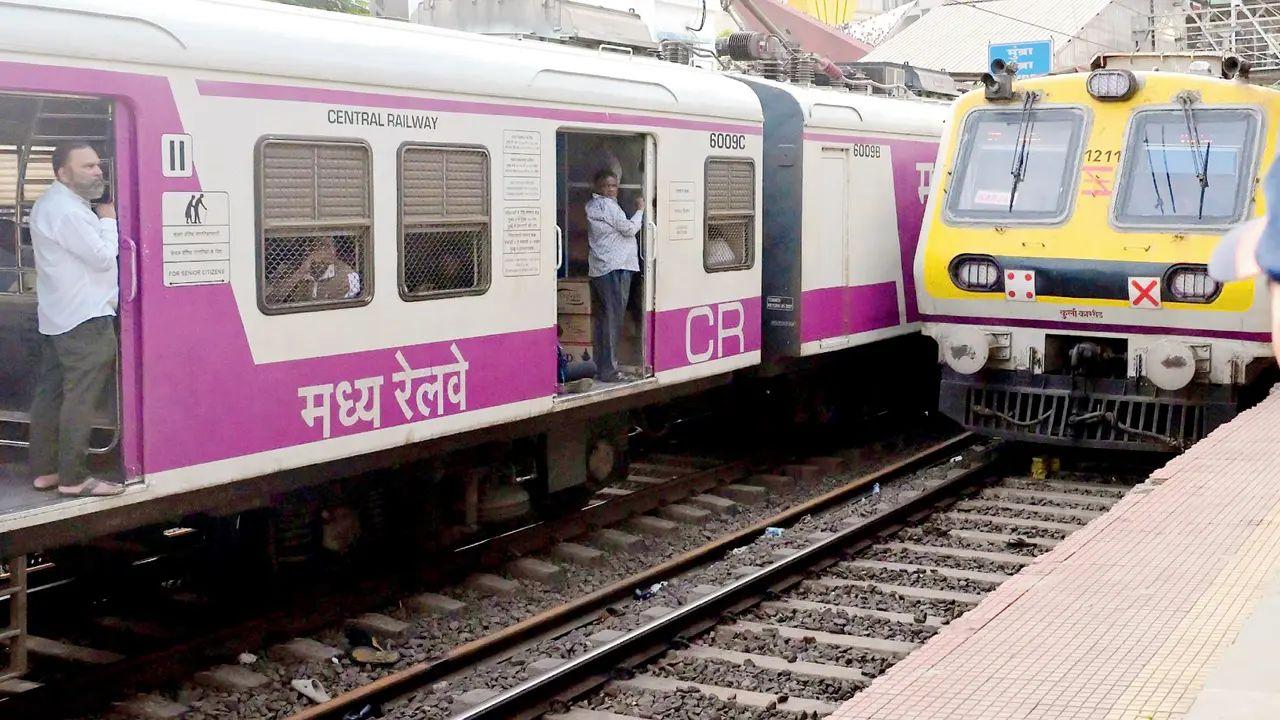
Central Railway’s Sunday Mega Block enables essential track and signal maintenance. Representational Pic
What happens on a Sunday mega block on CR
Central Railway’s suburban rail network, spread over CSMT to Karjat –Khopoli and Kasara on the main line, CSMT to Panvel/ Bandra on the Harbour line, Thane to Panvel on the Trans Harbour line and Nerul / Belapur to Uran on the Port line, runs over 1810 Suburban train services daily on its vast 325 km Suburban network. It also runs more than 210 Mail & Express trains on the Main lines daily.
Suburban services start from the first train starting its journey at 02.06 hrs to the last train reaching its destination at 02.30 hrs, serving people and ensuring a safe and smooth journey for all. This implies that the train services operate around the clock and more than 40 lakh people travel daily in these trains
What is a Mega Block
Running such a large number of train services puts a huge burden on the infrastructure, which results in wear and tear. This includes rails, sleepers, signalling equipment, Over Head Equipment, Electrical fittings, track fittings, etc. These need to be maintained regularly to ensure efficient and uninterrupted train operations.
The time for maintenance available every day is not adequate since the time margin between the last train and the first train is hardly a couple of hours. This duration is further affected due to various reasons like late running of long-distance trains, technical issues and failures at any intermediate locations, Snags due to heavy rainfall during the monsoon, etc.
Also, nighttime working has limitations like reduced visibility and is not as convenient and productive as daytime working. Besides, temperature-sensitive work like de-stressing cannot be carried out during the night, when the temperature is low.
Hence, it is essential to plan a periodical time slot once a week for maintenance work, which is called a Mega Block.
Mega Block can be termed as a ‘Breathing space for infrastructure work’ and is usually taken up section-wise on Sundays since the volume of passengers travelling is comparatively less and besides cancellation of a few train services or changes in train running schedule on weekdays, inconveniences a significant number of commuters.
How is Mega Block planned?
Mega Block planning begins with the identification of critical maintenance or replacement works that require track isolation and cannot be carried out under traffic. Based on asset condition monitoring, failure analysis, and project timelines, a priority list of work is drawn up.
This is followed by joint coordination & integration meetings with Engineering, Signal & Telecommunication, Electrical and other concerned departments to plan work in such a way as to ensure concentrated efforts for maintenance. Detailed job charts are prepared, indicating:
• Work site and nature of work
• Machine & Manpower deployment plan
• Safety precautions and disconnection/reconnection protocols
• Pre-block testing and post-block commissioning strategies
The block proposal is integrated at the Divisional Control Office for overall traffic block plan and final execution is done only after confirmation of material availability, readiness of skilled manpower and site clearance.
What happens in Mega Block
Although the operation of the Mega block involves work related to multiple departments, the major departments involved are as Engineering, Signal & Telecommunications and Electrical
Engineering Department-
The Engineering department is responsible for all work related to Track laying, Construction of Foot Over Bridges, Launching of Girders and maintenance of the same. It includes Road Safety Works like the construction and maintenance of Road Over Bridges, Road Under Bridges. It also includes upgrading railway tracks, rails, sleepers, ballast, and other infrastructure to ensure efficient, smooth and safe train operations.
The various works carried out by the Engineering department are:
• Replacement & Maintenance of Track components including Rails, Sleepers, Switches, Switch expansion joints, Glued joints, Turnouts etc.
• Renewal of Ballast,
• Rectification of defective or irregular track layouts,
• Inspection & maintenance of special track layouts
• Tamping work for lining, levelling and twist correction of sleepers,
• Deep screening of fouled ballast,
• De-stressing of Long welded rails to ensure stability and prevent buckling or fracturing,
• Welding work to ensure continuity of rails, eliminating rail joints, USFD testing to detect internal flaws in rails & welds to enhance track stability and ensure track safety and reliability
• Inspection of fish plates and landing joints to ensure track integrity,
Work done during monsoon
• The railway team leaves no stone unturned to ensure seamless operations of trains during the monsoon.
• Pumps are installed at strategic locations for enhanced pumping out of rainwater from railway tracks during the rains.
• Work of De-silting and cleaning of drains, culverts is carried out with loading of muck onto muck special wagons & trains for disposal.
• Work of cutting & trimming tree branches which pose a risk to safe running of trains.
• Erection / Installation of Tunnel Portal, Rockfall barrier, Boulder netting, Canadian fencing and Boulder catching sumps on the ghat section before monsoon to ensure safe train operations.
• In addition, major works like replacement of Girders, Structural repair & maintenance work of Foot Over Bridges / Road Under Bridges and Dismantling of redundant structures are also undertaken during mega block.
Manpower & Machinery Used-
The work is carried out with a workforce of more than 200 workers, including both railway personnel and contractual workers under the direction & supervision of technically competent Officers and Supervisors having adequate experience.
Following machines are used for the work:
• Track Relaying Train for renewal of Sleepers.
• Ballast Cleaning Machine for ballast cleaning of plain track and turnouts.
• Dynamic Track Stabiliser Machine for stabilising of track (ballast bed).
• Multi-Purpose Tamping Machine for spot attention of plain tracks & turnouts.
• Continuous Tamping Machine for lining, levelling, twist correction & tamping of sleepers.
• UNIMATE Point Crossing Tamping Machine for tamping of turnouts.
• Utility Track Vehicle for loading/unloading of materials like rails, sleepers and other heavy Permanent Way Materials.
In addition, other machines like Poclain & JCB for loading of muck, USFD testing machines for testing of rails & Welds, GEDO machines for track survey and Rail cutting/drilling equipment, Welding equipment, Gas cutting equipment, etc, are also used.
Safety Precautions-
The entire work is done with adequate safety precautions like obtaining Caution Orders, Placement of protection boards, Use of hooters at work to alert the workers of approaching trains, Retro-reflective jackets for enhanced visibility, and use of safety tools like Banner flags, Red & Green flag, Detonators, Safety gloves, helmets safety belt, Mould shoes etc.
Signal & Telecommunication Department-
The Signal & Telecommunication department is responsible for the installation, renewal, repair and maintenance of all Signal equipment and safety-related interlocking works.
The various works carried out by the Signal & Telecommunication department are:
• Replacement of overaged Track Circuits / Digital Axle Counters, enhancing detection accuracy and reducing maintenance requirements.
• Replacement & Overhauling of worn-out or defective Point Machines to ensure smooth and dependable turnout operations, critical for safe train routing.
• Replacement of Dilapidated or corroded signal posts to maintain structural integrity and reliable signal display.
• Replacement / Removal of Defective glued insulated joints, vital for track circuit insulation to restore track circuit separation and maintain detection integrity.
• Meggering of Signal cables to assess insulation resistance and replacement of damaged cables to improve system reliability.
• Renewal of rusted junction boxes, post boxes, and execution of proper track circuit bonding to ensure uninterrupted signal and track circuit functioning.
• Testing & Commissioning of New Installations, including signals, point machines, relays, and circuits to ensure safe integration with the existing system.
Besides the work of shifting Signal posts to a new location due to various reasons like yard remodelling, introduction of new lines or changes in track alignment, along with the shifting of signal cables to improve visibility, is also done during a mega block.
Manpower & Equipment Used-
The work is carried out with a workforce of more than 200 workers, including skilled railway personnel and contractual workers under the direction & supervision of technically competent Officers and Supervisors having adequate experience.
These works are carried out with the help of equipment like: Insulation Tester, Earth Testing Kit, Digital Multi-meter and Clamp Meter and Track Shunt Resistance Meter, Relay Testing Kit, Cable Jointing Tools, etc.
In addition, other equipment like handheld termination & splicing tools, Portable lights, DAC tool kits, Spanners, hammers, etc, are also used.
Safety Precautions-
The entire work is done with adequate safety precautions like Safety gloves, helmets, safety belts, moulded shoes, etc.
Electrical Department-
The Electrical department is responsible for providing electric supply for train operations through Over Head Equipment(OHE) and maintenance of EMUs. Its work during mega block involves installation, replacement, repairs and maintenance of all infrastructure related to OHE.
It is responsible for the upgradation and maintenance of all electrical equipment to ensure efficient, uninterrupted, smooth and safe train operations.
During the block, the Electrical department also carries out repairs & maintenance of EMUs which are not in service on the days of the block.
The various works carried out by the Electrical department are as follows:
• Replacement & Maintenance of OHE Components like worn-out contact wires, catenary wires, droppers, insulators, section insulators, auto-tensioning devices and corroded bonds.
• Switchgear & Sectioning Works like Replacement/repair of Isolators, Interruptors, Air Break Switches (ABS) and Overhaul and testing of Switching stations.
• Foundation laying & erection of new masts/portals, Replacement of rusted or damaged masts and Realignment or height adjustment of OHE structures.
• Maintenance of turnout overlaps, crossovers, and neutral sections and adjustment of wire height and stagger at points and crossings.
• Earth resistance testing and improvement (new earth pits) and Replacement/repair of surge arresters and protection devices
Manpower & Machinery Used-
The work is carried out with a workforce of more than 200 workers, including skilled railway personnel and contractual workers under the direction & supervision of technically competent Officers and Supervisors having adequate experience.
Following machines are used for the work:
• Tower Wagon(TW) used for accessing OHE wires, maintenance, and replacement works
• Rail-cum-Road Vehicle (RRV), which can be used for both rail and off-track OHE works
• Hydra Crane or JCB used for mast erection and unloading heavy equipment
• In addition to Hand tool equipment, Electrical testing instruments and Measurement & Safety tools are also used.
Safety Precautions-
The entire work is done with adequate safety precautions like obtaining a Power block, Earthi and discharge of OHE before work, Placement of protection boards and banners and Use of insulated tools, including special shoes with insulation to facilitate easy and safe working by the staff.
The Manpower Behind Mega Blocks
The entire work during Mega Block by the Engineering, Signal & Telecommunication, Electrical and other departments is carried out simultaneously on the entire section with efficient co-ordination of Senior Officers at the Divisional Headquarters, the Control Office, Officers and Supervisors on the field and the team of railway and contractual workmen so as to achieve the targeted work in the planned timespan.
More than 500 railway personnel and contractual workers, including skilled workmen, along with technically competent Officers and Supervisors having adequate experience, work collaboratively during Mega Blocks. Their effort ensures the execution of multiple, time-sensitive tasks across disciplines in a limited window.
When a majority of the City’s population is enjoying the Sunday holiday at home, when the commuter traffic is less on Sundays and Festivals, the entire dedicated team of Railway personnel are working in the field, ensuring the safety and security of trains.
Why Mega Blocks are essential
Mega Blocks are vital enablers of long-term reliability, operational safety, and network modernisation. Unlike working on running tracks with extreme caution and limited windows during regular days, Mega Blocks provide a dedicated time slot free from train movements, allowing safe and uninterrupted execution of critical tasks.
Many works—especially those involving crossovers, turnouts, or locations affecting both UP and DN lines—require complete isolation of the section. Mega Blocks make it possible to undertake these complex works efficiently without jeopardising safety. All equipment installed or modified during Mega Blocks undergoes thorough functional testing, ensuring the correctness of various aspects. This minimises the risk of failures, thereby enhancing the safety envelope of train operations.
Mega Blocks provide a dedicated time window, usually during off-peak periods on Sundays or holidays, when train operations are temporarily diverted over selected sections to facilitate critical maintenance, renewal, and upgradation works. Given the volume of daily traffic, even minor faults can have cascading effects on punctuality and safety.
Mega Blocks are not disruptions—they are strategic pauses. They are the backbone of preventive maintenance, capacity augmentation, and safety assurance for Central Railway’s high-density suburban and long-distance operations.
By effectively utilising off-peak hours, these blocks allow railway departments to work in synergy, modernising infrastructure while ensuring continuity, reliability, and above all, passenger safety.
“Behind every Mega Block lies a Mega Effort – a silent yet powerful testament to the Railway’s commitment to excellence.”
 Subscribe today by clicking the link and stay updated with the latest news!" Click here!


