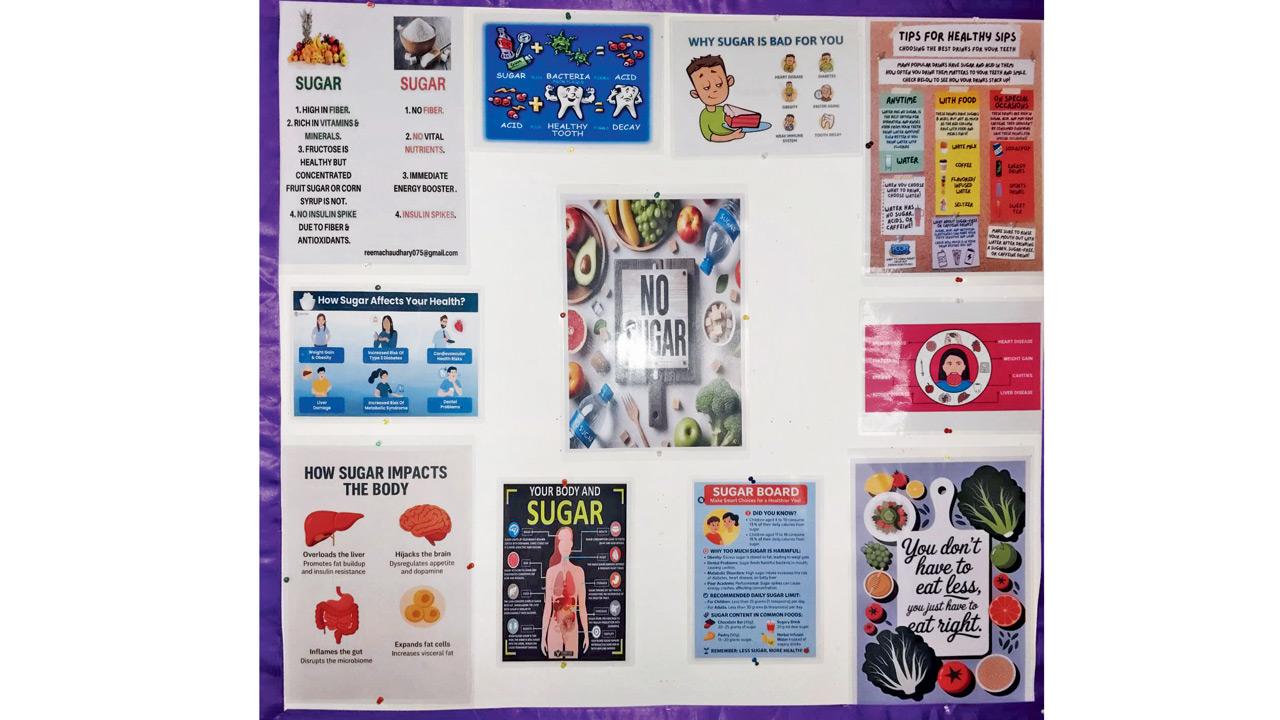
St Pius School in Mulund has scheduled a school assembly in the coming week to introduce young students to the concept of sugar boards. “We will start by putting up the sugar board at the school gates so that parents can see it too,” said a school teacher

A board highlights the harmful effects of sugar on the body
Following the guidelines issued by the National Commission for Protection of Child Rights (NCPCR), schools in Mumbai are set to implement the sugar board initiative in novel ways. While schools falling under certain BMC zones have already been asked to implement sugar boards, private schools are also preparing to go live with theirs.
St Pius School in Mulund has scheduled a school assembly in the coming week to introduce young students to the concept of sugar boards. “We will start by putting up the sugar board at the school gates so that parents can see it too,” said a school teacher. While the school cafeteria still offers sugary drinks, officials are planning to switch to healthier food options, expecting greater engagement from students after the launch of sugar boards.
“We especially aim to communicate this to older children, who already have autonomy over what they eat during school breaks. Eventually, we hope to involve all students in creating sugar boards so that each classroom can have its own reminder,” a teacher told mid-day.
The sugar board initiative was launched to raise awareness about the significant rise in Type 2 diabetes among children. Studies by the Central Board of Secondary Education show that sugar accounts for 13 per cent of the daily calorie intake for children aged 4 to 10 years, and 15 per cent for those aged 11 to 18 years—whereas the recommended limit is just five per cent. The CBSE, along with the NCPCR, has suggested that sugary snacks, beverages, and processed foods in school environments contribute significantly to this high sugar intake. As a result, schools across the country have been encouraged to initiate conversations around sugar consumption.
At St Xavier’s School in Kanjurmarg, students only have access to mid-day meals, with no sugary food items or cafeterias. “We plan to create charts on diabetes, different food groups, the sugar content in each, associated health risks, and the consequences of lacking access to healthy food,” said Vice-Principal Suchitra Nair.
The school also prohibits children from distributing sweets on their birthdays to prevent unhealthy eating habits and comparisons among peers. “The success of sugar boards will depend on how well they are implemented. Schools are already addressing several key messages — be it about drug addiction, environmental consciousness, or the Majhi Shala, Sundar Shala initiative. To make sugar boards effective, parents must also take responsibility for what their children consume at school,” Nair added.
In addition to setting up boards, schools are exploring interactive ways to raise awareness about sugar intake. From smart boards to assemblies, the initiative is being incorporated into school calendars.
“We will use assemblies, parent orientations, and Doctor’s Day celebrations as opportunities to discuss sugar boards. We’ve been raising awareness among students, parents, and staff, and have encouraged children to distribute fresh fruits, dry fruits, chikki, homemade savouries, or stationery instead of chocolates on their birthdays,” said Taskeen Bhore, Principal of Diamond Jubilee School.
Last week, in response to the central initiative, the education inspector of BMC’s North Chembur Ward instructed all schools under the ward to take note of the establishment of a Sugar Board, educate students, and take appropriate action. While schools prepare to implement these boards, experts caution that visual representation alone may not be sufficient to teach children about the dangers of sugar.
“Simple boards and images haven’t worked for cigarettes or drugs, so it’s unlikely that token sugar boards will be effective. If schools are serious, it should become a full-fledged campaign where the harms of processed food are included in the curriculum. Banning such items from canteens or enforcing a no-plastic policy may prove more effective. Children should also be taught to read food labels from an early age,” said Dr Dayal Mirchandani, psychiatrist and director of the Behavioural Science Network.
Subscribe today by clicking the link and stay updated with the latest news!" Click here!