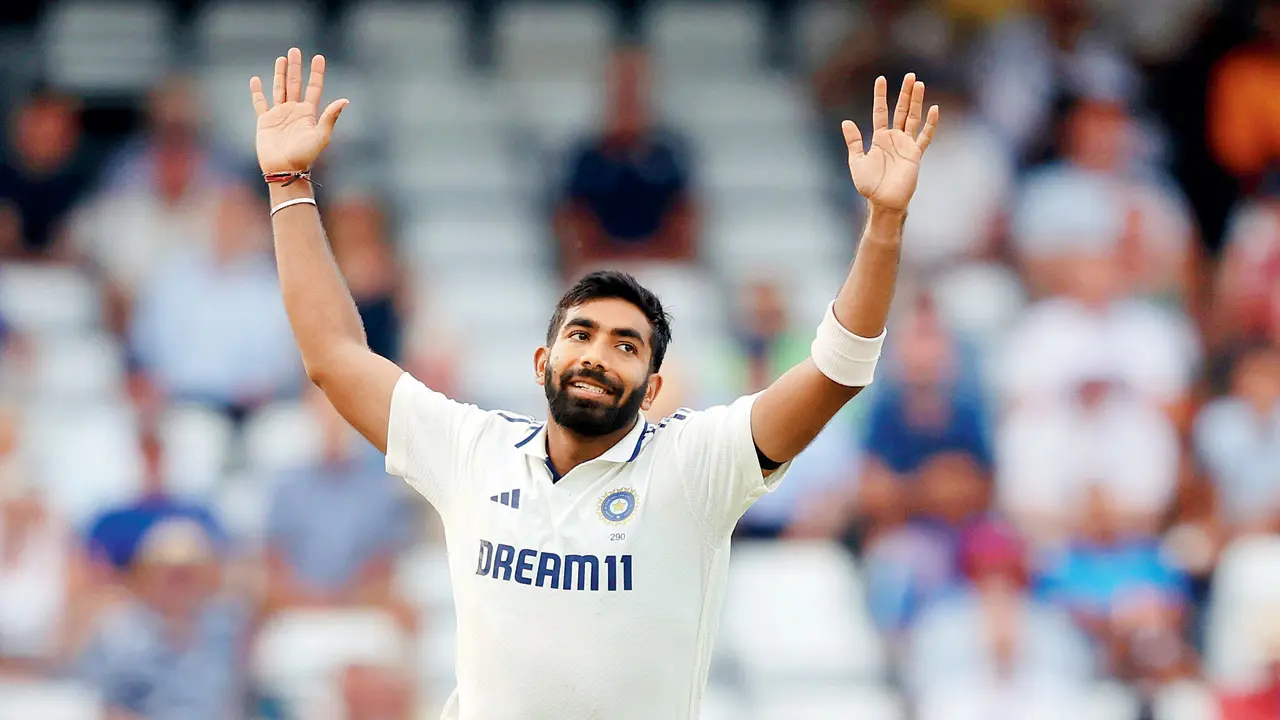
While several pundits feel Jasprit is the best fast bowler they’ve seen, the list of other pacemen known for skill, fortitude, longevity and, of course, their big bag of wickets is not a short one

India’s Jasprit Bumrah celebrates dismissing England Joe Root on Day Two of the Leeds Test last Saturday. Pic/Getty Images
The brilliance of Jasprit Bumrah has given rise to the question of who is the greatest fast bowler of all time.
Michael Vaughan, England’s 2005-Ashes winning captain, reckons the Indian pacer is the finest fast bowler he has seen. The Yorkshireman is known for making over-the-top statements, but he has seen a lot of international cricket as a player and broadcaster to get people to agree with his assessment.
Bumrah tops the heap with a superior average among all fast bowlers to have claimed more than 200 wickets, and that’s an impressive stat to go in his favour.
Cricket has seen some great fast bowlers. The Australians will point to Dennis Lillee as their greatest. Jeff Thomson will be rated as the quickest of fast men. And Ray Lindwall, who bowled for Australia in the Don Bradman era and beyond, was considered a great one too. But Lillee’s remarkable tenacity, which he displayed while overcoming a career-threatening back injury in 1973, put him ahead of other Australians when it came to the ‘best’ category. Lillee was told by his doctor that he’d never bowl again. He refused to accept that, worked his way through a tough and innovative recovery process and ended up being the highest wicket-taker in Test cricket by the time he quit in 1983-84. Yes, he went wicketless in his first two Tests on the sub-continent (vs Pakistan in 1979-80), claimed three in the final Test of that series and returned with only three wickets in the one-off Test on the 1982-83 tour of Sri Lanka when off-spinner Bruce Yardley bowled Australia to an innings victory.
Experts, teammates and adversaries rate Lillee’s bowling partner Jeff Thomson as the quickest they’ve faced, along with Michael Holding.
The West Indies had a battery of fine fast bowlers before and after the famous quarters of the 1970s and 1980s. Curtly Ambrose was big, mean and unplayable at times. His partner in prime, Courtney Walsh, was blooded in 1984 when the West Indies still had Michael Holding, Joel Garner and Malcolm Marshall were still around, and he picked the right brains for him to claim 519 Test scalps. Walsh was a one-time record holder, but it is believed that Marshall was better than the rest. Wes Hall, an all-time great fast bowler himself, said in 1999, the year Marshall succumbed to cancer, that his fellow Barbadian was the greatest fast bowler of all time.
After all, the Bajan dismissed a legion of quality batsmen.
Dr Rudi Webster, like Hall, has seen a factory full of fast bowlers through the years in his roles as manager and psychologist of West Indies teams. Dr Webster told me earlier this week that Marshall was the best in his time, but Bumrah is the greatest ever. Mind you, Dr Webster was also a fast bowler who claimed 200-plus wickets for Warwickshire county, whom he served from 1962 to 1966.
How can fast bowling greatness be dwelled upon without the mention of Fred Trueman, the first bowler to claim 300 wickets? Scyld Berry, the incisive cricket writer from England, told us only the other day what Trueman said when his biographer John Arlott asked for title suggestions for a biography he was writing on Trueman. “The finest bloody fast bowler that ever drew breath,” suggested Trueman. Of course, the book was just called Fred - Portrait of a Fast Bowler by John Arlott.
Another Englishman — Sydney Barnes — was placed in the great category. In 27 Tests from 1901 to 1914, he claimed 189 wickets at 16.43. Had he been less of a moody cricketer, he would have been on the 1903-04 tour of Australia, according to John Woodcock in the book One Hundred Greatest Cricketers. “He played when he wanted and said what he liked,” wrote Woodcock.
The late Richie Benaud included Barnes in his best World XI DVD; the rest being Jack Hobbs, Sunil Gavaskar, Don Bradman, Sachin Tendulkar, Viv Richards, Imran Khan, Garfield Sobers, Adam Gilchrist, Shane Warne, and Lillee.
When it comes to the Asian countries, popular opinion says Wasim Akram is the greatest Pakistani fast bowler. Batsmen in team meetings spent hours discussing how to tackle him, but it had no effect the next day. And while we justifiably think the world of Bumrah, let’s not forget 434-wicket man Kapil Dev. Ditto Chaminda Vaas, whose 355-Test wicket tally is the best from a Sri Lanka fast bowler.
Dale Steyn tops the list of most successful South Africa pacers with 439 wickets in 93 Tests, while when it comes to New Zealanders, one cannot see many people disagreeing over Richard Hadlee being their greatest fast bowler, the first man to scale Peak 400. “There can be no higher praise than to say that Hadlee bears comparison with Dennis Lillee. Both usually made the ball leave the right-hander, and both were blessed with classical, smooth, side-on actions which enabled them to bowl for long spells over a period of years,” wrote Imran Khan in All Round View, a sentiment shared by David Gower in his book, Heroes & Contemporaries.
Current leader of the pack, Jimmy Anderson’s Test 704 wickets is an unbelievable tally which will take a superhuman effort to surpass. Bumrah has 210 Test wickets in just 46 Tests.
Considering the rigours of current-day cricket that includes IPL appearances, it will be tough for the great Indian to match Anderson’s wicket tally.
Whether there will be a chorus for Bumrah being the greatest is to be seen, but it’s remarkable that an Indian fast bowler is in the conversation.
mid-day’s Deputy Editor Clayton Murzello is a purist with an open stance. He tweets @ClaytonMurzello
Send your feedback to mailbag@mid-day.com
The views expressed in this column are the individual’s and don’t represent those of the paper.
Subscribe today by clicking the link and stay updated with the latest news!" Click here!