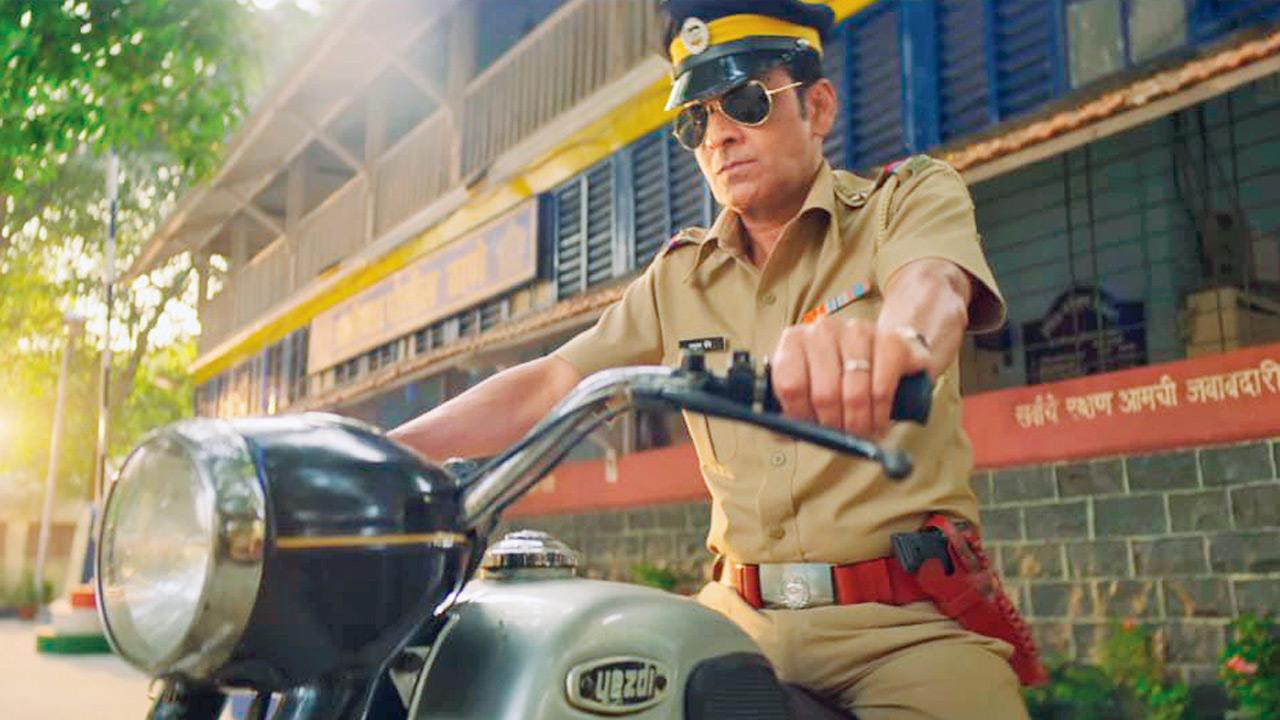
Read his book, and briefly spoke to retired Mumbai cop, Madhukar Zende, to realise there’s more to his career than nabbing serial killer, Charles Sobhraj, twice

A still from the Netflix comedy thriller Inspector Zende, starring Manoj Bajpayee
The only Charlie worth snorting is Inspector Zende (Netflix)!
By which I mean, it’s a film about the serial killer, Charles Sobhraj. As was Main Aur Charles (2015) — whose lead actor Randeep Hooda told me he’d also been regularly in touch with the OG Charles, then. So was the BBC series, The Serpent (2021; Netflix).
Only that, both, so stylish, and served steaming hot, left me cold. The problem isn’t with gangster as protagonist. The issue is with lack of empathy for the hero.
For all that onscreen colour/chemistry, what must you feel for a darkly dangerous bloke, allegedly responsible for over 32 motiveless, bloody murders; many of them, bikini-clad women, across continents; while he gets away, through jail-breaks, multiple times?
I suppose the only way to see a serial killer is, say, Nawazuddin Siddiqui, as the disturbed, deranged Psycho Raman (2016).

Madhukar Zende, the actual police officer on whom the film’s protagonist is based. Pic/mid-day archives
What if you kept that smooth criminal, Charles, for a charming character, as is, still. But switched the picture’s PoV to the cop, instead. Wouldn’t that work better for an effective counterpoint?
That’s Chinmay Mandlekar’s film, with Manoj Bajpayee in and as Inspector Zende; modelled on the retired, cool, Mumbai Police cop, Madhukar Zende (pronounced, Jh-en-de), who happened to nab Charlie, twice, during his career (1959-96).
Having met him, I can tell, OG Zende is blessed with innate sense of humour. The tone the movie adopts is fairly playful, despite the subject. “Which is actually tougher to achieve... Humour humanises,” Ruchikaa Kapoor Sheikh, Netflix’s film content head, tells me.
Brilliant Jim Sarbh plays Charles, at the other end. Did the OG Charlie, 81, currently in France, having served a term in Nepal, call him, too? I ask Jim.
Nope! “Maybe he doesn’t, if he’s not [explicitly] named,” co-actor Manoj jokes to me. Jim’s character in Inspector Zende is called Carl Bhojraj!
If I’m not mistaken, he’s half Indian, half Lebanese, in the film — as against half Indian/Sindhi, half Vietnamese, with a French step-father, in real life.
That’s the dude, and it’s true, who fled Delhi’s highest-security Tihar Jail, like it was plainly a walk in the park, with his car parked outside — having sedated all the inmates and officials inside, back in 1986 (when the film is set)!

The retired top cop’s recently released book Mumbai’s Most Wanted: The Thrilling Casefiles of a Supercop
Which is also an elaborate sequence in the series, Black Warrant (2025; Netflix), based on the life of Sunil Gupta, jailer at Tihar for 35 years.
That show was the first time I read the book it’s based on, right after. Which is a genuinely fulfilling experience, if the source material, as was the case, is non-fiction.
As against fiction, where the pleasure inevitably gets conflicted between the book and the film/series.
Hence, I repeated the experiment, laying my hands on the OG Madhukar Zende’s memoir, Mumbai’s Most Wanted (HarperCollins), right after watching Inspector Zende! What did I figure?
That there’s so much more to ‘Inspector Zende’s’ career than nabbing Charles twice, that’s merely two chapters in his book. Which isn’t to ignore the stardom he achieved as a result.
Consider, as OG Zende tells me, the Prime Minister of India (Rajiv Gandhi) was on a routine visit to Mumbai, soon after. Inspector Zende was on ‘bandobast’ duty to the PM’s motorcade passing by, that stopped, suddenly, because Rajiv had recognised Zende on the street!
Likewise, he recalls, Lata Mangeshkar noticed the Amul hoarding outside her home — with the tag-line, “Atake pe Zende”; referencing Zende to Marathas’ victory over Atak, Afghanistan. She personally felicitated him at a family event.
What’s there in the book (but not in the film) is how Zende arrested Charles, first time on. He’d helped reform a wayward, drug-addict youth, Ajay, once, who came in contact with Charles later, still.
The guy chickened out of Charlie’s group, but ended up accidentally killing a person, instead. For help, boy visited Zende. Zende, using that intelligence, followed Charles to Hotel Taj Mahal Palace…
Most police memoirs are by top, retired IPS officers who, obviously, provide a BTS, eagle-eye perspective on major case files.
Which is quite different from a beat cop’s daredevilry, and worm’s eye view of street gangs, and how they grew, literally from scratch — Dawood, Byculla Company, Pathan gang… Zende’s the only cop to have arrested Haji Mastan (twice; that too).
Mumbai’s Most Wanted is a rare, first-hand draft of crime history. Some of my surprise at it is natural. OG Zende belongs to a time before my adult life, let alone in Bombay, when puns over Zende and Zindabad were recurring headlines in city dailies.
Yet, what emerges is a portrait of a conscientious, unpretentious gentleman cop, who believed in building bonds with community; whether posted in the dark Dharavi of the 1980s, or calming violent crowds after a hockey match at Cooperage Ground.
I asked OG Zende what episode, he thinks, must make it to the sequel of Inspector Zende. He recalls an incident during the 1992 riots, when he dived in alone, inside a frenzied/demented mob, that had surrounded a packed police van to torch it in Suleiman Chowkie.
He knew these people. They trusted him. The crowd parted.
Inspector Zende deserves a sequel/series. Whether or not he’s interested — it’d be hard to match Manoj in the role, though!
Mayank Shekhar attempts to make sense of mass culture.
He tweets @mayankw14 Send your feedback to mailbag@mid-day.com
The views expressed in this column are the individual’s and don’t represent those of the paper.
Subscribe today by clicking the link and stay updated with the latest news!" Click here!