Put your hands together for the cheeriest gift of the season — the inaugural edition of Pudding, an anthology uniquely mirroring the suburb we all love

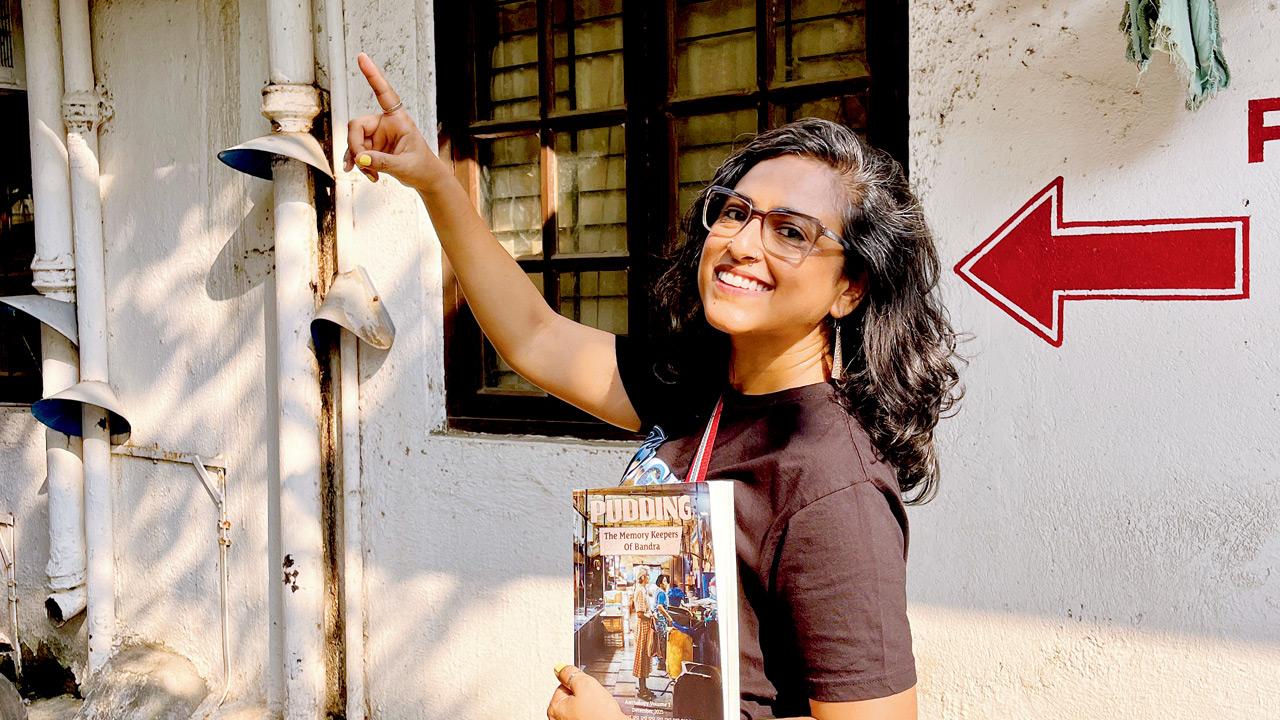
Shormistha Mukherjee with the first copy of Pudding. PIC/HUZEFA ROOWALA
Stories beget stories. This is ringingly true of Shormistha Mukherjee’s hot-from-the-oven Pudding — an anthology on Bandra, by Bandra, but for Bandra and far beyond. Lovingly baked layer upon layer with insightful perspectives and delightful first-person narratives centred on the history of the growth of the tiny seaside hamlets that collectively created the Queen of the Suburbs, the first of this annual volume is out next week.
Sitting between stories of joy and loss, Pudding organically flows from media professional Mukherjee’s Memory Keepers of Bandra series on Substack. Realising there are several residents (like her) who set up home here later in life, Mukherjee takes care to have different essays describe why this suburb is a place where everyone feels they somehow fit in. “I want this book to be something they read as well, and sort of grow roots with,” she says.
Mukherjee wishes we return next year for flavourful second helpings. Before offering Bandra on a plate, she says, “Pudding is self-made and scrappy. It’s made with jugaad, and favours, and help and a whole village backing it.” Arrestingly designed by Gary Curzai, the introductory Pudding, in the words of its curator-editor, “with its sweet bits and its burnt bits, is now yours to love”.
It all turns out tasty
How was the idea of Pudding seeded?
SM: Sometime in June this year. I was already observing and documenting my neighbourhood of Bandra on Instagram, via the handle Houses of Bandra. I got frustrated because I couldn’t tell long-form stories on that platform. So, Memory Keepers of Bandra was born on Substack. Then I thought there has to be a way for people to read these stories without having to click a link. I loved the idea of a brilliantly designed book, almost like a magazine. With stories of Bandra geography, history, sport, food, nature, music and, of course, people. With not just my voice. I wanted lots of voices to bring alive all these topics and reasons why we love Bandra.
Why name the anthology Pudding?
SM: Pudding is like Bandra, how can you not love it? A dessert with a bunch of tasty ingredients, it can be basic but also super complex. You can add alcohol, dry fruits, caramelise it, blowtorch it. Do anything at all, it will always turn out tasty. I felt this book would be like that. Many voices, many topics, but all coming together to make you fall in love with Bandra.
How much inspiration do you trace to cycle rides and walks through the COVID years?
SM: I was privileged to spend time walking and cycling then and saw initial signs of the city changing. I’d cycle past Haji Ali almost every day and watched the reclamation right when it started. Big changes were coming to Bandra. Iconic bungalows began to go under. I realised I should start to document what was there. You can’t stop change, but it’s good to know where you come from.
Anyone from Bandra will tell you it’s not just about change. It’s also the disconcerting pace at which the change happens. All of Bandra is being redeveloped. The cottages, low walls, small kirana shops, bazaars and buildings with sweet seaside names, are going. This is my attempt at holding on to what’s there before it all goes.
What features of Bandra make it unique in the city?
SM: The fact that this tony suburb has living villages right in the middle of it. Like the jetty where every morning little boats come in with their catch to the fishing village of Chimbai. And just behind the spot where the boats turn in for the jetty, you see the high-rises of Bandstand. Where cars are already making their way to glass buildings in Parel or BKC.
Two worlds exist in Bandra. Like Bazaar Road parallel to Hill Road. One, like a local haat, doesn’t feel like fancy Bandra. The other is shopping, eating, trendy Bandra. If you find the other Bandra, the older, slower Bandra, you’ll never miss the fast Bandra.
Any message for city lovers wanting to explore Bandra?
SM: First, walk. Ditch the car. Embrace the bylanes. Come in the morning, have puri bhaji from a small window in Chimbai. Do your grocery shopping, not from an app, but from Bazaar Road. Watch Aunties shop at the fish market. Stop to hear Joe Vessaokar sit playing his trumpet between fruit sellers. Walk up to the Mount. Sit by the sea. Grab a beer at Yacht. Slow down and embrace an easy-going Bandra.
The times, they are a-changing
A beloved community newspaper is on its way out. With the closure of Gloria and Clarence Gomes’ Bandra Times folds yet another part of the suburb’s history, writes Shormistha Mukherjee
This is the heart of Bandra. A tiny community paper propelled by two people who do it (from the ground floor of their 150-year-old house since 2011) because they know it’s the simple, everyday stories that we carry with us.

It’s not just putting together articles, recipes, health tips and news features. It’s also how thoughtfully it’s packed and sent off. Gloria and Clarence fold each and every paper twice over. Then slip paper bands with address labels on them, neatly typed by Gloria. Stamps will be fished out from a glass bowl and stuck. After which Gloria will bundle the papers street-wise and tie them together in bunches, so the post office doesn’t have to do extra work. A rickshaw will be called and she will head to Bandra Post Office with her four big bags full of Bandra Times. Which will get distributed to subscribers all over the neighbourhood, for free.
Gloria simply states, “We like to do it. Sometimes I might complain, but somehow it gets done. When people stop to tell us how much they loved an article, or when we see the postman going into a building with our paper, we feel so happy. We have met many kind people, who come forward to cover our costs.”
Clary talks about the love and respect they get. How in today’s busy world just the fact that people want to stop in front of their house and talk about the paper and Bandra and life, is their biggest reward.

But… the December issue of Bandra Times will be the last. Clary’s health and rising expenses have made it difficult to continue. Plus, with all the redevelopment, many papers come back to them. That breaks their heart a little. To see their jaunty little paper not find a home.
Goodbye, Bandra Times. You remind us that our neighbourhood, in spite of the gentrification and proliferation of coffee shops, is still a village where people are kind. Thank you for all the good news, Gloria and Clary.
Pudding can be pre ordered till December 10 at a special price on www.housesofbandra.com and will be available soon after on Amazon and at Kitab Khana, Kahani Tree and Fluxus on Chapel Road, Bandra
Memories of Pali Road
Three girls grew up in a house with a garden. As the years passed, everything around changed. But they stayed. An account from one of the sisters, urban historian Mariam Dossal
It is the flowers of Bandra that my memory returns to and brings with it the greatest sense of loss. The brilliant and beautiful colours of childhood, vividly etched in my mind by the flaming red flowers of the over-abundant gulmohar tree and the delicate yellow of the laburnum flowers, were connected by little bluebell flowers that covered much of the entire wall of St Joseph’s Convent along Pali Road.

Mariam Dossal’s ancestral home Al Dossal on Pali Road. PIC/THE DOSSAL FAMILY
There were countless of them and they fell to the ground, actually creating a carpet on the sidewalk, so that very often when I strolled down to Hill Road, I would stop frequently to pick up a number of these blue flowers. And keep them in the palm of my hand, only to select the closed buds one at a time, hold one end firmly between the two fingers of my right hand, and blow into the little bulb that formed at the other end and then try to split it on the back of my left hand so that every successful phut gave me immense joy! I cannot count the innumerable walks I took to Hill Road to buy something small from Wahedna Stores or Cheap Jack for my mother or my school, that involved this wonderful exercise of examining these beautiful blue flowers and the wonderful sound they made.
There were flowers in our garden which were tended to with great care by my father who loved gardening. Our garden had two lawns, one in front and one at the side. The lawn was bedecked with borders of colourful phlox, cannas, bougainvillea, zinnias, marigold and the flowers that my father loved, especially ixoras and roses.
The open spaces, the many trees, the quiet bungalows, the excitement brought about by Sunday cricket matches and festivities centering around Mount Mary’s feast or Christmas; all made it possible to draw comfort from the outside world. Every child deserves this. And yet, it seems so incredibly preposterous and unfair, even worse, criminal, the manner in which we have allowed this quiet graciousness in the pleasure in the open outdoors to be stolen from our children.
Author-publisher Meher Marfatia writes fortnightly on everything that makes her love Mumbai and adore Bombay. You can reach her at meher.marfatia@mid-day.com/www.meher marfatia.com
Subscribe today by clicking the link and stay updated with the latest news!" Click here!