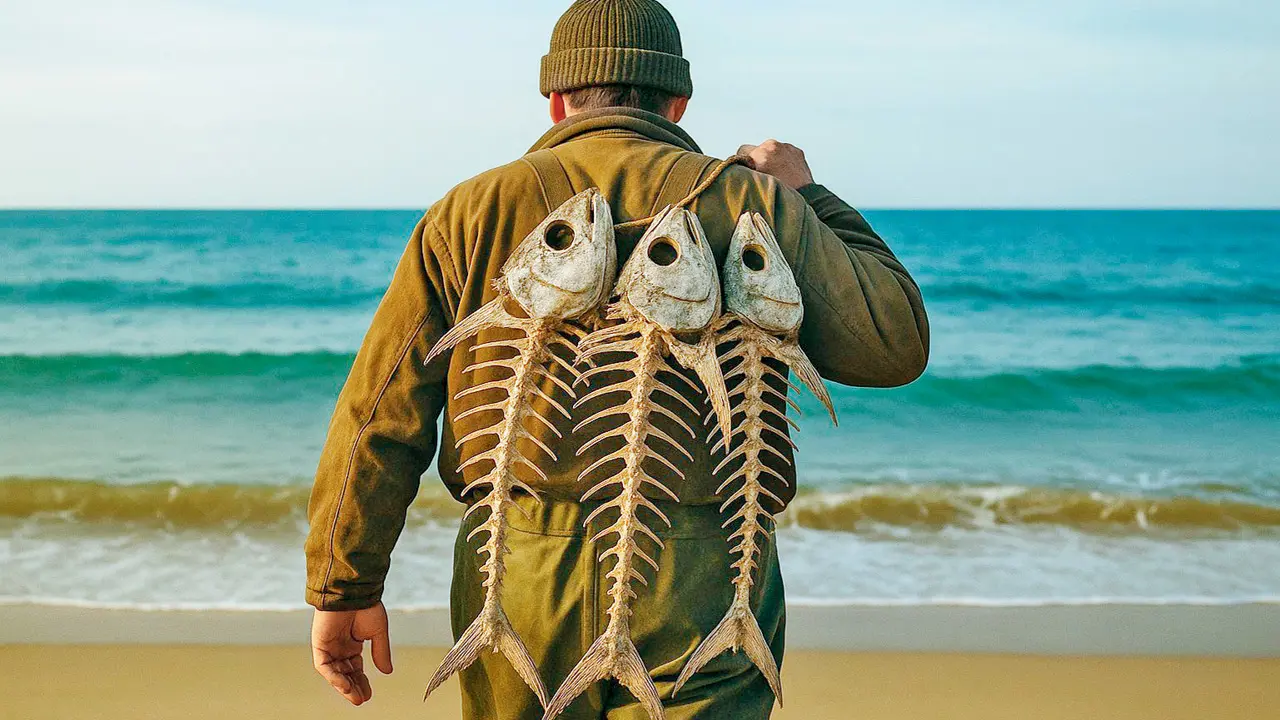
The next time you eat tuna, remind yourself that 45 dolphins died for every eight bluefin tunas that made it to the table. That’s just the tip of the iceberg

We have depleted 97 per cent of the bluefin tuna that existed a few decades ago. By 2048, our oceans will be practically empty of fish. Illustration by C Y Gopinath using AI
I’d like to ask you if you’re a vegetarian, but I’m afraid you’ll give me a complex answer and befuddle me. You might tell me you’re vegan, not vegetarian. The first time, I went scrambling for a dictionary to learn that a vegan is much like a Jain but has problems with anything that has emerged from an animal or bird, such as eggs and milk. Paneer pasanda would be out.
You might mess with my head and say you’re ovo-lacto-vegetarian. I’d finally figure out that you’re all about plants but don’t mind a few animal things like eggs and milk.
Like sex, food preferences are no longer binary; there’s a universe of permutations between vegetarian and non-vegetarian. But everyone agrees: real men (and women) eat meat, spitting out the bones, and then fight wars. TamBrams and similar wusses eat leaves and grains, and solve quadratic equations.
Raw red meat now has a bad rap because factory farming is brutal, greedy, dirty, and lethal to the environment. Producing 1 kg of beef requires 1451 litres of water, the equivalent of 10 bathtubs, and creates about 99 kg of greenhouse gases (GHG) — the equivalent of a drive from Mumbai to Pune in a petrol car. The main GHG are methane released by the cows and emissions from growing animal feed.
Let’s talk about Bombai. Click the QR code above to join my WhatsApp group to share your Bombai stories for my book—and perhaps answer some of my Bombai questions
In India, openly espousing beef could expose you to an income tax review, so you may focus on demeaning mutton. “No issues, ma’am, who eats mutton any more? Myself, I prefer chicken. It has a smaller carbon footprint. And I do love cheese.”
You may have to rethink cheese. Making 1 kg of hard cheese requires about 10 litres of milk and uses up about 5600 litres of water (37 bathtubs). This gives it a carbon footprint of around 23 kilograms of CO2 equivalents per kilogram of cheese (roughly the same as driving a petrol car from Ahmedabad to Vadodara).
Here, the Bengali will up the ante, saying he eats only feesh. He believes he has found the sweet spot between vegetarians and non-vegetarians. Fish is white, like chicken, and apparently has no blood. It cooks quickly, like vegetables. And hallelujah, it has no carbon footprint at all.
Really? I give you, ladies and gentlemen, the smug pescatarian, the one foodie who believes he rules them all. He’s so wrong.
I have bad news for you, fish-eater. Fishing may not release greenhouse gases and destroy rainforests, but it is devastating our planet in ways I never dreamed of till I saw a documentary called Seaspiracy.
By the time I’m done with you, you’ll be craving grass. You will never look at a Fish Moilly the same way again.
Let me count the ways.
You’ve heard of the Great Pacific Garbage Patch, the swirling vortex of man-made junk, primarily plastic, covering 1,605,000 sq km of ocean somewhere between Hawaii and California. Nearly half of it is made up of discarded fishing nets, more dangerous to fish than plastic straws because they’re designed to ensnare and kill. The practice of long-line fishing sets enough fishing lines to wrap around the entire planet 500 times every day.
Here’s a new word for you: bycatch. It’s all the fish that are caught accidentally while fishing for something else. They’re irrelevant fish, and they just die and are thrown back in the water. The next time you eat tuna, remind yourself that 45 dolphins die for every eight bluefin tunas that make it to the table.
Sharks kill about 10 people per year, but we kill 11,000 to 30,000 sharks per hour, mostly as bycatch, adding up to an estimated 50 million sharks a year.
Commercial fishing kills over 300,000 whales and dolphins annually as bycatch. Up to 40 per cent of all the fish humans catch are thrown back as bycatch, most of them dead before they hit the water.
Still interested in that maguro nigiri sushi with red slices of bluefin tuna? Here’s more deterrent: thanks to our savage fishing habits, we have depleted 97 per cent of the bluefin tuna that existed a few decades ago. By 2048, our oceans will be practically empty of fish.
Where will you go for your Goan fish curry then?
Let’s talk about bottom trawlers, monstrous vessels that claw and dredge the ocean to net fish, irreparably scarring the sea floor, destroying corals and habitats that have taken millions of years to form.
Bottom trawling wipes out an estimated 3.9 billion acres of seafloor every year, equivalent to the combined land area of Greenland, Norway, Sweden, Finland, Denmark, the UK, Germany, France, Spain, Portugal, Italy, Turkey, Iran, Thailand, and Australia.
Altogether, those fishing boats we don’t see, hear or know about are killing 2.7 trillion fish every year.
It’s becoming harder for me to say yes to any meat any more, even if it makes me an unwelcome outlier. In Palakkad, where everything is simpler, my mother was taught to make self-respecting, wholesome vegetarian food that tasted real and didn’t have blood on its hands. I don’t know anyone there who failed their exams or died early because they ate only plants.
We grew up on that, and I’m back to it now.
You can reach C Y Gopinath at cygopi@gmail.com
Send your feedback to mailbag@mid-day.com
The views expressed in this column are the individual’s and don’t represent those of the paper.
Subscribe today by clicking the link and stay updated with the latest news!" Click here!