shot-button
E-paper E-paper
Home > Sunday Mid Day News > So ducking good Pronoti Dattas new book rewrites Mumbais food history

So ducking good! Pronoti Datta’s new book rewrites Mumbai’s food history

Updated on: 14 December,2025 08:46 AM IST  |  Mumbai
Debjani Paul | debjani.paul@mid-day.com

From legends about Lord Rama and Bombay Duck, to tales of some of Mumbai’s oldest foods that have all but disappeared from common knowledge, Pronoti Datta’s new book serves up the city’s food history perfectly prepared to a golden crisp

So ducking good! Pronoti Datta’s new book rewrites Mumbai’s food history

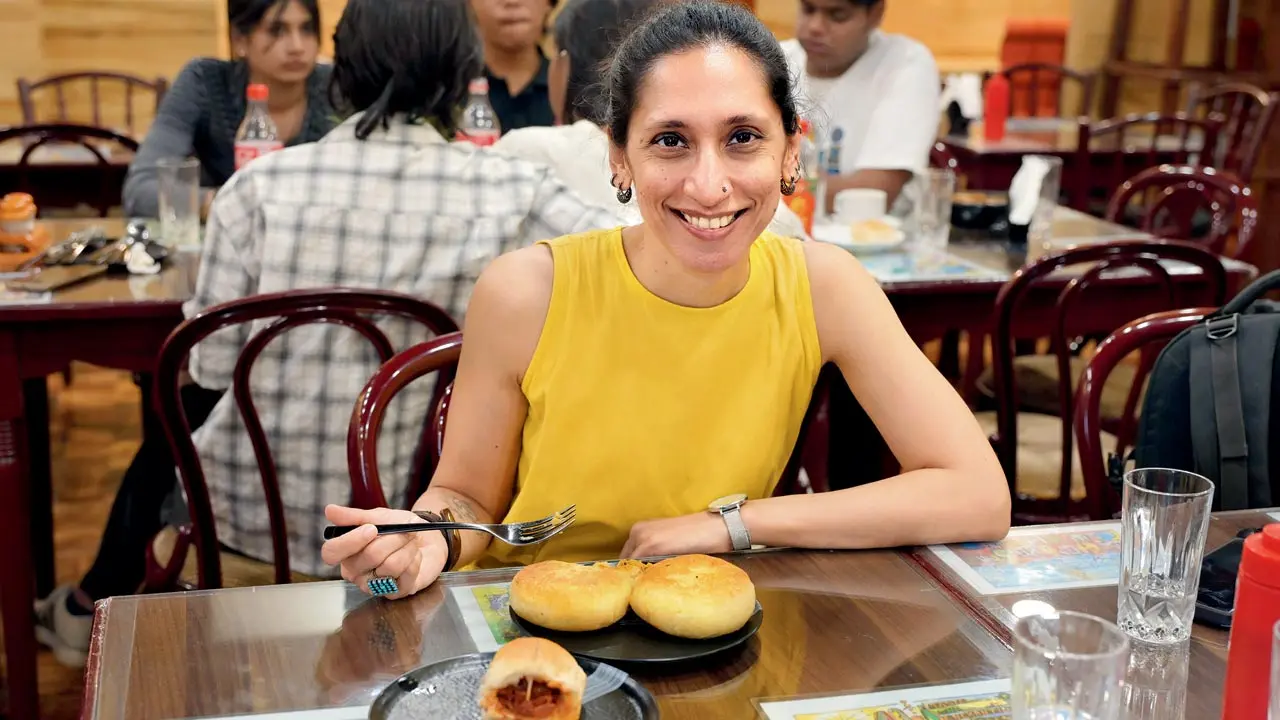
Pronoti Datta at CD’Souza Marosas, a Goan restaurant in Dhobi Talao that has stood the test of time for over 70 years. Pics/Kirti Surve Parade

So much has been written already about Mumbai, its food, and cultural history that it’s hard to find anything new to write about. And yet, as we begin Mumbai author Pronoti Datta’s new book, In the Beginning There Was Bombay Duck, we’re immediately bombarded by juicy morsels of information we had never tasted before. 

For example, did you know that there’s a legend tying the famous Bombay Duck or Bombil fish to Lord Rama? There’s unlikely to be anyone who doesn’t know what Bombay Duck is. Whether or not you’ve sampled it fried in rava at any of the innumerable Gomantaks lining the coastal city, the rows of drying fish along our beaches will not have escaped your eyes — or nose. The aroma gave even the British colonisers pause, making Bombay a poor second choice when compared to their former Indian capital of Calcutta. No matter how far up north they went, the suburbs kept getting “fishy, fishier, fishiest”, Datta cites James Douglas, the one-time sheriff of Bombay (in 1893 and 1902), as having written. The story of how the fish came to be called Bombay Duck (transported to the rest of India by the mail train, Bombay Daak) is now common knowledge. Datta digs deeper into the past and finds an account written by ethnographer Govind Narayan in 1863 that narrates the legend of why this fish had to be transported by train in the first place —  because of a curse from Lord Rama!


The Mahim Koliwada Seafood Plaza has seafood stalls managed by Koli women self-help groupsThe Mahim Koliwada Seafood Plaza has seafood stalls managed by Koli women self-help groups


The book takes off from this interesting tidbit and moves from mythological lore to the city’s history seen through the lens of its food. Datta captures one of the city’s biggest paradoxes: the communities that have been around for the longest have become the most invisible when it comes to the city’s dining scene. From the city’s original residents (the Kolis, adivasis, and East Indians) to its very first migrants (the Agris, Bhandaris, Pathare Prabhus, Palshikhar Brahmins and Panchkalshis), there are barely any places where gourmands with can go to whet their curiosity about the city’s oldest cuisines. “The Kolis eat simple food, with few key ingredients like fish and coconut, and put together in a hurry before they get back to their work for the day. We can now sample a bit of this in the Koli seafood festivals at Worli and Versova, but that is just the tip of the iceberg,” says Datta. But with the Pathare Prabhus, it’s a completely different story. “Unless you have a friend from the community, you might never taste their food, or even hear about it,” says the author.

In fact, one of the revelations that came to her through the process of researching this book over the past three years, was the discovery of Mumbra, an unusual tea-time snack of the Pathare Prabhu community: a cake made from ripe Rajeli bananas, either prawn or Bombay Duck, onion and rice rava. “The community loves its shrimp, they add it to many things, even poha,” says Datta.

Among the offerings there are fried and curried surmai and crab, stir-fried dried shrimp and fried bombil. Pic/Pronoti DattaAmong the offerings there are fried and curried surmai and crab, stir-fried dried shrimp and fried bombil. Pic/Pronoti Datta

“In their daily life, a Pathare Prabhu family will have either a khadkhadla — a curry named after the sound the shellfish in it makes — or a bhuzna — a no-nonsense seafood or vegetable curry where everything is mashed together at once and then put on the stove in one pot,” Datta tells us.

For those curious about the cuisine, Datta recommends the catering service, Hungry Cat Kitchen, although even they do not offer Mumbra on their menu.   

We stop for a bite at Royal Opera House Sev Khamani near St Teresa’s Church in Girgaum; (right) Regional food cultures like Goan restaurants and Irani cafes have steadily been disappearing from the city as the communities spread out and thinned

Mumbra is not just a curious dish because of the unexpected combination of ingredients, but also because it’s a historical marker of when the concept of baking came to the city. Pathare Prabhus were early adopters of baking because of their close association with the British. The community, being among the educated class in the city, were among the first to adopt English and be absorbed into the colonial administration.   

The book also dwells on what it means to be a native of Mumbai. As railway tracks were installed in the city, it started to grow into the metropolis we know today, with migrants pouring in from all over the country. Datta points out how each community that migrated to the city made it their own, shaping its landscape and the food by merging their culture with it.

The book also features rare dishes such as the Iranian stew, ghormeh sabzi. Pic/Café Mommy JoonThe book also features rare dishes such as the Iranian stew, ghormeh sabzi. Pic/Café Mommy Joon

Sometimes this manifests as “local modifications of their customs, such as the Bene Israeli practice of eating rice bhakri on Passover, a day on which eating leavened bread is forbidden”, Datta tells us.

Over time, as demographics in the city changed, some regional food cultures such as Udupi restaurants gained popularity, while others like  Goan restaurants and Irani cafes have steadily been disappearing as the communities spread out and thinned in representation.

Pathare Prabhus make a banana cake with either shrimp or bombil called mumbra. Soumitra Velkar, who runs a food delivery outfit, makes it with shrimp. Pic/Soumitra VelkarPathare Prabhus make a banana cake with either shrimp or bombil called mumbra. Soumitra Velkar, who runs a food delivery outfit, makes it with shrimp. Pic/Soumitra Velkar

To illustrate this point, we join Datta on a food walk from Girgaon to Dhobi Talao. Girgaon, once a Marathi stronghold, was one of the first parts of the city to be hit with waves of migration as the borough’s diamond trade took off, drawing merchants and diamond workers from Gujarat. Datta leads us to a popular snack stall in the neighbourhood: Royal Opera House Sev Khamani centre near the iconic red St Teresa’s church. At R25 a plate, Sev khamani is a healthy, filling, and affordable snack for the majorly vegetarian workers in this precinct. We dig into the warm, gooey dome, topped with crunchy sev and accompanied by zingy fried chillies. 

Sated, we walk towards Dhobi Talao, once known as Little Goa for its population of Goans who had settled here. Today, there remain few signs of this Little Goa, with most Catholic neighbourhoods here being replaced by towers — a wave of gentrification that has priced out the original residents and pushed them to the suburbs or to other cities and countries. One of the last remaining vestiges of Goan culture here is C D’Souza Marosas, a restaurant that has stood the test of time for more than 70 years. After briefly shutting down during the COVID pandemic, it was renovated and reopened in 2023. Second-generation owner Jude D’Souza tells us that there are very few Goan residents left in the neighbourhood, but Instagram fame has helped bring customers all the way from Bandra and Mahim.

“Sev khamani is not widely available in the city. Opera House Sev Khamani is popular in the neighbourhood, but not really known outside it. Marosa’s is better known, but still not as famous as Martin’s in Colaba even though it’s older,” says Datta.

“Both places occupy historic neighbourhoods. Girgaon was home to early Maharashtrian and Saraswat migrants, followed by Gujaratis. Many of the patrons of Opera House Sev Khamani are no doubt Gujarati migrants who work in the diamond businesses in the area. Dhobi Talao was where Goan migrants made their way. In the early twentieth century, Dhobi Talao, Dabul and Cavel formed the nucleus of Goan life in the city. It’s a shadow of its former self but you get glimpses of its past in the buildings, the surviving establishments and so on,” she adds.

Our walk at an end, we stroll towards Marine Lines station, and Datta tells us why this neighbourhood is known as Sonapur, named so for the graveyard lining stretch. “There’s a legend that when people die, they become gold. That’s why the place was called Sonapur,” she tells us. 

There’s barely any mention of this online; it’s yet another nugget of culture lost to time. We walk through Dhobi Talao, past the ghosts of other things lost to time — the Catholic homes replaced by new buildings, the Goan and Irani eateries that have disappeared with the changing face of Mumbai — and think, perhaps the entire city is like Sonapur, where we’ve lost so much history. And yet, memory-keepers like Datta find ways to keep it all alive in the gold mine of our collective memory.

"Exciting news! Mid-day is now on WhatsApp Channels Subscribe today by clicking the link and stay updated with the latest news!" Click here!

Did you find this article helpful?

Yes
No

Help us improve further by providing more detailed feedback and stand a chance to win a 3-month e-paper subscription! Click Here

Note: Winners will be selected via a lucky draw.

Help us improve further by providing more detailed feedback and stand a chance to win a 3-month e-paper subscription! Click Here

Note: Winners will be selected via a lucky draw.

mahim marine lines girgaon mumbai Sunday Mid-Day book launch Books

Mid-Day Web Stories

Mid-Day Web Stories

This website uses cookie or similar technologies, to enhance your browsing experience and provide personalised recommendations. By continuing to use our website, you agree to our Privacy Policy and Cookie Policy. OK