shot-button
E-paper E-paper
Home > Mumbai > Mumbai News > Article > Amid online noise schools teach students real financial sense

Amid online noise, schools teach students real financial sense

Updated on: 05 August,2025 06:40 AM IST  |  Mumbai
Aditi Alurkar | aditi.alurkar@mid-day.com

ccording to teachers, the students hang on to every word discussed in their finance lectures. Tardeo resident Reshma Poojari says that her younger daughter, who studies in the third grade, asked about the family budget when  they were buying her a gift

Amid online noise, schools teach students real financial sense

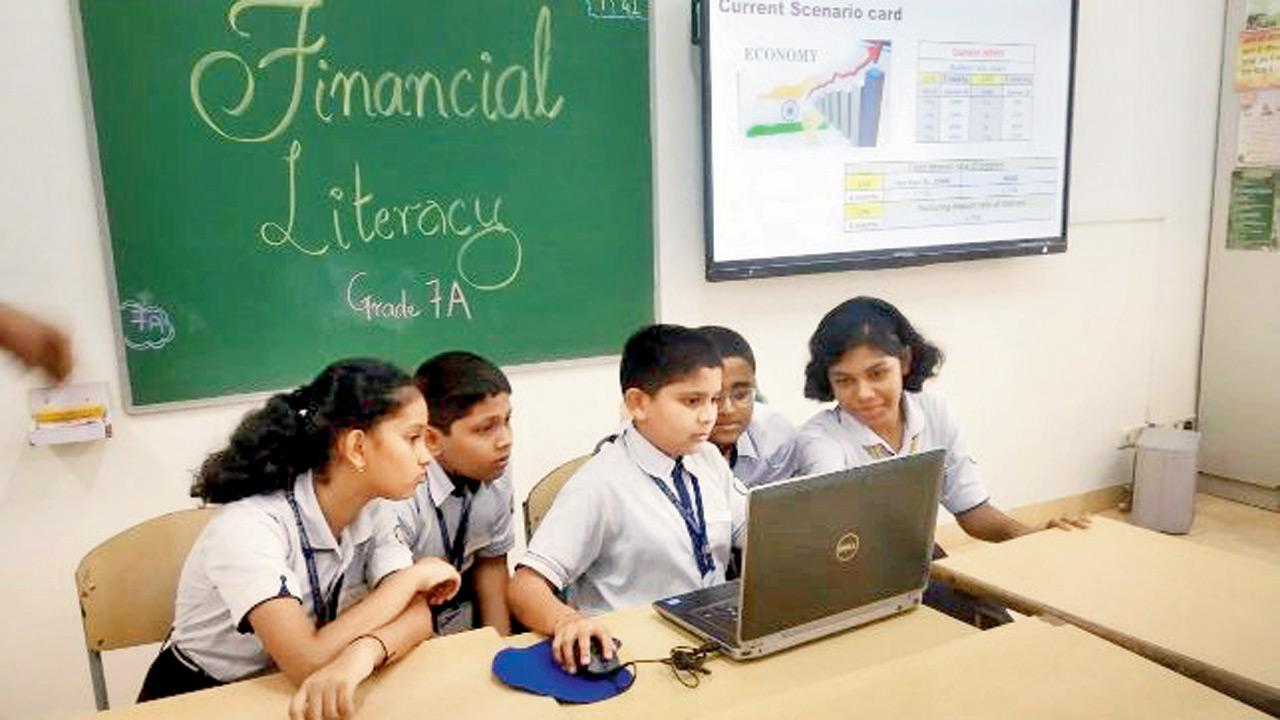
Students from Pawar Public School, Bhandup, and (left) Mumbai Public School, Pratiksha Nagar, learn about finance

While influencers, podcasters, and finance gurus flood the internet with fiscal advice, sometimes contradictory, students have found respite in the streamlined education within their classrooms. Several schools around Mumbai, be it state board or international institutions, are finding innovative ways to initiate their students into the ever growing subject of financial literacy.

Tours to the RBI, crowdfunding social causes, make-belief banking with monopoly money — all these novel activities have found their place within the classroom. Taking steps to strengthen fiscal education, the Finland International School runs a programme on phenomenon-based learning, where students are exposed to real-life hurdles which they are soon to face after school. “Be it piggy banks or barter system, students already deal with money from a young age, so why not educate them about fiscal responsibility?” says Fatema Agarkar, School Board Advisor and Mentor to Finland International School.


Emphasising the importance of learning money matters early in life, Agarkar says, “Learning how to save after your first salary is too late.” She adds, “Under our curriculum, we talk about consumer mathematics, economic development, while touching upon topics like wealth management. A few parents who already manage hedge funds make an appearance to talk about their experience. The course is created to equip our students with basic fiscal skills while keeping them grounded about topics like money. It’s never a lesson to make a quick buck.”

According to teachers, the students hang on to every word discussed in their finance lectures. Tardeo resident Reshma Poojari says that her younger daughter, who studies in the third grade, asked about the family budget when  they were buying her a gift. “This change in mindset has left me pleasantly surprised,” she says. Poojari often involves her children while planning their household budgets and is seeing her older daughter take great interest in entrepreneurship.

When schools don’t teach finance, Mumbai parents often take it upon themselves to help their ward understand money matters. Nupura Samant, a Dadar resident, recently encouraged her daughter to appear for the National Financial Literacy Assessment Test or NFLAT. “In our time we were asked to go to the bank for simple tasks like depositing money or updating passbooks. There’s no reason to keep today’s children from such experiences, especially as they have more spending power at a young age,” she says.

Breaking down the basics of banking for students of Mumbai Public School, Pratiksha Nagar

Aryan Singh, a Standard 9 student of Mumbai Public School, Pratiksha Nagar, says that he started saving 20 per cent of his pocket money after these lectures started at his school. “Our teachers tell us about digital payments, UPIs, and even fraudsters. Now I try to use these e-banking services and I am very careful about my OTPs and banking information.”

Laavya Poojari, a Grade 11 IBCP (International Baccalaureate) student learning finance, recently saved up her pocket money for tickets to an upcoming international artiste’s concert in Mumbai. “I love the artiste so I set aside a portion of my pocket money to buy the tickets in time. After learning finance, I try to spend my pocket money more mindfully and limit expenditures to once or twice a month,” said Laavya.

Those schools that don’t have a curriculum spelled out for finance have also managed to bring in fests and conclave to ensure that their students know how to deal with money. In a first, Navi Mumbai’s OES International School plans to create a large-scale event where students can pitch their startups in a ‘Shark Tank’ style. “Exposing school students to finance is not premature at all. It helps the young ones understand the value of money, especially those students who already come from affluent backgrounds and think every want can be met,” says the school’s Principal Dr Rashmi Choudhri.

Rashmi Choudhri, Rashmi Poojari, Fatema Agarkar and Suma Das
Rashmi Choudhri, Reshma Poojari, Fatema Agarkar and Suma Das

Following a Cambridge curriculum, the DG Khetan School in Malad allocates funds to grade 8 students, who are grouped into becoming business partners. The students go on to source raw material, make final products, and put them up for sale at an exhibition attended by parents. They go on to balance their accounts, calculate profits, and donate the amount to NGOs. “Right from grade 1, students are taught to check price tags, expiry dates, and make budgets. The older students are introduced to capital markets and trading, too,” says Director and School Head Dr Kavita Aggarwal.

In Bhandup, the mathematics department at Pawar Public School takes dedicated efforts to teach finance. They arrange immersive activities where students are trained to give loans, borrow money, and calculate interest. The students also learn to deal with digital currencies, the economic booms, and even war economy. “The school has a no-bag day every month, where we utilise the opportunity to talk about these things. We also have an extensive general knowledge course where students develop these hands-on life skills,” explains Principal Suma Das.

Earlier this month, the State Council of Educational Research and Training (SCERT) released a draft of the new syllabus for all state schools. While it does not explicitly deal with fiscal subjects, the students are taught GST and Income Tax calculations through subjects like mathematics.

Deliberating whether school-going students are too young to understand finance, Dr Srinivasan R Iyengar, Professor of Strategy at JBIMS says, “Concepts like saving need to be inculcated since childhood, since today’s students are stepping into a part-time and a gig economy. Teaching them how to save and invest helps them broaden their horizons right away.” 

"Exciting news! Mid-day is now on WhatsApp Channels Subscribe today by clicking the link and stay updated with the latest news!" Click here!

Did you find this article helpful?

Yes
No

Help us improve further by providing more detailed feedback and stand a chance to win a 3-month e-paper subscription! Click Here

Note: Winners will be selected via a lucky draw.

Help us improve further by providing more detailed feedback and stand a chance to win a 3-month e-paper subscription! Click Here

Note: Winners will be selected via a lucky draw.

bhandup mumbai police brihanmumbai municipal corporation mumbai news mumbai

Mid-Day Web Stories

Mid-Day Web Stories

This website uses cookie or similar technologies, to enhance your browsing experience and provide personalised recommendations. By continuing to use our website, you agree to our Privacy Policy and Cookie Policy. OK