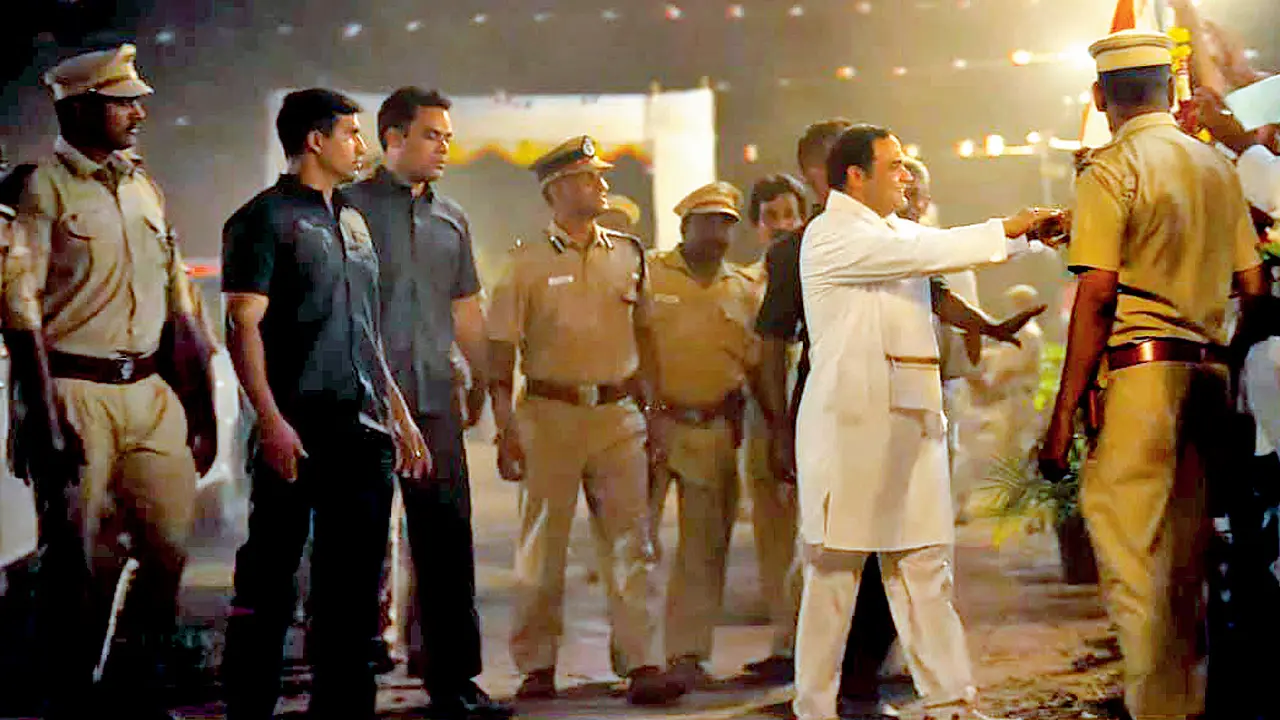
Kukunoor’s series, The Hunt, on Rajiv Gandhi’s assassination probe, is the sort of comeback he deserves!

A still from The Hunt: The Rajiv Gandhi Assassination Case
I just called, to say, where are you?” I nearly croon to director Nagesh Kukunoor over the phone, who tells me, “[Publicly] I just went off the radar, sometime around 2019 — no interviews, no social media… The word toxic doesn’t even do justice to what’s [happening] around us; so, I just decided to stay away.”
In case you’re Gen Z; but even then, if you’re a film buff, how would you not know — Kukunoor, 58, is the OG man of desi middle-of-the-road indies.
Starting with Hyderabad Blues (1998), that inspired a generation of English-speaking folk to fiddle with the camera, while he carried on with remarkably memorable work in Hindi, especially until the mid-2000s (Rockford, 3 Deewarein, Iqbal, Dor).
He tells me he’s been even busier since: “What with having wrapped up six web-series, over the past seven years.”
The one I called him right after watching is The Hunt: The Rajiv Gandhi Assassination Case, on the 90-day probe, between May-August, 1991, to nab killers of the ex-Prime Minister of India — belonging to Sri Lankan-based militant group, Liberation Tigers of Tamil Eelam (LTTE).

Nagesh Kukunoor, the series’ director. Pic/Instagram
It’s dropped on Sony LIV. It’s mainly set in Tamil Nadu. It’s certainly Kukunoor’s comeback of sorts. And it’s simply stellar.
But not as a breathless thriller, with breathtaking action; the kinda mood that Shoojit Sircar set for Madras Café (2013), on the same subject.
Over seven episodes, of roughly 45 minutes each, Kukunoor’s The Hunt sticks to muted realism, patiently, like a police procedural; where crime is not the point, the investigation is. As a genre, it’s closest to Richie Mehta’s Delhi Crime (2019), which is really high praise.
You watch incredibly cast officers of the Special Investigation Team (SIT) navigate through LTTE sympathisers, suspects, and safehouses, before they zero-in on the ‘One-Eyed-Jack’ Sivarasan (Shafeeq Mustafa), nicknamed after a 1961 Marlon Brando western. This bloke’s so brazen, he wants to get to J Jayalalithaa next.
This is also a series that grows on you before it peaks, fifth episode onwards.
Kukunoor tells me the show’s tone essentially came from published group-photographs of the said SIT officers: “[They looked like] such unbelievably normal men, that they could disappear in the background — in grey safari [suits], white shirts, brown pants…”
Clearly, of the many things that’s changed between India, 1991, and 2025, is the safari-suit for work clothes, especially in the government (I wonder why; it must certainly be comfier than proper suits for desi climate).
One thing that hasn’t changed since, I noticed in the series, is the white 045 Reynolds pen!
Kukunoor adds, “These men were still attached to the biggest man-hunt in history! I had to lens The Hunt [likewise] — washed out colours; nobody must pop out from [among] the SIT; with not even the camera as a dramatic part of the action.”
In fact, the series is pretty much in line with the superb Scam 1992, and Black Warrant — both, along with The Hunt, produced by Applause (Sameer Nair, Deepak Segal) — based on journalistic works, that make for compelling pieces of contemporary history.
I haven’t read the bestseller reportage, Ninety Days, by Anirudhya Mitra, that The Hunt is adapted from. Kukunoor says, “The book gave me lots of material to fit into long-format.”
That said, access to official documents is nearabout impossible, and as filmmaker, he had “too many dots to join; blanks to fill.” Which is where the writing team came into play.
I have once heard a scintillating (Aaj Tak) podcast on the investigation, by retired police officer, Amod Kanth, SIT member (played by Danish Iqbal in the series), preciously detailing his days in Chennai (Madras, then).
I wonder if Kukunoor reached out to the team directly as well.
He avoided that, consciously: “The problem is there are several points of view, and I have read their books, studied them enough, to handle their portions with sensitivity. Eventually, you still have to move in one direction.” Also, couple of the officers are no more.
The Hunt, rather openly, insinuates that there was a conspiracy to go slow on getting to the mastermind of Rajiv Gandhi’s assassination, if not protect him, or his identity, entirely. PV Narasimha Rao had taken over as PM, once Rajiv, set to win the elections, was no more.
It’s been widely reported (including in Neerja Chowdhury’s brilliant book, How Prime Ministers Decide) that Rajiv’s widow, Sonia, later a politician, wasn’t happy with the way Rao was going about the case.
In the series, this background produces, on-ground, one of the best anti-climaxes for a climax. Of course, not gonna tell you more, besides that it ends with the SIT posing before photojournalists — the image that evidently inspired the show’s tone!
Oh, also, I wanna know, did actor Kukunoor never think of casting himself in the series? He balks, “Absolutely not. There was a point when we were having trouble finding the actor for DR Kaarthikeyan (the SIT boss).
“People began tossing around the idea that I should, and that I look like him. I said, ‘Are you mad?’
“And then we had Amit Sial in the role, and I kept telling everyone on the set, ‘Just look at this guy; look at what he’s doing; and what would I have?’” Sial’s splendid. Couldn’t agree more.
Mayank Shekhar attempts to make sense of mass culture.
He tweets @mayankw14 Send your feedback to mailbag@mid-day.com
The views expressed in this column are the individual’s and don’t represent those of the paper.
Subscribe today by clicking the link and stay updated with the latest news!" Click here!